Endangered
Sterlet
Acipenser ruthenus
The sterlet (Acipenser ruthenus, placed by some authorities in Huso) is a small, slim sturgeon of big Eurasian rivers, from the Danube to Siberia's Yenisei. The IUCN Red List rated it Endangered in 2022. It's the sturgeon that stays in fresh water, and it survives partly because people keep restocking it.
How to recognise it
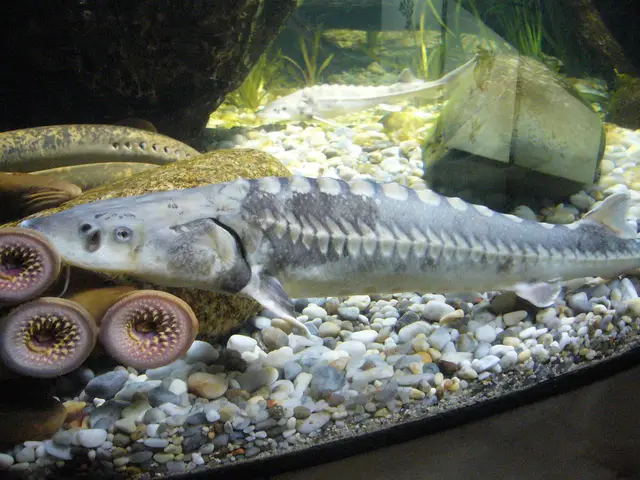
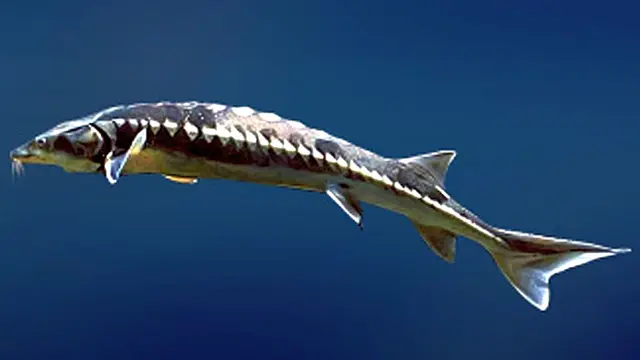
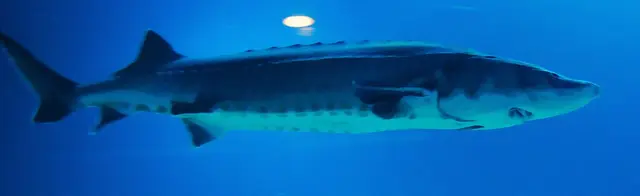
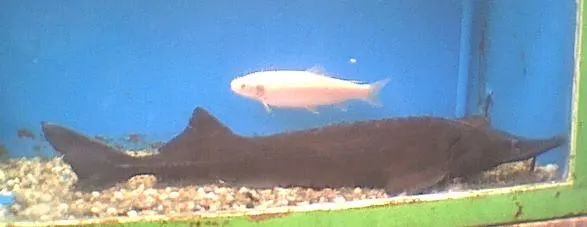
A sterlet is a narrow-bodied fish with a long, slender snout that turns up slightly at the tip, fringed barbels hanging in front of the mouth, and a row of pale bony scutes along each flank. Colour varies a lot between rivers, but the back is dark and the underside is usually yellowish or dirty white.
Most adults are 40 to 60 cm long. Very large fish can reach a metre or a little more and a weight of about 16 kg, though few pass 90 cm.
Where it lives
Its native range covers large rivers that drain into the Black, Azov and Caspian Seas, plus Siberian rivers eastward as far as the Yenisei. The IUCN lists it from countries along those rivers, among them Austria, Germany, Hungary, Serbia, Romania, Bulgaria, Ukraine, Russia and Kazakhstan. Sea-going populations have reportedly died out, so surviving sterlets live their whole lives in rivers.
It favours deep, fast water over gravel. In winter, adults gather in deep holes on the riverbed and stay fairly inactive.
Pins are Wikidata “endemic to” fields. Orange dots, when present, are GBIF occurrence tiles — survey bias included.
How it lives
Sterlets feed on the bottom, taking small crustaceans, worms and insect larvae. Males reportedly mature at 3 to 7 years and females at 4 to 12. When the ice breaks in spring, fish move upstream and scatter their eggs over gravel in strong current, mostly from mid April to early June at about 12 to 17 degrees C. A female lays roughly 15,000 to 44,000 eggs.
Lifespans of 22 to 25 years are typical, and one reference gives up to 36. The IUCN puts a generation at 17.6 to 26 years, so any recovery will be slow.
Why it is in trouble
The IUCN reports a decreasing global population, with harvest and dams the main threats. Sterlets have been taken for meat, caviar and isinglass, and poaching continues. Dams and flood works cut off the routes between spawning, feeding and wintering areas, and pollution is also blamed.
The Danube shows the scale of the loss. The sterlet is reportedly the last of five native sturgeon species in its middle and upper stretches, and WWF cites an IUCN estimate of a fall of about 70 percent in sterlet numbers over the 20th century.
What is being done
Restocking is the main tool. In 2021 WWF-Ukraine released 10,000 young sterlets into the Ukrainian Danube, tagging 1,000 so their fate can be followed. Austria's Donau-Auen National Park also runs coordinated stocking. Fish introduced outside the native range have generally failed to form self-sustaining populations.
Most sterlets in international trade now come from fish farms, and the species is listed under CITES Appendix II. The IUCN records harvest management, trade management and reintroduction among the actions in place.
Sources
Written for this catalog in our own words from the sources below, checked against them on 12 November 2026. Population figures are estimates and carry the year they were made. Status and assessment year: IUCN. 2026. The IUCN Red List of Threatened Species. Version 2026-1. iucnredlist.org.