Critically Endangered
St Lucia Whiptail
Cnemidophorus vanzoi
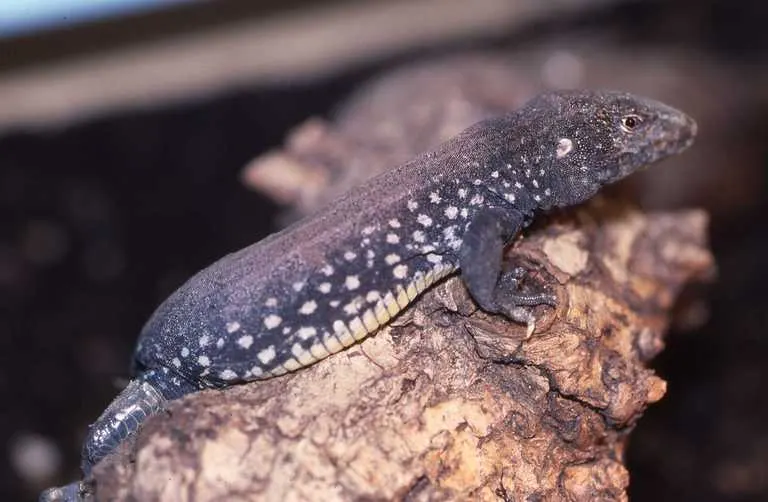
The Saint Lucia whiptail is a lizard from the Caribbean island of Saint Lucia, now living only on a few small offshore islets rather than the mainland. The IUCN Red List rated it Critically Endangered in 2016, though it lists the trend as increasing. Adult males carry all the colours of the national flag.
How to recognise it
This is a whiptail, a member of the Teiidae lizard family. Saint Lucia's government describes the adult male as bearing all the colours of the island's national flag. It is also known as the Maria Islands whiptail and Vanzo's whiptail.
Baskin and Williams described the species in 1966 as Ameiva vanzoi, and it was moved to the genus Cnemidophorus in 1971. The species name honours the Brazilian herpetologist Paulo Vanzolini. It lays eggs.
Where it lives
The whiptail is found only on Saint Lucia and its offshore islets. It has been wiped out on the main island, and the original surviving populations were on Maria Major, about 10 ha, and Maria Minor, under 2 ha, off the southeast coast.
Conservationists have since moved lizards to new homes. In 1995, 42 were taken from Maria Major to Praslin Island (1.1 ha). Three years later a 2001 study in Animal Conservation by Dickinson and colleagues estimated about 145 lizards there. They occupied the whole island and used all five of its habitat types, from open grassland to closed woodland. Saint Lucia's government also lists Rat Island among the places they now live.
The IUCN gives the area the species occupies as about 4 square kilometres, treats the population as severely fragmented, and lists dry shrubland and dry forest as its habitats.
Pins are Wikidata “endemic to” fields. Orange dots, when present, are GBIF occurrence tiles — survey bias included.
Why it is in trouble
Introduced predators are the main concern. Alien species brought to Saint Lucia, including rats, mongooses and cats, are linked in general terms to the loss of native wildlife, and the whiptail was wiped out on the mainland. On the offshore islets, the government treats invasive mammals such as rats as a standing threat, which is why it keeps bait stations out.
The IUCN also lists storms and flooding as an ongoing threat across the whole range, and collection of the animals as a concern. A possible future threat from an unspecified species is rated as medium impact.
What is being done
The Saint Lucia Forestry Department, Fauna & Flora International and the Durrell Wildlife Conservation Trust removed rats from Praslin Island in 2000. Today five offshore conservation islands carry bait stations, which are checked, cleaned and refilled monthly to detect any new arrival.
Visitors have to pass biosecurity checks on bags, clothing and shoes, and killing wildlife or taking eggs is banned under the Wildlife Protection Act.
The IUCN lists site management and control of invasive species among the actions in place.
Counts have grown. Older summaries put the species at fewer than 1,000 animals (undated), while Saint Lucia's government now gives about 2,500 (undated). The IUCN trend is increasing, though it also records a continuing decline and a severely fragmented population, and the species stays Critically Endangered.
Sources
Written for this catalog in our own words from the sources below, checked against them on 12 November 2026. Population figures are estimates and carry the year they were made. Status and assessment year: IUCN. 2026. The IUCN Red List of Threatened Species. Version 2026-1. iucnredlist.org.




