Critically Endangered
St. Kitts Bullfinch
Melopyrrha grandis
The St. Kitts bullfinch (Melopyrrha grandis), locally called the mountain blacksmith, is a black songbird known only from the Caribbean island of Saint Kitts. The IUCN Red List rated it Critically Endangered in 2022. It has not been confirmed alive since a single bird was collected in 1929.
How to recognise it
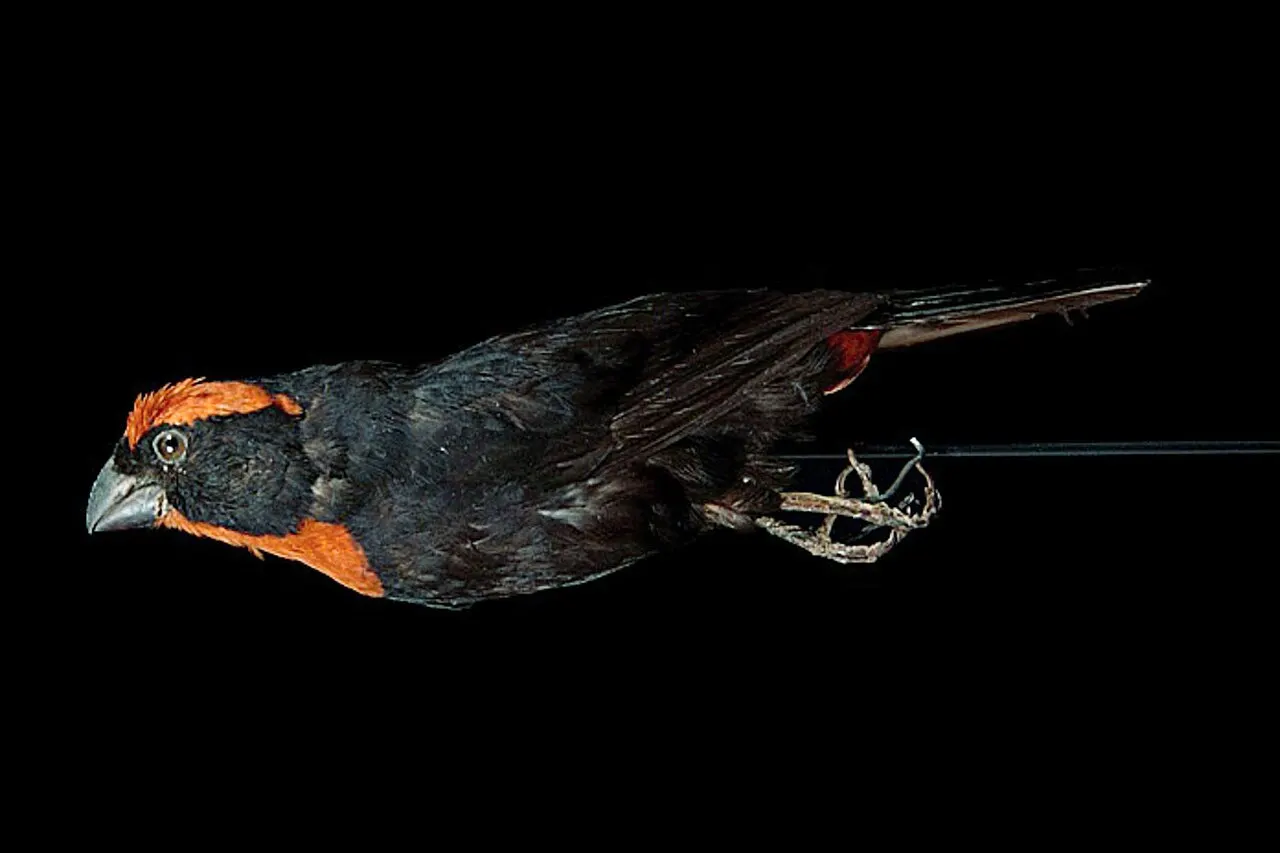
It's a black bullfinch with a reddish-brown patch on the throat and upper breast. Compared with the Puerto Rican bullfinch, which it was long treated as a form of, it is about a quarter larger, with a bigger, heavier bill, glossier plumage, and a larger and darker throat patch.
The island also has the smaller, common Lesser Antillean bullfinch, and that is the main source of false alarms. Anyone looking for the St. Kitts bird has to rule it out first.
Where it lives
It was described in 1881 and is known from the montane forest of the mountain then called Mount Misery, now Mount Liamuiga. The Red List assessment places it in moist montane forest between 900 and 1,160 m, at a single location, and lists Saint Kitts and Nevis as the only country.
In 1880 it was reported as not uncommon on the mountain, and it was thought common in the 1890s. Nothing reliable is recorded about its nesting or diet.
Pins are Wikidata “endemic to” fields. Orange dots, when present, are GBIF occurrence tiles — survey bias included.
Why it is in trouble
Two major hurricanes in 1899 are the event most often linked to its disappearance, and reports then stopped for decades. In July 1929 the American naturalist Paul Bartsch collected one bird, which sat unrecognised in the Smithsonian's collection until 1984.
Several other causes have been suggested, and none is proven. They include introduced vervet monkeys, competition from the Lesser Antillean bullfinch, and farm clearing of lowland forest over three centuries. The Red List assessment lists storms, agricultural expansion, and pressure from introduced animals (vervet monkeys, rats, cats and mongooses) and the Lesser Antillean bullfinch as threats.
Is it still out there?
Possible sightings leave open the chance that a few birds survive. A couple reported a probable bird in 1993. A visiting Puerto Rican naturalist heard a bullfinch-like call high in the forest on 16 November 2012, though nobody saw the bird. A sound recording made in a Department of the Environment experiment was later ruled inconclusive.
From November 2022 to February 2023, the local naturalist Michael Ryan made eight Sunday trips to Wingfield Level, above 1,000 feet, playing Puerto Rican bullfinch calls. Lesser Antillean bullfinches answered often. No St. Kitts bullfinch appeared.
The assessment gives the population as 1 to 49 individuals, an estimate rather than a count, and rates the trend as unknown. It records no recovery plan, no monitoring scheme and no captive population. It calls for intensive searching around Mount Liamuiga and analysis of sound recordings.
Sources
Written for this catalog in our own words from the sources below, checked against them on 12 November 2026. Population figures are estimates and carry the year they were made. Status and assessment year: IUCN. 2026. The IUCN Red List of Threatened Species. Version 2026-1. iucnredlist.org.




