Critically Endangered
Sri Lankan relict ant
Aneuretus simoni
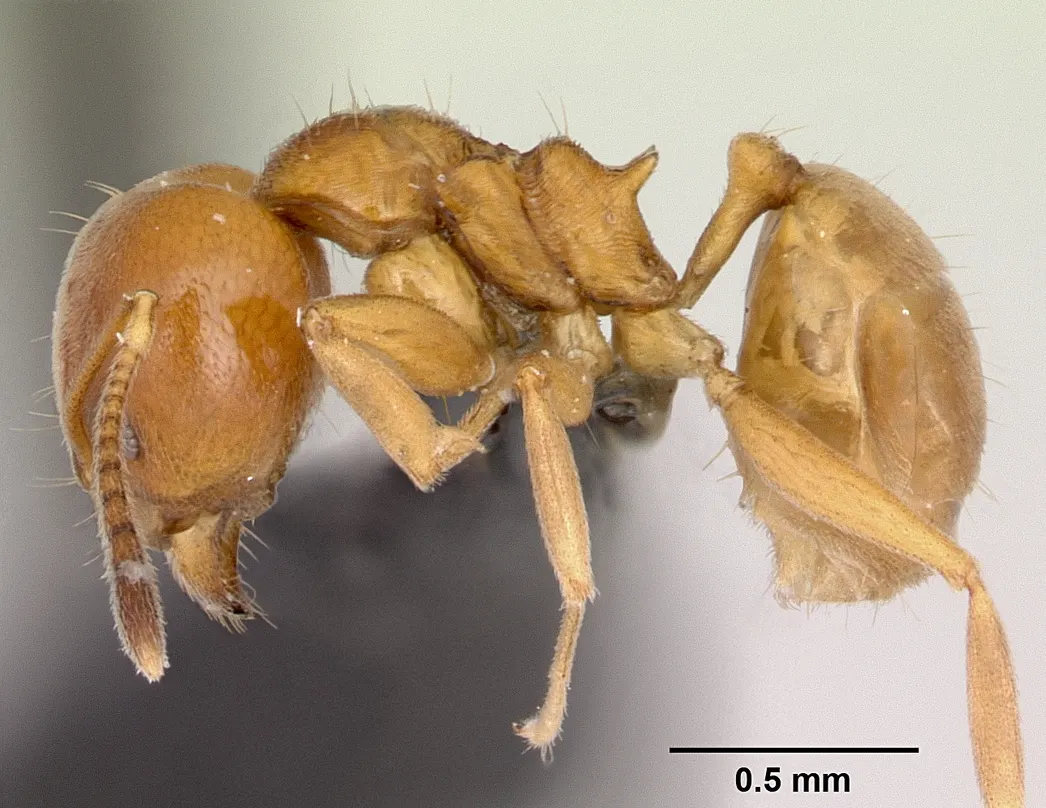
The Sri Lankan relict ant (Aneuretus simoni) is a small yellow to orange ant found only in the wet forests of Sri Lanka. It is the last living member of an ancient lineage that otherwise survives as fossils. The IUCN Red List assessed it as Critically Endangered in 1996, and researchers have since asked for a reassessment.
How to recognise it
Workers are yellow to orange with fine transverse ridges on the body. They come in two very different sizes. The small workers make up most of a nest and have tiny compound eyes with only about 30 lenses. Large workers are reportedly rare, with no more than two in a colony. The queen is bigger than the large workers and has a broader head.
Emery described the species in 1893. It is the only species in its genus, and the only living ant in the subfamily Aneuretinae, which is otherwise known only from fossils.
A living relic
The ant was once thought to sit between the primitive and advanced groups of ants. More recent studies place it as the nearest living relative of the Dolichoderinae. Its fossil cousins include Protaneuretus, Paraneuretus and Mianeuretus. Its social organisation is reportedly similar to that of the dolichoderines.
Where it lives
It is endemic to Sri Lanka and lives in wet-zone and intermediate-zone forest. Records include Peradeniya, Pompekelle, Adam's Peak, Gilimale, Sinharaja and Kirikanda forests, plus a handful of forests in the south and centre of the island.
Early work tied it to places with 2,000 to 5,000 mm of annual rain and elevations of at least 450 m. Later surveys found it lower down, at 95 to 250 m in two southwestern forests, and in 2014 in the Meethirigala Forest Reserve, Gampaha District, at just 57 m, the lowest record for the species.
Pins are Wikidata “endemic to” fields. Orange dots, when present, are GBIF occurrence tiles — survey bias included.
How it lives
Colonies are reportedly small, from about 2 to 100 ants, and nest on or near the ground. Nests turn up in leaf litter, the top layer of soil, rotting wood and fallen logs, hollow twigs, crevices among boulders and on flat rock surfaces. The ants forage mainly in the litter, and workers have been recorded feeding on rotten fruit and nectar.
At Meethirigala in 2014, a survey with 0.5 m by 0.5 m quadrats counted 0.2 to 0.8 nests per square metre in the one locality where the ant occurred. That put it among the four densest ground-nesting ants there, and above the density recorded at most of its other known sites.
Why it is in trouble, and why the picture is mixed
A 1956 study by Wilson and colleagues recorded the ant at Peradeniya, Pompekelle and Adam's Peak. A 1985 study reportedly found it at only one site, Gilimale, and later surveys found it rare or absent at several former localities. E. O. Wilson urged conservation measures and a Red Data Book listing, and the IUCN Critically Endangered rating dates from 1996. That assessment cited human impact on its forest habitat.
Since then, more records have appeared, often in forests disturbed by people. Sri Lanka's own national assessment rates it Endangered rather than Critically Endangered, and a 2016 survey at Meethirigala called for an urgent reassessment of its local and global status after more surveys in the wet-zone districts of Colombo and Kegalle.
Sources
Written for this catalog in our own words from the sources below, checked against them on 12 November 2026. Population figures are estimates and carry the year they were made. Status and assessment year: IUCN. 2026. The IUCN Red List of Threatened Species. Version 2026-1. iucnredlist.org.




