Endangered
Sri Lanka Whistling Thrush
Myophonus blighi
The Sri Lanka whistling thrush (Myophonus blighi) is a shy, dark thrush spangled with blue, found only in the cloud forests of Sri Lanka's highlands. It lives beside fast mountain streams and is scarce. The IUCN has listed it as Endangered since 1994, most recently in 2025, with a population of a few hundred to a couple of thousand birds.
How to recognise it
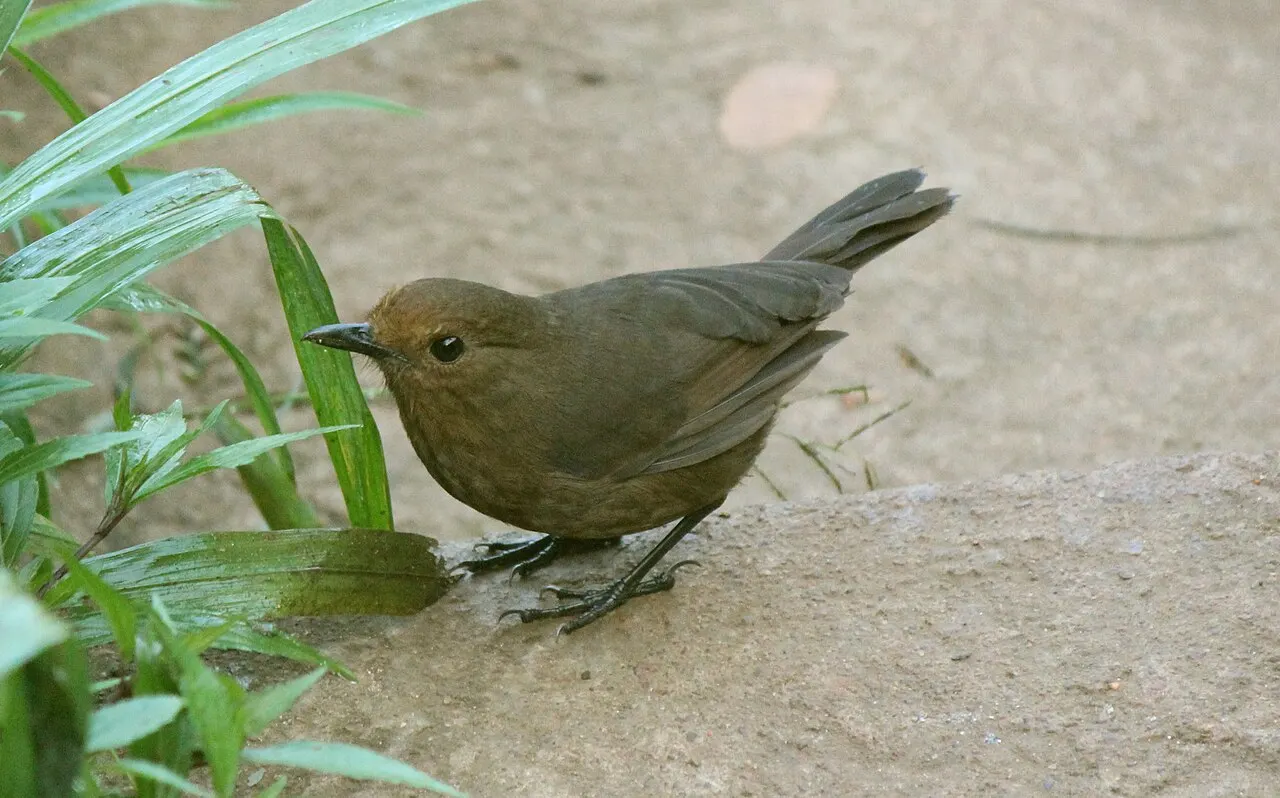
It is a small thrush, about 20 cm long. The male is dark, close to black, with bright blue patches on the forehead, above the eye and on the shoulder. The female is brown above and rusty-chestnut below, but she carries a blue shoulder patch too. Young birds resemble the female, with pale streaking below.
The call, given by both sexes, is a shrill, high whistle written as sree, loud enough to carry over the sound of running water. Only the male sings a longer song, usually from a rock or branch in or near a stream.
Where it lives
The species is endemic to Sri Lanka's central highlands. Birders look for it on Horton Plains, in the Peak Wilderness and in the Knuckles Range, and it has also been seen around Nuwara Eliya. The Red List gives an elevation range of about 840 to 2,180 m and an extent of occurrence of roughly 6,650 square kilometres.
Within that range it needs wet montane forest with dense cover beside torrential streams. The assessment estimates 6 to 30 locations and three subpopulations. Between 61 and 70 percent of the population is thought to live inside protected areas.
Pins are Wikidata “endemic to” fields. Orange dots, when present, are GBIF occurrence tiles — survey bias included.
How it lives
It is most active around dawn and dusk and usually lives in pairs. It eats insects, earthworms, frogs, freshwater crabs and geckos, and probably some berries. It often fans its tail.
The nest is a large, deep cup set in a mass of moss near running water, and pairs reportedly reuse a locality year after year if they are not disturbed. It lays one or two eggs. Sources disagree on the season. The Ceylon Bird Club gives April as the main month, while another account puts the start of breeding in February.
Why it is in trouble
The Red List estimates the population at 325 to 2,250 birds (2025), with the largest subpopulation put at 240 to 1,690, and records it as decreasing under criterion C2a(i). The wide ranges show how little direct counting has been done. In July 2007, Ceylon Bird Club members saw or heard at least 15 birds along one path in the Peak Wilderness, an observation rather than a census.
Loss of upland forest is the central problem. The assessment names large-scale agriculture as the biggest threat, with shifting cultivation and small-scale harvesting adding smaller pressures. It also records habitat shifting and alteration across the whole range, with unknown effects.
What is being done
Protected forest holds most of the birds. The Red List's conservation actions needed are site and area protection and site management, and it records the range as covered by identified conservation sites. No species recovery plan, monitoring scheme or captive programme is recorded.
Sources
Written for this catalog in our own words from the sources below, checked against them on 12 November 2026. Population figures are estimates and carry the year they were made. Status and assessment year: IUCN. 2026. The IUCN Red List of Threatened Species. Version 2026-1. iucnredlist.org.




