Critically Endangered
Spotted houndshark
Triakis maculata
The spotted houndshark, Triakis maculata, is a stout, black-spotted shark of the shallow continental shelf in the eastern Pacific, from Peru to northern Chile and the Galápagos. The IUCN Red List (2020) lists it as Critically Endangered because fishing has driven a decline.
How to recognise it
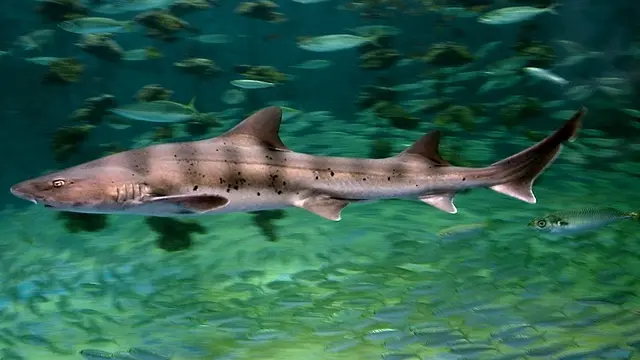
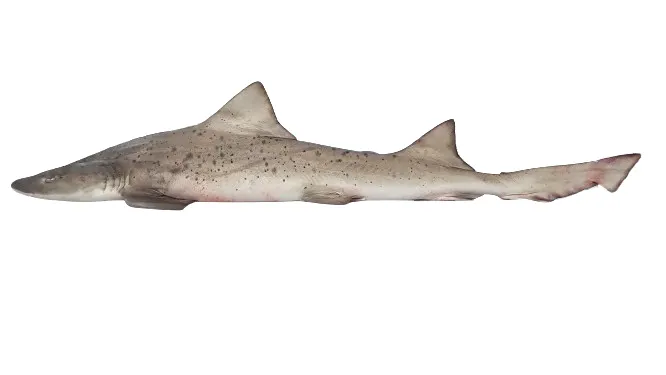
It is a heavy-bodied houndshark with a short, broadly rounded snout and lobed flaps at the nostrils that do not reach the mouth. Most individuals carry many small black spots, though some are plain. Its teeth have strong upright cusps.
Reported lengths are usually around 180 centimetres. A maximum of about 240 centimetres has been reported, though FishBase calls that figure doubtful.
Where it lives
It lives near the coast over the shelf, along Peru and northern Chile, with a record from the Galápagos. That island record rests on photographs of a tagged shark caught and released off Fernandina in 1980. Mexican records are considered erroneous.
The IUCN gives its depth range as 10 to 200 metres, over sand, rock, gravel and coral reef. Locations listed are Peru, Chile, Ecuador and the Galápagos.
Pins are Wikidata “endemic to” fields. Orange dots, when present, are GBIF occurrence tiles — survey bias included.
How it lives
Its biology is little studied. Its diet is thought to be mostly crustaceans and other bottom-living invertebrates. Mothers give birth to live young that develop inside the body, and a litter of 14 pups was found in one female. Newborns are about 30 to 40 centimetres long.
The IUCN gives a generation length of about 20 years, so recovery from heavy fishing would be slow.
Why it is in trouble
People catch it for food, mainly in small-scale fisheries in Peru that use gillnets and sometimes trawls. It is caught alongside two smooth-hounds, the humpback and the speckled, and locally all three are called tollo. The IUCN lists both targeted and accidental catch, small-scale and large-scale, as threats, and its decreasing trend led to the Critically Endangered listing under criterion A2bd in 2020.
It is probably less common than those two relatives. The assessment estimates a past population reduction of about 80 percent, based on an abundance index and levels of exploitation. A minimum landing size reportedly exists but is low relative to the size at which the sharks mature.
What is being done
The IUCN lists harvest management, species recovery and national-level measures, and notes that it occurs in at least one protected area, but records no recovery plan and no systematic monitoring scheme. Fishing pressure has reportedly eased as the main target, the humpback smooth-hound, became scarcer, and monitoring is needed to see whether the decline turns around.
Sources
Written for this catalog in our own words from the sources below, checked against them on 12 November 2026. Population figures are estimates and carry the year they were made. Status and assessment year: IUCN. 2026. The IUCN Red List of Threatened Species. Version 2026-1. iucnredlist.org.