Endangered
Anguilla Bank skink
Anguilla Bank skink
The Anguilla Bank skink is a small, glossy lizard of the northern Lesser Antilles. It lives on Anguilla, Saint Barthélemy and a few offshore islets. The IUCN Red List rated it Endangered in 2017, mainly because of introduced predators and a tiny range.
How to recognise it
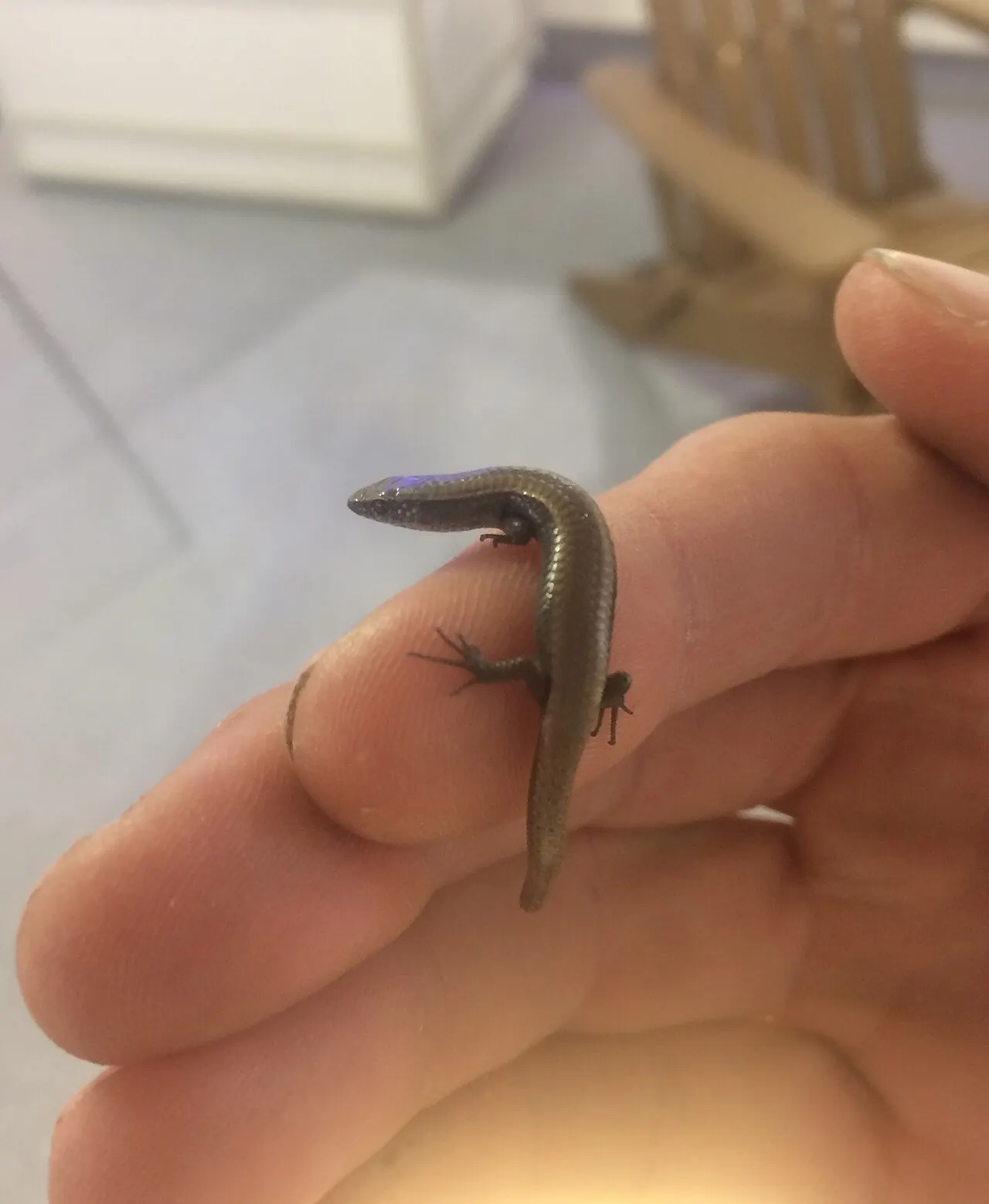
It's a slim skink with short legs and shiny scales. Adults grow to about 70 mm from snout to vent, with males slightly larger than females, up to about 72 mm. A pale stripe runs down the middle of the back, flanked by dark stripes, and another dark stripe runs along each flank. The palms and soles are pale.
Where it lives
For most of history the skinks of the eastern Caribbean were lumped together as one species. S. Blair Hedges and Caitlin Conn split them in 2012, describing 24 new Caribbean skink species, this one among them. The type specimen was collected on Anguilla in 1963 by James Lazell at Shannon Hill, north of Sandy Ground. The species is named for the herpetologist Robert Powell.
It occurs on the Anguilla Bank, mainly on Anguilla and Saint Barthélemy. The Red List counts four locations and gives an elevation range from sea level to 65 m. Its habitats are rocky areas and dry shrubland, and the extent of occurrence is about 855 square kilometres. On Anguilla it lives in rock-built walls, and on Saint Barthélemy it turns up in sunny spots on cacti and in tall grass, and sometimes inside houses.
It was long thought to be absent from the main island of Saint Martin. In 2017, however, a team including Olivier Lorvelec and S. Blair Hedges reported a population on Tintamarre, an uninhabited islet just off Saint Martin. The skinks there live in old stone walls left from early 20th century farming. A population on Dog Island, off Anguilla, has been tentatively assigned to the species too.
Pins are Wikidata “endemic to” fields. Orange dots, when present, are GBIF occurrence tiles — survey bias included.
Why it is in trouble
The 2017 assessment rates it Endangered under criterion B1ab(v), which fits a small range with a continuing decline in the number of mature animals. The Red List names two introduced predators. The black rat is an ongoing threat across the whole range, rated as a medium impact causing slow but significant declines. The small Indian mongoose is listed as a past threat that is unlikely to return.
The mongoose, introduced to Saint Martin in 1888, may also have wiped out a close relative, the Saint Martin skink (Spondylurus martinae). The assessment lists Saint Martin's French and Dutch halves as places where this species is extinct, a record that predates the Tintamarre discovery.
What is being done
The skink is known from at least one protected area, and the assessment records no other conservation action. The population trend is recorded as decreasing.
Sources
Written for this catalog in our own words from the sources below, checked against them on 12 November 2026. Population figures are estimates and carry the year they were made. Status and assessment year: IUCN. 2026. The IUCN Red List of Threatened Species. Version 2026-1. iucnredlist.org.




