Endangered
Spikedace
Meda fulgida
The spikedace (Meda fulgida) is a slim silvery minnow, under 3 inches long, that lives in a few clear, fast streams of the Gila River basin in Arizona and New Mexico. The IUCN Red List assessed it as Endangered in 2013, and it now occupies roughly a tenth of its old range or less.
How to recognise it
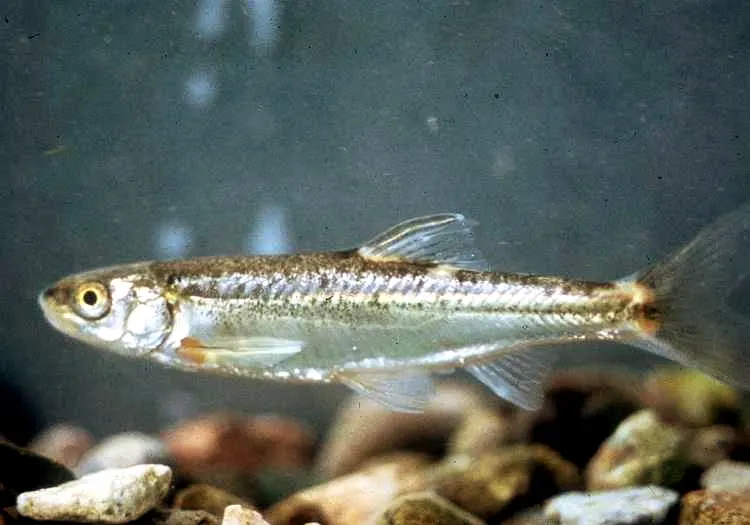
It's a small, slender fish, usually under 75 millimetres (3 inches) long. The back is olive-gray to brownish, the sides are silvery, and the body carries elongated black specks. There are spines in the dorsal fin.
Breeding males turn brassy gold, mostly on the head and the fins on the underside. The spikedace is the only species in the genus Meda, a minnow now placed in the family Leuciscidae (older sources, including the 2012 federal rule, use Cyprinidae).
Where it lives
The spikedace was once common across much of the Gila basin, including the main Gila River upstream of Phoenix and the Verde, Agua Fria, Salt, San Pedro and San Francisco river systems. The first specimens were collected from the San Pedro River in 1851.
A 2012 federal rule listed the remaining wild populations in four places: the upper Gila River in New Mexico, Aravaipa Creek, Eagle Creek and the Verde River in Arizona. Only Aravaipa Creek and one stretch of the Gila south of Cliff, New Mexico, were described as having the fish in common numbers. The last fish caught in the Verde came from a 1999 survey, and Eagle Creek fish were reported as unseen for more than a decade, though thought to persist at levels too low to detect. No population estimate exists, because the species is hard to detect and surveys have been sporadic and inconsistent. The rule put its present range at about 10 percent or less of the historical one.
Pins are Wikidata “endemic to” fields. Orange dots, when present, are GBIF occurrence tiles — survey bias included.
How it lives
Spikedace live in moderate to large streams that flow all year. They use shallow riffles over sand, gravel and rubble, and favour shear zones where fast water runs beside slow water, plus eddies at the downstream edge of riffles. They eat a mix of insect larvae, other aquatic invertebrates, algae and plant matter, and they spawn in spring.
Floods matter to them. A natural flow regime, with regular high water, keeps their habitat in shape and helps them hold their own against invading non-native fish.
Why it is in trouble
The IUCN lists the population trend as decreasing. Its assessment names drought, water taken from rivers and groundwater for farming, dams, erosion and sediment, and invasive species among the ongoing threats. Federal biologists add channelisation for flood control, livestock grazing, heavy water use by large mines and pollutants washing off roads.
Non-native fish are a particular problem. Smallmouth bass and channel catfish are documented predators of spikedace, and red shiner and rainbow trout are also listed among the invaders that threaten it. When smallmouth bass numbers rose on the East Fork Gila River, native fish numbers fell.
What is being done
The US Fish and Wildlife Service raised the spikedace from threatened to endangered in a rule that took effect on 26 March 2012. The same rule designated critical habitat of about 1,013 kilometres (630 miles) of streams in Arizona and New Mexico.
Arizona Game and Fish keeps spikedace from Aravaipa Creek, the upper Gila and the West Fork Gila in a hatchery refuge at Bubbling Ponds. Hatchery stock was released into Redfield Canyon, Hot Springs Canyon, Fossil Creek and Bonita Creek from 2007, the first reintroductions of the species since 1970. Earlier attempts in Sonoita Creek (1968) and 7-Springs Wash (1970) failed. As of 2012, monitoring was still under way to see whether the new populations can sustain themselves.
Sources
Written for this catalog in our own words from the sources below, checked against them on 12 November 2026. Population figures are estimates and carry the year they were made. Status and assessment year: IUCN. 2026. The IUCN Red List of Threatened Species. Version 2026-1. iucnredlist.org.




