Critically Endangered
Speckled ground squirrel
Spermophilus suslicus
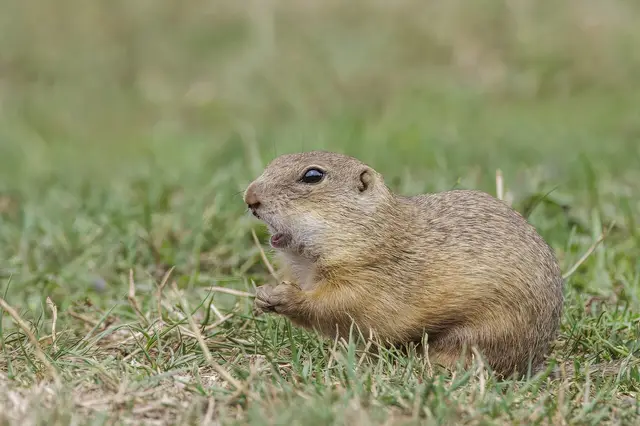
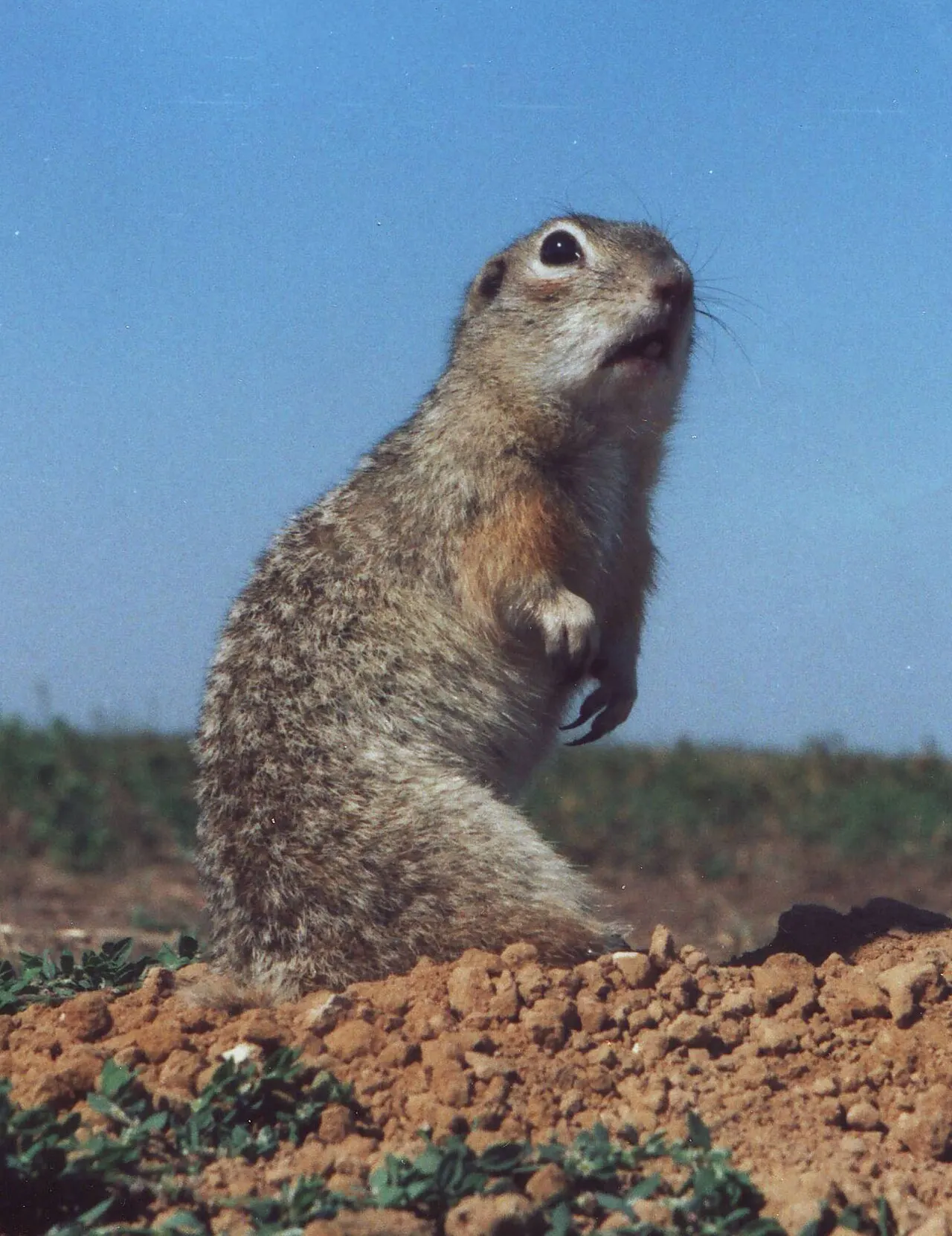
The speckled ground squirrel (Spermophilus suslicus), also called the spotted souslik, is a small, white-flecked burrowing rodent of the steppe grasslands of Eastern Europe. The IUCN Red List moved it to Critically Endangered in 2024, with a decreasing trend, after a collapse in numbers across most of its range.
How to recognise it
Adults are about 25 cm long and weigh around 280 g. The fur is dark brown with pale spots across the back, and the tail is short and slim. Three subspecies are recognised. Animals west of the Dnieper River have 36 chromosomes and those to the east have 34, a split that has led some authors to treat the western animals as a separate species.
Where it lives
The species is found only in Eastern Europe, from the Volga valley in western Russia through Ukraine to north-eastern Moldova and south-eastern Poland, where it is limited to the Lublin province. The IUCN lists Belarus, Moldova, Poland, Russia and Ukraine, and gives an elevation of 5 to 500 m.
It needs open ground with low, sparse vegetation and soil that can hold deep burrows. Grass taller than the animal's own body, about 20 cm, is a problem, because the squirrels stand upright to watch for danger. Besides steppe and dry meadow, the assessment lists pasture and urban areas. In Poland they sometimes settle on arable fields, road verges and airfields, and in Russia a source population lives in a cemetery.
Pins are Wikidata “endemic to” fields. Orange dots, when present, are GBIF occurrence tiles — survey bias included.
How it lives
Squirrels feed mostly on grasses and cereal plants, with some small animals and insects. They are active by day, feeding in the morning, resting in the burrow in the heat of the day and feeding again late in the afternoon. They hibernate from about October to April. Each animal keeps its own burrow, and colonies can reach more than 160 animals per hectare.
Mating happens in April and May, gestation lasts 23 to 26 days, and litters usually hold four to eight young. The IUCN gives a generation length of about 2.9 years.
Why it is in trouble
The assessment describes a severely fragmented population in 20 to 100 locations, with a continuing decline in area, and puts the largest subpopulation at about 6,300 animals. Pressures include conversion of grassland to farms, housing and industry, persecution or control, drought, temperature extremes and dumping of waste. The assessment records a 99 percent decline, which a published summary dates to the past 30 years, and the species has reportedly lost about nine tenths of its mid-20th-century range in Poland and southern Russia.
Poland shows how fragile small colonies are. About 40 animals were illegally released at the Świdnik airfield in 1976 to 1978, and the colony passed 12,000 within twenty years. Numbers then fell to 9 in 2010. Managers moved in 150 animals from the Popówka reserve in 2011 and 60 more in 2014, which brought a small improvement. A 2025 analysis by Grzegorz Grzywaczewski in Chrońmy Przyrodę Ojczystą recorded an average of just 22 animals in 2024 and concluded that rebuilding the airfield colony was becoming impossible.
What is being done
The species occurs in at least one protected area, though only 1 to 10 percent of the population is covered, and a systematic monitoring scheme is in place. The assessment lists reintroduction, habitat restoration, site protection and management, captive breeding, awareness work and payments to landowners as conservation actions. A relict Polish population is protected by national law, and the species is on Appendix II of the Bern Convention.
One bright spot is in Russia. Between summer 2020 and early spring 2021, 214 animals taken from a cemetery population near Lipetsk were released in Lomovskoy Natural Park in the Voronezh region. By July 2021 they had bred and spread over more than 7 hectares, and the colony was estimated at about 300. A 2021 report in Field Biologist Journal called it the first stable free-living colony in seven years of reintroduction work.
Sources
Written for this catalog in our own words from the sources below, checked against them on 12 November 2026. Population figures are estimates and carry the year they were made. Status and assessment year: IUCN. 2026. The IUCN Red List of Threatened Species. Version 2026-1. iucnredlist.org.