Endangered
Spanish Algyroides
Algyroides marchi
The Spanish algyroides (Algyroides hidalgoi, long known as A. marchi) is a tiny lizard found only in a few mountain ranges of south-east Spain. It lives on shaded, damp rocks near water and is rated Endangered on the IUCN Red List (2024 assessment), with a decreasing population.
How to recognise it
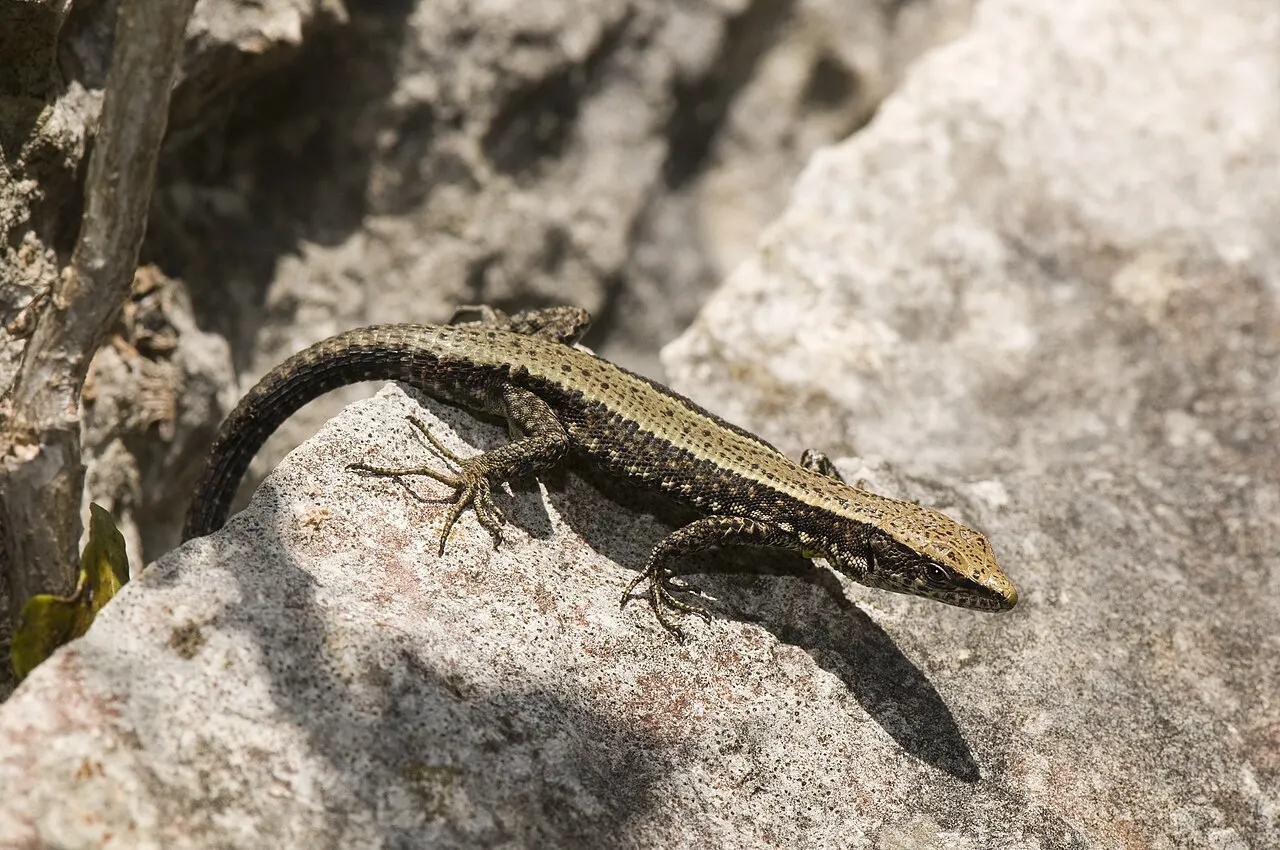
It is a small, slender lizard with a flatter head and body than other Iberian lizards, and a Spanish national atlas calls it the smallest continental lacertid in Spain. Females reach maturity at about 38 to 39 mm from snout to vent, from their third year. The large back scales are keeled, while the flank scales are small and granular.
Adults are greyish-brown, bronze or brown, sometimes with an olive tint, and the dark brown to almost black flanks contrast with the back. The belly is whitish or yellowish. Breeding males can show bright yellowish or glossy green underparts.
Where it lives
The species is endemic to Spain, in the Prebetic and Subbetic mountains of the south-east: the sierras of Alcaraz, Cazorla, Segura and Castril, across Albacete, Jaen and Granada and, by one account, Murcia. Populations are concentrated in a few localities and well isolated from each other. The IUCN gives an estimated extent of occurrence of 4,057 square km and an area of occupancy of 504 square km.
Altitude sources differ. One Spanish atlas puts it above 700 m with the highest population at 1,700 m, another source says 550 to 1,700 m, and the IUCN gives 700 to 2,100 m. It likes cool, humid, shaded ground: steep north-facing gorges and rock faces with big boulders, stream sections, springs and damp sinkholes. Dense shrub and long hours of sun count against it.
Pins are Wikidata “endemic to” fields. Orange dots, when present, are GBIF occurrence tiles — survey bias included.
How it lives
It is active by day and fairly shy, from early March to early October. Males chase each other in April and early May and use rapid head bobbing in courtship and threats. Eggs are laid in June or July in clutches of one to four, with a mean of 2.2 eggs.
Its diet is not well studied. The atlas says it takes mostly arachnids found under rocks, and flies and spiders have been recorded. Estimated lifespan is about five years. At one favourable site, a 1994 study cited in the atlas found 213 adults and subadults per hectare.
Why it is in trouble
Its needs are narrow and its range small. The 2024 assessment (criterion B1ab(iii,v)) records severely fragmented populations in continuing decline. Droughts affect the whole range, and the assessment also lists livestock and small-scale farming, roads, tourism and recreation areas, and past groundwater abstraction.
Spanish sources add logging, new tracks, diverted springs, forest fires, and cats, rats and wild boar. Some populations have vanished within a short time because streams silted up or dried. Traditional stone water tanks have been replaced in places by metal tanks the lizards cannot use. One source also lists collecting, including for the pet trade, as a concern.
What is being done
It occurs in a protected area, and the Andalusian part of its range lies within a natural park. A conservation plan was drawn up for Castilla-La Mancha in 1998. The IUCN recommends site management and habitat restoration, but reports no species recovery plan, no invasive species control and no captive programme.
Sources
Written for this catalog in our own words from the sources below, checked against them on 12 November 2026. Population figures are estimates and carry the year they were made. Status and assessment year: IUCN. 2026. The IUCN Red List of Threatened Species. Version 2026-1. iucnredlist.org.




