Endangered
Somanniathelphusa zanklon
Somanniathelphusa zanklon
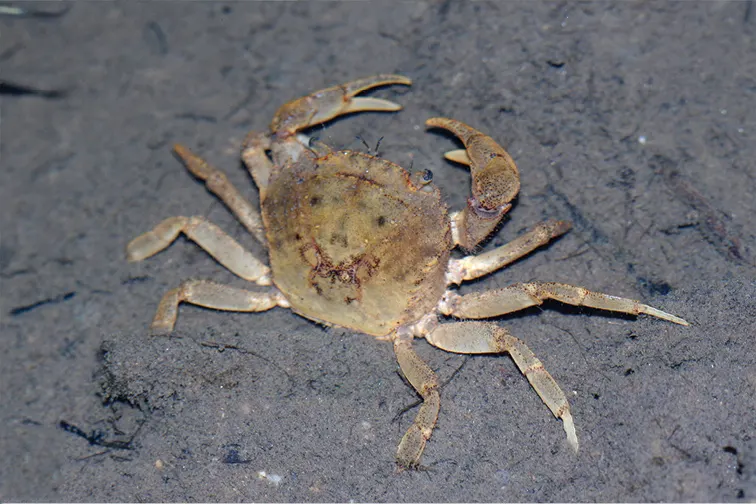
Somanniathelphusa zanklon is a freshwater crab known only from Hong Kong, where it lives in slow lowland streams, marshes and ditches. The IUCN Red List assessed it as Endangered in 2008, citing a small known range and a probable decline in habitat quality. It has no widely used common name.
Where it lives
The species was described in 1992 by Peter Ng and David Dudgeon, who separated it from a similar crab, Somanniathelphusa sinensis, with which it had been confused. The first specimens came from the lower Lam Tsuen River and irrigation ditches at Su Kwun village in the New Territories.
A 2016 review in the Journal of Threatened Taxa by David Stanton and Michael Leven went through 104 environmental impact reports from 2002 to 2015 and found at least 43 sites. They lie in the north-western and north-eastern New Territories and on Lantau Island, all below 220 m, within an area of about 250 square kilometres. The reviewers found no recent records from the river and ditches where it was first collected. No record exists outside Hong Kong so far, but they think it likely occurs beyond it, given its presence in the Hong Kong part of the Shenzhen River catchment.
Pins are Wikidata “endemic to” fields. Orange dots, when present, are GBIF occurrence tiles — survey bias included.
How it lives
It prefers low-gradient tributaries and marshes to large rivers or fast, small watercourses. It has been found among the roots of floating plants and riparian grasses, and in flooded furrows. Every site surveyed showed signs of human influence, such as channelling or pollution, and the crab appears tolerant of murky, low-oxygen water, though Stanton and Leven say firm conclusions are not yet possible.
It is an omnivore. One crab was seen eating a Bauhinia variegata seed, and laboratory tests showed a preference for thin-shelled snails. Like other true freshwater crabs, it skips a free-swimming larval stage. Hatchlings look like small adults and are released at the start of the wet season. Brooding females are secretive and rely on damp ground beside the water. It was not abundant at any site, which suggests low densities.
Why it is in trouble
The main problem is the loss and chopping up of lowland watercourses and wetlands, through development, channelling and piping streams. Piped sections can isolate groups of crabs from one another. Hong Kong has no system for protecting whole river catchments, and only one of the known sites has any conservation designation.
The IUCN assessment also lists pesticide use, but Stanton and Leven consider this hypothetical because the crab has not been found in rice-growing areas. They also argued that the species probably does not meet the criteria for Endangered, while still describing a small, fragmented and probably declining population known only from Hong Kong.
What is being done
Little has been done directly. Mitigation in development projects usually means keeping a watercourse, adding riparian buffers or moving animals, without firm guidelines. The 2016 review recommended protecting known sites, managing habitat, keeping or creating corridors between populations, including streamside habitat in restoration plans, and surveying lowland waterways around the Pearl River Estuary.
Hong Kong Golf Club says it holds the largest known population of the crab. In 2019 WWF Hong Kong reportedly asked the Environmental Protection Department to stop planned redevelopment of the club's Fanling course because of it.
Sources
Written for this catalog in our own words from the sources below, checked against them on 12 November 2026. Population figures are estimates and carry the year they were made. Status and assessment year: IUCN. 2026. The IUCN Red List of Threatened Species. Version 2026-1. iucnredlist.org.




