Extinct in the Wild
Socorro dove
Zenaida graysoni
The Socorro dove is a cinnamon-coloured, mostly ground-living dove that once lived only on Socorro Island, in Mexico's Revillagigedo Islands. The IUCN Red List has it as Extinct in the Wild (assessed 2020). Nobody has seen one on the island since 1972, but captive birds survive in zoos and aviaries.
How to recognise it
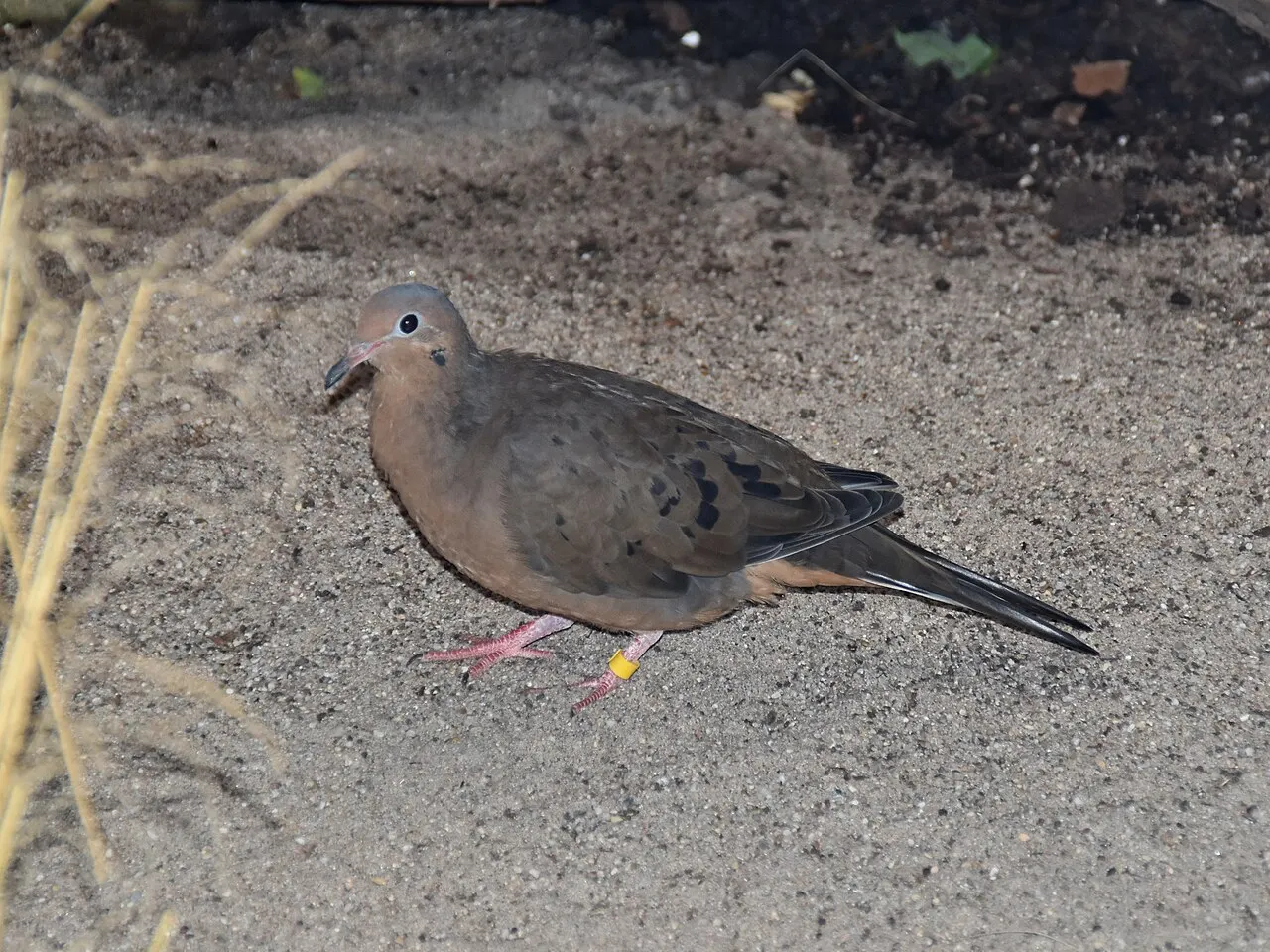
It's a medium-sized dove, about 26.5 to 30.5 cm long, and spends most of its time on the ground. The male has a deep cinnamon head and underparts, a blue-grey nape and an iridescent pink patch on the neck, with dark brownish upperparts boldly spotted in black. Females are duller, with smaller nape and neck patches.
Both sexes have a pale blue ring around the eye, pinkish legs and a dark grey bill with a reddish-pink base. It's larger and more heavily built than the mourning dove, and its song is very different, a hoarse cooing.
Where it lived
The species was found only on Socorro, one of the Revillagigedo Islands off Mexico's Pacific coast. It lived in humid forest and seems to have been commonest above about 500 m, up to a limit of roughly 950 m. The islands were declared a biosphere reserve in 1994.
It was a fruit eater that lived mostly on the ground, and it probably depended on an intact understorey of ferns and spurges. Forest trees in its home range included figs and wild cherry relatives.
Pins are Wikidata “endemic to” fields. Orange dots, when present, are GBIF occurrence tiles — survey bias included.
Why it vanished from the wild
Predation by feral cats is blamed as the main cause. Cats are thought to have arrived with a military base set up in 1957, although the IUCN assessment says they may not have turned feral until the early 1970s. That timing leaves room for other factors, such as hunting by people and heavy grazing by sheep, which were introduced in 1856.
The last sighting in the wild was in 1972, and expeditions in 1978 and 1981 found none. All the sheep had been removed by 2010. Cats and house mice were still unresolved on the island as of 2011.
Life in captivity
Today's captive birds descend from doves collected on an expedition in 1925 and bred in the United States, with some sent on to Europe. A European breeding programme was recognised in 1995, and birds were moved to Mexico in 2013 and 2014 to form a national flock for an eventual return to the island.
Counts vary. The IUCN put the captive total at about 150 in 2016, and a later report gives about 180 birds in fewer than 50 collections in 2026. London Zoo reportedly hatched eight chicks in April 2025.
Hybrids are a problem. Socorro doves cross with mourning doves, and many birds in the United States turned out to be hybrids. Hybrids are kept out of any release plan.
A return to Socorro is planned but depends on controlling cats and mice. Biologists also worry about avian diseases such as West Nile virus, and about whether birds bred in captivity for generations will cope in the wild.
Sources
Written for this catalog in our own words from the sources below, checked against them on 12 November 2026. Population figures are estimates and carry the year they were made. Status and assessment year: IUCN. 2026. The IUCN Red List of Threatened Species. Version 2026-1. iucnredlist.org.




