Endangered
Snaggletooth shark
Hemipristis elongata
The snaggletooth shark (Hemipristis elongata) is a coastal shark of the Indo-West Pacific, found from the Red Sea and southeast Africa to China and northern Australia. It is named for its saw-edged upper teeth and hooked lower ones. The IUCN Red List assessed it as Endangered in 2024, after steep declines.
How to recognise it
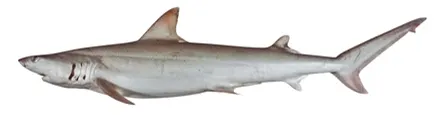
The snaggletooth is a light grey to bronze shark without prominent markings. Its give-away is the mouth. The upper teeth are sharp and saw-edged, while the lower teeth are hooked.
A common length is about 2 metres. Published maximum lengths run from 240 cm to 259 cm, depending on the source. It is the only living member of its genus, Hemipristis, which sits in the weasel shark family.
Where it lives
It ranges across warm shelf waters from the Red Sea and the east coast of Africa, through the Persian Gulf, India and Southeast Asia, to China, Papua New Guinea and the northern coasts of Australia. The Red List records it from more than 40 countries and territories, from Madagascar and Mozambique to Taiwan and Queensland.
It lives near the seabed in coastal waters on continental and island shelves, from the surface down to about 130 metres. The Red List lists muddy and sandy bottoms, seagrass beds, rocky reefs and estuaries as habitat.
Pins are Wikidata “endemic to” fields. Orange dots, when present, are GBIF occurrence tiles — survey bias included.
How it lives
Snaggletooths eat bony fish, other sharks, rays, crabs and squid and their relatives. Females give birth to live young. Litters of 2 to 11 pups are reported after a gestation of 7 to 8 months, and females possibly breed only every second year. Pups are born at roughly 45 to 52 cm long.
That slow, small-litter pace matters. The Red List puts a generation at about 9 years, so a population that has been fished down takes a long time to rebuild.
Why it is in trouble
The threat is fishing. Snaggletooths turn up regularly in inshore gillnets and longlines, in small-scale fisheries and occasionally in bottom trawls. The meat is eaten fresh, the liver is processed for vitamins, the fins go into the shark fin trade and the rest becomes fishmeal. The assessment lists targeted and accidental catch, by both small-scale and large-scale fisheries, as a medium-level threat across most of the range.
The 2024 assessment records a past population reduction of 50 to 79 percent, assessed over three generations and judged from abundance indexes and levels of exploitation. The causes have not ceased, and the trend is still downward.
What is being done
Protection is thin. The species occurs in at least one protected area, but the assessment records no recovery plan, no monitoring scheme, no harvest management plan and no international trade controls for it. The conservation actions it calls for are harvest and trade management, species recovery, site protection and action at national level.
Sources
Written for this catalog in our own words from the sources below, checked against them on 12 November 2026. Population figures are estimates and carry the year they were made. Status and assessment year: IUCN. 2026. The IUCN Red List of Threatened Species. Version 2026-1. iucnredlist.org.




