Endangered
Silver Oriole
Oriolus mellianus
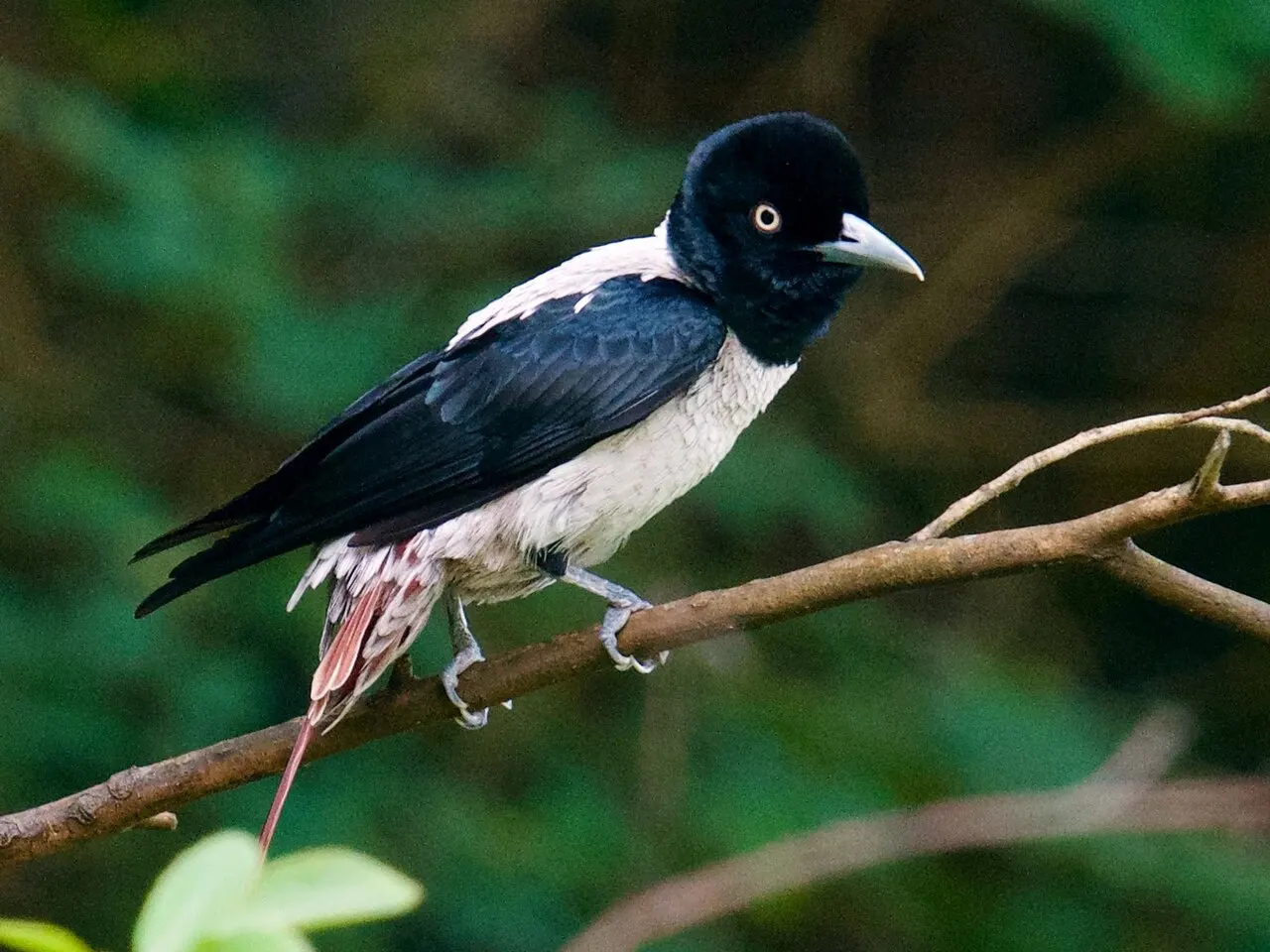
The silver oriole (Oriolus mellianus) is a slim, 28 cm songbird that breeds in south-central China and winters mainly in southern Thailand and western Cambodia. The IUCN Red List rated it Endangered in 2025, with a small population that is decreasing. The male has a silvery-white body with a black hood and wings.
How to recognise it
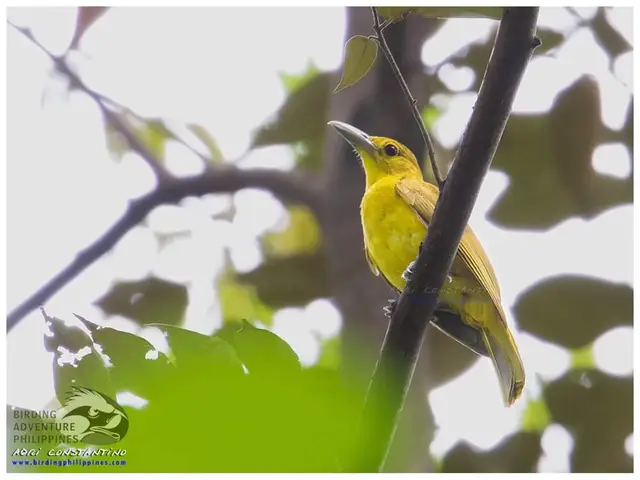
Adults are about 28 cm long. The male has a black head and wings, a silvery-white body, a pinkish-grey tail and a white iris. The female is duller, mid-grey above and streaked blackish-grey on white below.
It closely resembles the maroon oriole, with silvery white replacing the red body plumage. Erwin Stresemann first described it in 1922 as a form of the maroon oriole, and it is now treated as a separate species.
Where it lives
Breeding areas in China are scattered across the south-central part of the country, including Sichuan, Yunnan, Guizhou, Guangxi and Guangdong. The bird is a full migrant. It winters in southern Thailand and western Cambodia, and the IUCN's list of countries also includes Laos, Myanmar and Viet Nam.
The IUCN gives an extent of occurrence of about 206,000 square kilometres, at elevations from sea level to 1,800 m. It uses moist lowland and montane forest, and also heavily degraded former forest. In Thailand it is a rare winter visitor, with records from protected areas such as Doi Inthanon, Huai Kha Khaeng, Kaeng Krachan and Khao Yai, though the range map behind that list rests on limited data.
It does wander. Hong Kong has a single record, a first-winter bird on Po Toi on 29 November 2018.
Pins are Wikidata “endemic to” fields. Orange dots, when present, are GBIF occurrence tiles — survey bias included.
Why it is in trouble
The 2025 assessment estimates 1,000 to 10,000 individuals, all in a single subpopulation, and records the population as decreasing. A Hong Kong bird society page gives an older, undated figure of 1,000 to 2,499. The listing rests on criterion C2a(ii), meaning a small population in continuing decline with nearly all birds in one subpopulation.
The IUCN lists small-holder and industrial farming among the threats, with forest conversion and degradation as the resulting stresses. It also lists harvest as a threat, both accidental take by small-scale users and targeted use, though the scale of targeted use is recorded as unknown.
What is being done
The bird occurs in at least one protected area, and conservation sites have been identified across its whole range. The assessment records no recovery plan, no systematic monitoring scheme, no captive population and no awareness programmes aimed at the species.
Sources
Written for this catalog in our own words from the sources below, checked against them on 12 November 2026. Population figures are estimates and carry the year they were made. Status and assessment year: IUCN. 2026. The IUCN Red List of Threatened Species. Version 2026-1. iucnredlist.org.