Endangered
Sierra Madre Sparrow
Xenospiza baileyi
The Sierra Madre sparrow, Xenospiza baileyi, is a small, streaky, rufous sparrow found only in the high bunchgrass meadows of Mexico. Its two populations lie more than 800 km apart. The IUCN Red List classed it as Endangered in 2020, estimating 1,300 to 9,999 mature birds and a declining trend.
How to recognise it
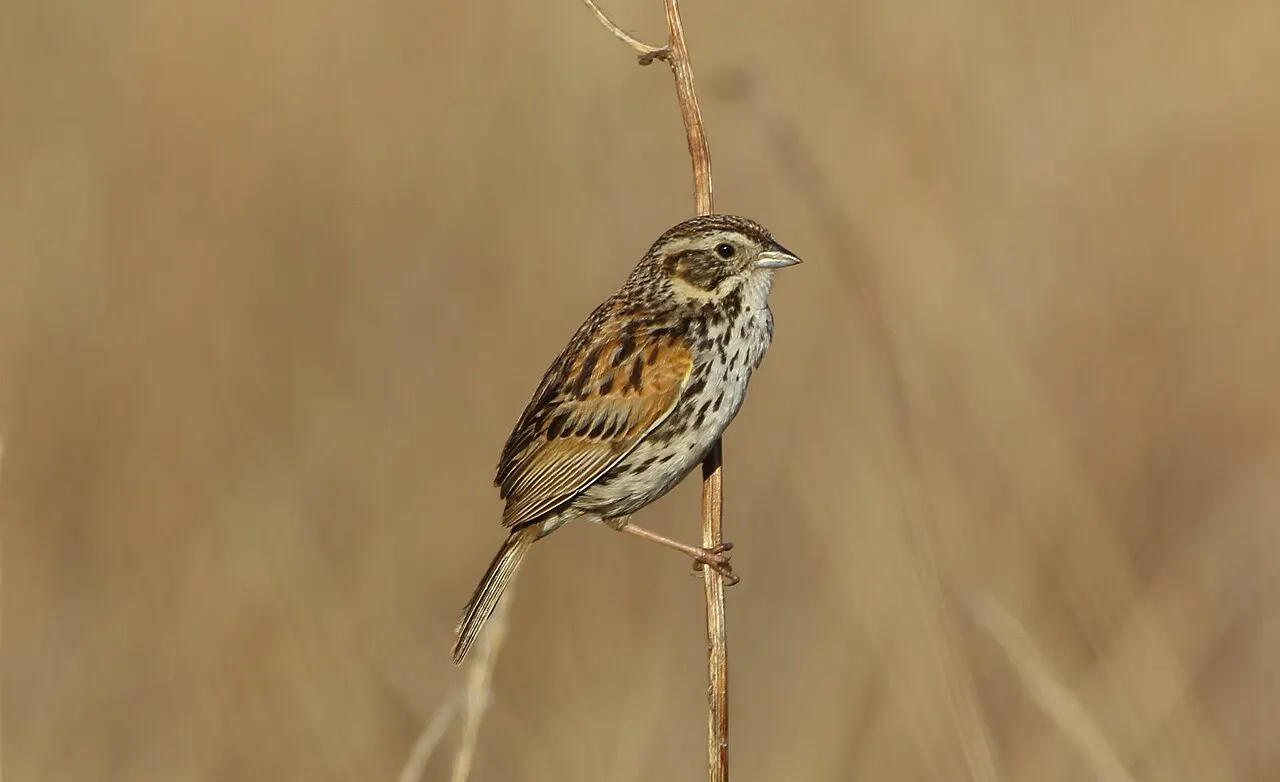
It's a compact sparrow about 12 cm long. The upperparts are rufous and streaked with black, the wings and tail are dark brown edged in rufous, and the nape is greyer. The face is marked by a grey eyebrow and ear patch, a blackish eye-stripe and a moustache stripe. Underneath it's whitish and heavily streaked, and the bill is grey.
It resembles a Song Sparrow but is smaller and more rufous, with a shorter tail that's notched at the tip and a bright yellow bend at the wing. The song is a varied run of seven to twelve chip notes mixed with buzzes. The call is a nasal note much like a Song Sparrow's.
Where it lives
The sparrow is endemic to Mexico. The larger population lives in the volcanic highlands near the Distrito Federal and Morelos border, around La Cima and Milpa Alta. The other is far to the northwest in the Sierra Madre Occidental of southern Durango. The IUCN says earlier records from north Jalisco no longer hold. Genetic work reportedly shows no exchange between the two groups.
It favours medium to tall bunchgrass meadows, mostly at 2,800 to 3,050 m, although Durango birds have been found as low as 2,285 m. Dominant grasses include Muhlenbergia and Festuca species. It also feeds in farm fields and sings from clumps in heavily grazed pasture.
Eight birds were reportedly shot near Bolaños, Jalisco, in 1889 and taken for odd Savannah or song sparrows. A bird collected near the city of Durango in 1931 led to the species being described by Outram Bangs. The southern population was found in 1945. The northern one went unrecorded from 1951 until it was rediscovered in 2004.
Pins are Wikidata “endemic to” fields. Orange dots, when present, are GBIF occurrence tiles — survey bias included.
How it lives
Territories sit within bunchgrass, and nests are built low in the tussocks. Clutches are two to four eggs, and nesting success at La Cima has been about 36%, with predation a major cause of failure.
In a study at La Cima, Adán Oliveras de Ita and Héctor Gómez de Silva colour-banded 53 adults in 1999 and mapped the territories of 21 males. The territory count was the same in 2000, and survival from one year to the next was relatively high. In Durango, a survey found that the area of bunchgrass in a meadow predicted whether sparrows were present.
Why it is in trouble
The IUCN gives a population of 1,300 to 9,999 mature birds, in three to five locations, and the trend is downward. Estimates vary. The La Cima study put the southern population at 5,380 to 6,150 adults, but later surveys in 2012 to 2015 found about 2 birds per hectare, which would mean roughly 2,000 individuals there. Twenty-eight singing males were recorded at one Durango site in 2016. A later survey reported 193 birds at nine of 30 Durango meadows.
The main threats are burning and grazing to renew pasture, conversion of meadows to farmland (mainly oats), housing and urban growth, and cutting of bunchgrass for thatch. The IUCN rates the farming and grazing pressure as affecting most or all of the range. At La Cima, planted pines would eliminate the sparrow from the site if they survive.
What is being done
The IUCN records a systematic monitoring scheme, conservation sites identified across the whole range, and education programmes. A community-based project by CONABIO, UNAM and CORENA has worked to protect and restore habitat with landowners since 2008, and local people were trained in bird monitoring in 2011. There is no recovery plan, and no protected area is known to hold the species.
The Durango survey, published in Bird Conservation International, described the northern birds as genetically distinct. The survey team saw the newly found meadows as both an opportunity and a challenge for conserving them.
Sources
Written for this catalog in our own words from the sources below, checked against them on 12 November 2026. Population figures are estimates and carry the year they were made. Status and assessment year: IUCN. 2026. The IUCN Red List of Threatened Species. Version 2026-1. iucnredlist.org.




