Endangered
Sierra Leone Prinia
Schistolais leontica
The Sierra Leone prinia (Schistolais leontica), also called the white-eyed prinia, is a small grey warbler of thickets and forest edge on the hills of West Africa. The IUCN rated it Endangered in 2017, with an estimated 1,000 to 2,499 birds and a decreasing trend.
How to recognise it
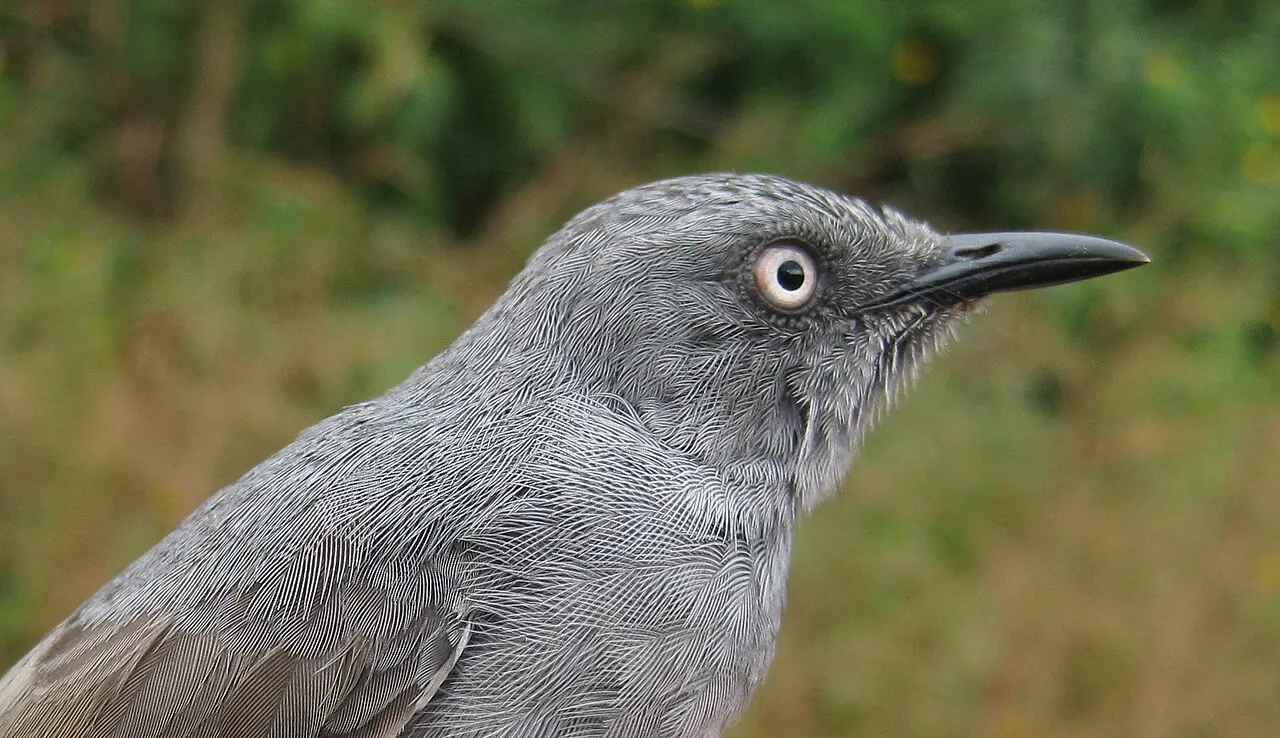
It is a small, long-tailed grey warbler, 14 to 15 cm long, with rounded wings, a whitish belly, buff flanks, a thin black bill, fairly long pink legs and a cream-white eye. Birds watched in Guinea in 1999 held the tail low as they moved through cover, though earlier accounts describe the tail being cocked.
The voice is the best clue. Pairs duet, but without keeping time together: one bird gives rapid high notes and the other lower, nasal ones. It is a close relative of the white-chinned prinia of Central Africa, but is smaller and sounds different, with higher-pitched duet notes.
Where it lives
It was described by the British naturalist George Latimer Bates in 1930 from the Tingi Mountains of Sierra Leone, and is recorded from Sierra Leone, Liberia, Guinea and Cote d'Ivoire. The IUCN estimates its extent of occurrence at about 88,800 square kilometres, at elevations from 700 to 1,600 m.
Within that area it is patchy. It uses thickets, shrubland, streamside vegetation and the edges of moist montane forest, especially where submontane forest gives way to grassland. Pic de Fon and Mt Nimba, in southeastern Guinea, are known sites. A pair found in 1999 near Dalaba in Guinea's Fouta Djalon, at about 1,160 m, was a long way west of the species' known range at the time (Pic de Fon is about 500 km away).
Pins are Wikidata “endemic to” fields. Orange dots, when present, are GBIF occurrence tiles — survey bias included.
How it lives
It is seen alone, in pairs or in groups of up to nine. The Dalaba pair stayed in thickets beside a trail and stream and did not enter the forest. One bird was carrying insects and had a brood patch, which pointed to a covered nest nearby, although the nest was not found. That was the first evidence of breeding for the species.
The IUCN gives a generation length of about 3.8 years and treats it as non-migratory.
Why it is in trouble
The IUCN estimates 1,000 to 2,499 birds, split among 6 to 10 locations and many small groups, with the largest holding an estimated 51 to 250 birds. It was listed as Vulnerable in 2016 and moved up to Endangered in 2017. Its range, habitat and numbers are all judged to be declining. Ongoing threats include small-holder farming, the unintended effects of large-scale and small-scale harvesting, roads and housing. Mining is listed as a past threat likely to return, and habitat shifting is a future one.
Iron ore matters here. Mining firms plan to extract billions of tonnes of high-grade ore from the Simandou mountains in southeastern Guinea, in a mine described as among the largest in Africa. A Rio Tinto-sponsored survey at Pic de Fon, about 22 years before a December 2024 report, recorded the prinia there. Mining is for now confined to the northern part of that peak, while the south faces indirect effects such as new roads, noise and an influx of workers.
What is being done
Conservation sites have been identified across the whole range, and the bird occurs in at least one protected area. There is no recovery plan or monitoring scheme. The IUCN assessment calls for surveys at unstudied sites near Mount Nimba and Pic de Fon, such as Mount Bero and the Simandou range, monitoring of forest clearance, a population monitoring programme, and work with mining companies to limit their impact.
Sources
Written for this catalog in our own words from the sources below, checked against them on 12 November 2026. Population figures are estimates and carry the year they were made. Status and assessment year: IUCN. 2026. The IUCN Red List of Threatened Species. Version 2026-1. iucnredlist.org.




