Critically Endangered
Siderastrea siderea
Siderastrea siderea
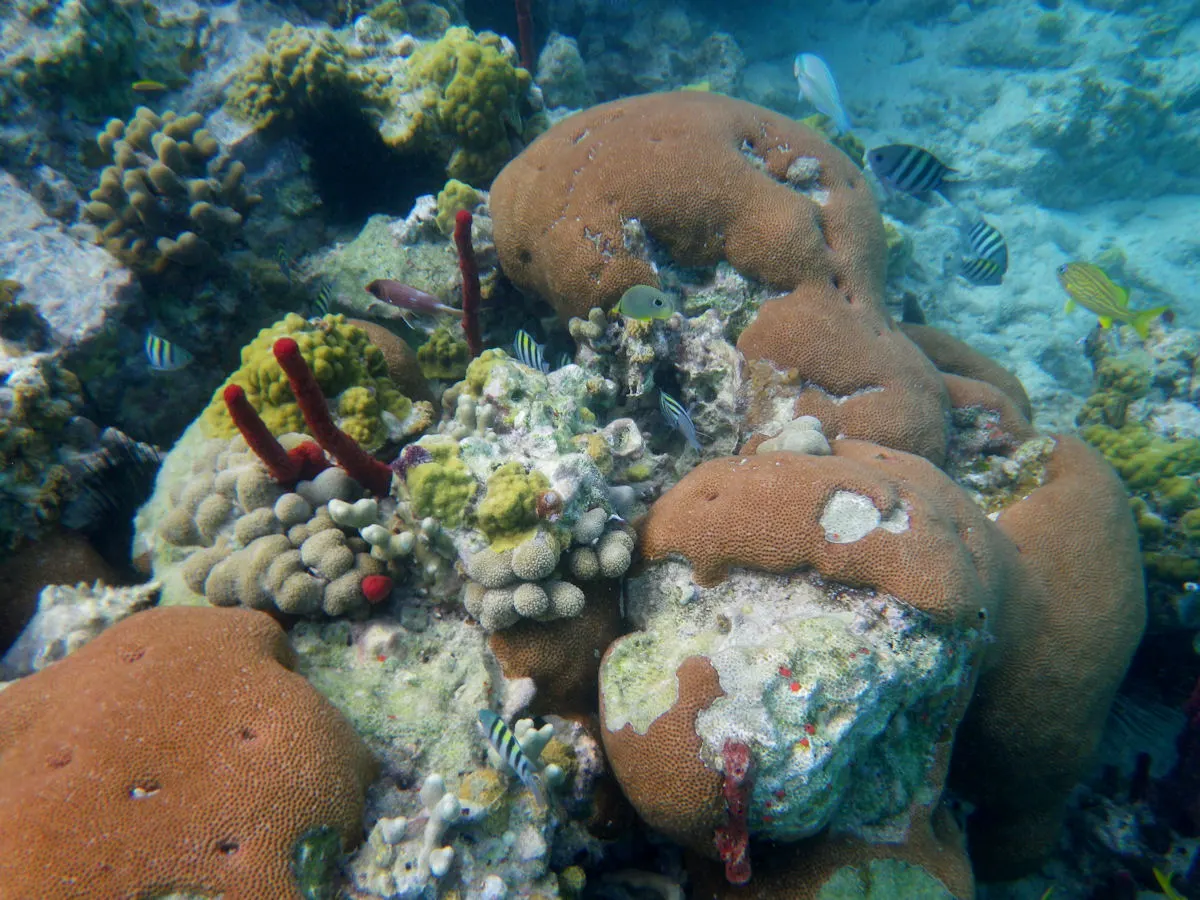
The massive starlet coral (Siderastrea siderea) is a boulder-shaped reef-building coral of the western Atlantic and Caribbean. The IUCN Red List placed it in the Critically Endangered category in 2022 even though it is common today, because warming seas are projected to cut its numbers sharply by 2050.
How to recognise it
Massive starlet coral grows as a low dome or rounded boulder, and old colonies can reportedly reach about 2 meters across. Young ones may spread as a flat crust over the rock. The surface is smooth and finely dimpled, and the colour is usually reddish brown.
Each polyp sits in a cup (a corallite) roughly 5 millimeters wide, ringed by about 50 to 60 thin ridges called septa. That count helps separate it from the lesser starlet coral (Siderastrea radians), which is usually smaller and has 30 to 40 septa in deeper, more angular cups.
Where it lives
It is found across the western Atlantic, including the Caribbean Sea, the northern Gulf of Mexico, southern Florida, the Bahamas and Bermuda. The Red List records it from dozens of countries and territories, from Mexico and Belize through the Lesser Antilles to Venezuela, and from North Carolina south to Brazil. In the eastern Atlantic it has been reported only from São Tomé and Príncipe.
It lives in all kinds of reef settings, chiefly on rocky reef and coral reef, and less often on loose rock or among seagrass. The Red List gives a depth range down to 70 meters, with most colonies between 5 and 15 meters. Another reference puts the limit near 40 meters. It copes well with muddy, silty water, which many reef corals do not.
Pins are Wikidata “endemic to” fields. Orange dots, when present, are GBIF occurrence tiles — survey bias included.
How it lives
The coral is a colony of tiny polyps that grows slowly, reported at roughly 1.5 to 9 millimeters of added diameter per year, and slower in deeper water. Most colonies are under a meter across, though a few reach several meters.
Males and females are separate colonies. They release eggs and sperm into the water once a year, in late summer, rather than brooding young. Colonies are not thought to mature until they exceed about 100 square centimeters. The Red List assessment infers a generation length of 10 years.
It is rated moderately prone to bleaching, the stress response in which a coral loses its algae partners, and it can recover when conditions improve.
Why it is in trouble
The 2022 listing is under criterion A3c. The assessors inferred a past decline of under 20 percent over three generations, but projected that annual severe bleaching will cut the species by at least 80 percent over the next three generations, by 2050. It is the projected loss that places it in the highest-risk tier.
Disease is already causing losses. Stony coral tissue loss disease reduced colony numbers by about 42 percent in parts of southeast Florida from 2014, and by 26 to 58 percent along parts of the Mexican Caribbean coast from 2018 to 2020. The assessment says the disease has not been recorded in other parts of its range.
In a 2021 laboratory study at the University of the Virgin Islands, the species ranked among the three most susceptible of six corals tested, along with Colpophyllia natans and Orbicella annularis, and its lesions spread faster than those of most of the six.
The Red List also cites a Belize study that found a century-long decline in skeletal growth in nearshore colonies of this species, linked mainly to warming and land-based stresses. Coastal development, tourism, shipping and small-scale harvest are listed as minor pressures.
What is being done
The species occurs in at least one protected area. The Red List lists site protection and management, habitat restoration, species recovery, captive breeding or propagation, and a genome resource bank among the actions in place or needed. Atlantic reef corals are not part of the international aquarium trade, according to the assessment, so trade controls are not the main lever. Cutting warming and protecting reefs matter most for a coral this widespread.
Sources
Written for this catalog in our own words from the sources below, checked against them on 12 November 2026. Population figures are estimates and carry the year they were made. Status and assessment year: IUCN. 2026. The IUCN Red List of Threatened Species. Version 2026-1. iucnredlist.org.




