Critically Endangered
Siberian sturgeon
Acipenser baerii
The Siberian sturgeon (Acipenser baerii) is a large, long-lived bottom-feeding fish of the big Siberian rivers, from the Ob to the Lena and Kolyma, plus Lake Baikal. The IUCN Red List rated it Critically Endangered in 2022, with wild numbers falling under dams, harvest and degraded spawning grounds.
How to recognise it
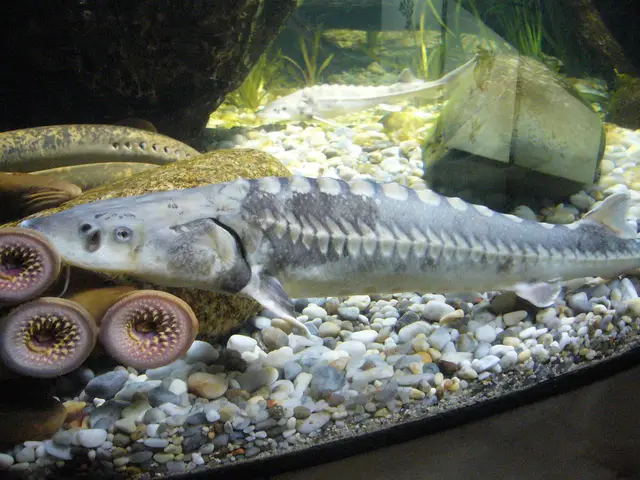
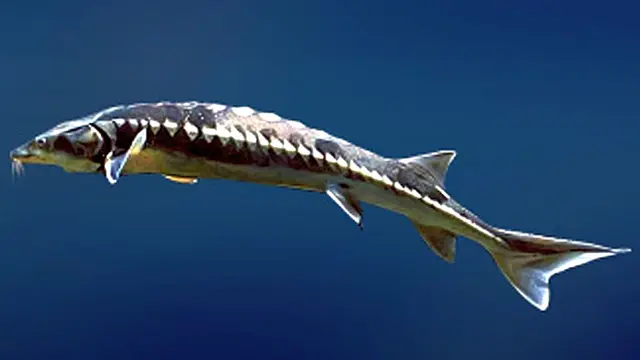
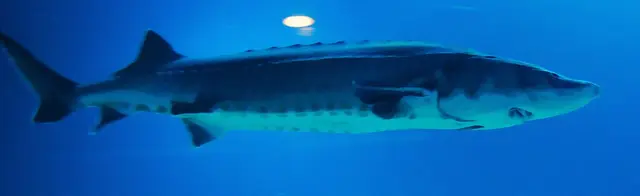
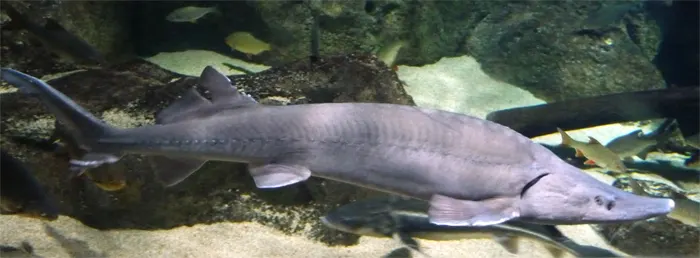
It's a classic sturgeon: an elongated body, a pointed snout, four barbels in front of the mouth and five rows of bony scutes along the body. The back runs from light grey to dark brown and the belly from white to pale yellow.
Size varies a lot between river basins. Typical adults weigh around 65 kg, and the largest recorded weighed 210 kg. FishBase gives a maximum length of about 2 m and a maximum reported age of 63 years.
Where it lives
The species is native to Siberian river systems that drain north into the Kara, Laptev and East Siberian Seas, including the Ob, Irtysh, Yenisei, Lena and Kolyma, and it also occurs in Lake Baikal. The Red List records it as present in Russia and Kazakhstan, possibly present in Mongolia, and extinct in China, where the wild Irtysh population is gone.
It lives mostly in freshwater rivers and large lakes, and the Red List also counts estuaries as suitable habitat.
Pins are Wikidata “endemic to” fields. Orange dots, when present, are GBIF occurrence tiles — survey bias included.
How it lives
It feeds along the bottom on invertebrates such as crustaceans and midge larvae. Maturity comes late. FishBase gives 9 to 29 years for males and 9 to 34 for females, and also a narrower wild range of 9 to 15 for males and 16 to 20 for females. Spawning generally happens every second year.
Spawning takes place in summer in the main channel, in strong current over stone or gravel. The eggs turn sticky and cling to the riverbed, and incubation takes about 16 days at 10 to 15 degrees C.
Why it is in trouble
A fish that matures this slowly can't absorb heavy harvest. FishBase rates its resilience as very low, with a population needing more than 14 years to double. The 2022 Red List assessment records a decreasing trend and an ongoing decline in habitat area, and it lists dams, large-scale harvest and subsistence fishing among the threats.
Dams are a particular problem for a migrating spawner. Up to 40 percent of spawning habitat is reportedly cut off by them, and pollution has reportedly damaged gonad development in some places. The Ob River population is said to make up about 80 percent of the species, so what happens there largely decides the total.
Taxonomists have long split the species into two subspecies, but newer genetic work suggests the populations are connected and the species may be a single unit.
What is being done
The Red List records a recovery plan, a harvest management plan, conservation sites over part of the range, captive populations and awareness programmes. The species is also covered by international trade controls (CITES Appendix II).
Wild catches are falling while farming for caviar and meat grows. Lena River fish are the most common breeding stock, France is the main caviar producer, and Russia and China lead meat production. Escapes happen: a 1.8 kg fish caught in the Mekong in Thailand in October 2023 was believed to have come from a farm in Laos.
Sources
Written for this catalog in our own words from the sources below, checked against them on 12 November 2026. Population figures are estimates and carry the year they were made. Status and assessment year: IUCN. 2026. The IUCN Red List of Threatened Species. Version 2026-1. iucnredlist.org.