Endangered
Shortspine thornyhead
Sebastolobus alascanus
The shortspine thornyhead (Sebastolobus alascanus) is a bright red, big-headed deepwater fish of the North Pacific, found from the Bering Sea and Japan south to Baja California. It grows slowly and may live 80 to 100 years. The IUCN Red List lists it as Endangered, assessed in 2000.
How to recognise it
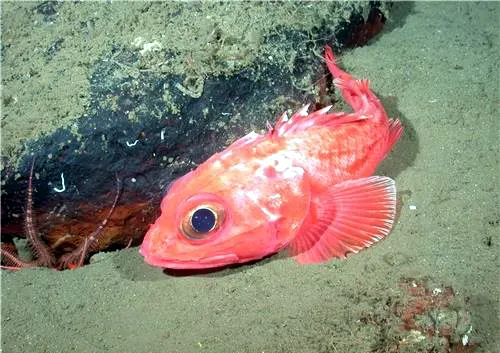
It's a bottom-dwelling relative of the rockfishes with a large head, a strong spiny ridge on the skull and a tapering body. The colour is bright red, with varying amounts of black on the fins. The dorsal fin has 15 to 17 spines and 8 to 9 soft rays, and the pectoral fin has a deep notch. The fin spines carry glandular tissue believed to be venomous.
The oversized head and eyes earned it nicknames such as "idiot fish" and "idiot cod". Other common names include channel rockcod and spinycheek rockfish. The maximum recorded length is 80 cm, and the heaviest published weight is 9 kg.
Where it lives
The range runs across the North Pacific, from the Sea of Okhotsk and Navarin Canyon in the Bering Sea, through the Aleutian Islands, and south along the North American coast to Cedros Island, Baja California. It has also been reported from Japan. The IUCN assessment lists Canada, Russia and the United States.
Depth records run from 17 to 1,600 metres. Different sources give typical depths from under 100 metres to a few hundred. In Alaska it associates with muddy or hard bottoms, sometimes near rocks or gravel, and is most often seen resting in small hollows on the seabed. Adults reportedly live mainly in the low-oxygen zone, and young fish move deeper as they grow.
Pins are Wikidata “endemic to” fields. Orange dots, when present, are GBIF occurrence tiles — survey bias included.
How it lives
It eats shrimp, crabs, zooplankton, amphipods and other animals from the seabed. Unlike most rockfish, which bear live young, thornyheads lay eggs: fertilised eggs are released in floating gelatinous masses.
Growth is slow. Reported ages reach 80 to 100 years, though a 62-year-old is the oldest fish aged by a validated method, and ages from ear bones are hard to read. A 2025 study in Fishery Bulletin sampled females in the Aleutian Islands and Gulf of Alaska in 2014 to 2016. It put the age at which half are mature at 12.8 years, at about 23 cm fork length, with spawning in May and June.
Why it is in trouble
The Endangered listing dates from 2000 and rests on criterion A2d, an observed decline in the population. It is reported to have drawn on an estimated 53 percent fall in biomass between the 1960s and 1998. Slow growth and long life make the fish slow to recover from heavy fishing, and FishBase rates its resilience as very low.
In the Gulf of Alaska most of the catch comes as bycatch in bottom trawl and longline fisheries aimed at sablefish, other rockfish and flatfish. Catch there has stayed below the quota and has been fairly stable.
What is being done
Management differs by region. In the Gulf of Alaska, directed fishing for thornyheads isn't permitted, and the fish may only be kept as incidental catch. NOAA says it isn't subject to overfishing there or in the Bering Sea and Aleutian Islands, but there isn't enough information to say whether those stocks are overfished.
Off the US Pacific coast, a 2023 assessment found the stock not overfished and not subject to overfishing. The IUCN assessment is from 2000, so it reflects the older decline rather than these later management findings.
Sources
Written for this catalog in our own words from the sources below, checked against them on 12 November 2026. Population figures are estimates and carry the year they were made. Status and assessment year: IUCN. 2026. The IUCN Red List of Threatened Species. Version 2026-1. iucnredlist.org.




