Endangered
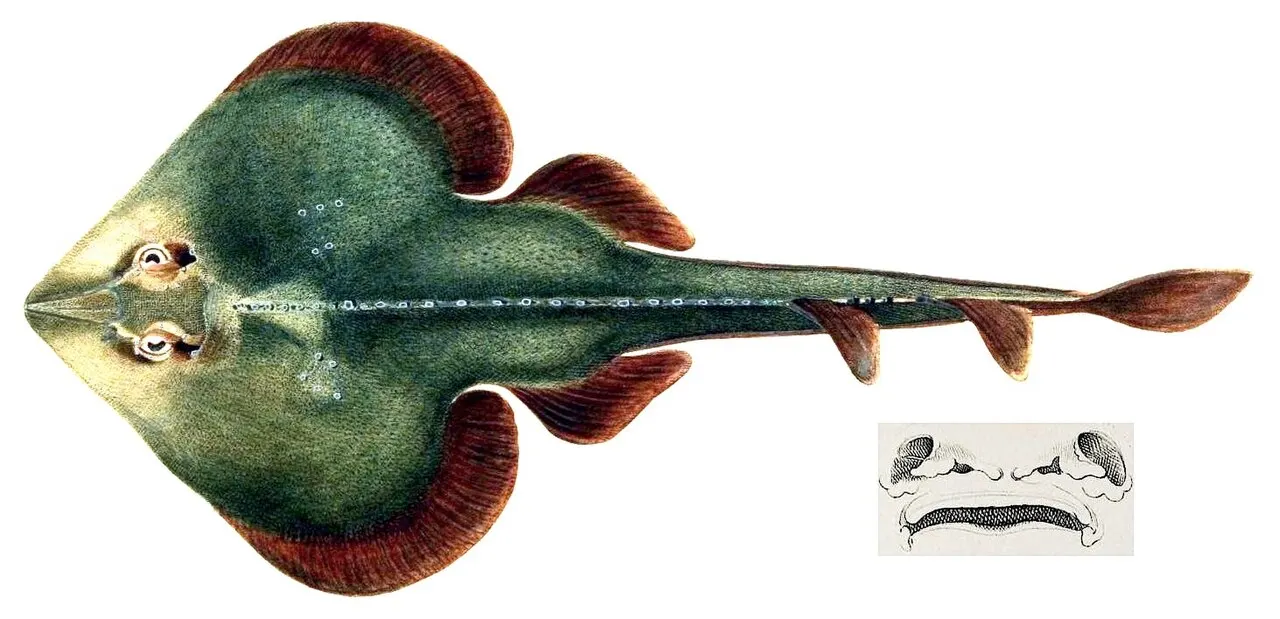
Shortnose guitarfish
Zapteryx brevirostris
The shortnose guitarfish (Zapteryx brevirostris) is a small, bottom-living ray of the south-western Atlantic, found off Brazil, Uruguay and Argentina. The IUCN Red List moved it from Vulnerable to Endangered in 2020 because fishing is cutting its numbers. It breeds slowly, and pregnant females caught as bycatch often abort.
How to recognise it
It's a guitarfish, a ray with a shark-like tail and a broad, heart-shaped body disc, and it has a short, blunt snout. The back is brownish gray to olive. It stays small, and published sizes differ: one source gives average lengths of about 66 cm for females and 63 cm for males, while FishBase lists maximum lengths of roughly 59 cm and 53 cm.
Where it lives
The species lives in the south-western Atlantic, from south-eastern Brazil through Uruguay to north-eastern Argentina. The IUCN lists these three countries. It stays on or near the seabed on sand, sandy mud and mud. The IUCN gives a depth range of about 2 to 140 m, though it is described as mostly an inshore fish, usually shallower than about 50 m.
Pins are Wikidata “endemic to” fields. Orange dots, when present, are GBIF occurrence tiles — survey bias included.
How it lives
It feeds on the sea floor. The diet includes amphipods, bristle worms, lancelets, decapod crustaceans, cumaceans and isopods. Larger fish eat fewer amphipods and more isopods, decapods and worms. Pups are born at roughly 13 to 16 cm.
It breeds slowly. Gestation is estimated at 9 to 12 months, a litter can hold up to eight pups, usually born in autumn, and females mature at around 42 cm and males at about 44 cm. The IUCN puts the generation length at 7 years. A slow-growing animal with few young can't replace fishing losses quickly.
Why it is in trouble
The IUCN names harvest as the threat, both targeted and accidental, in small-scale and large-scale fisheries. Its 2020 assessment suspects a population decline of 50 to 79 percent over three generations (21 years), based on an index of abundance and on levels of exploitation. The decline is recorded as reversible and understood, but the causes have not stopped.
Capture also kills indirectly. Reports from southern Brazil describe pregnant females caught as bycatch aborting their young, and most of those females went on to die. A single capture can therefore cost the next generation as well.
What is being done
The assessment lists harvest management, species recovery, trade management and site protection as conservation actions, at national level. It records no recovery plan, no monitoring scheme and no harvest management plan in place, no ex situ conservation programme, and no international trade controls. Whether the species occurs in any protected area is unknown.
Sources
Written for this catalog in our own words from the sources below, checked against them on 12 November 2026. Population figures are estimates and carry the year they were made. Status and assessment year: IUCN. 2026. The IUCN Red List of Threatened Species. Version 2026-1. iucnredlist.org.




