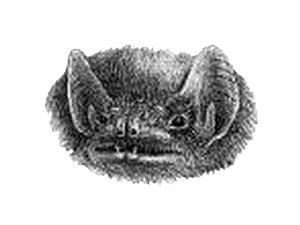
Critically Endangered
Seychelles Sheath-tailed Bat
Coleura seychellensis
The Seychelles sheath-tailed bat (Coleura seychellensis) is a small insect-eating bat found only in the Seychelles' main island group, where it roosts in caves. The IUCN Red List rated it Critically Endangered in 2025, with a population of perhaps 50 to 100 and still falling.
How to recognise it
It's a sac-winged bat (family Emballonuridae) that reportedly weighs roughly 10 to 11 g. Reports from the 1860s describe daytime roosts in sea-facing crevices, often shielded by large palm fronds. Today the bats roost in caves and stay in groups all year.
Where it lives
It occurs only in the Seychelles' main island group. The bat was abundant on Mahé in the early 1960s and on Silhouette in the 1970s. It died out on Praslin in the mid-1970s and on La Digue around 1980, and a 2009 survey found none on either island.
Known roosts are now on Mahé, including Cap Ternay and Anse Major, and on Silhouette, which holds the largest colony. A nationwide census in March 2013 recorded 61 bats, with a maximum of 31 at the Silhouette roost. The IUCN counts four locations, all below 100 m elevation.
Pins are Wikidata “endemic to” fields. Orange dots, when present, are GBIF occurrence tiles — survey bias included.
How it lives
It hunts insects at night and feeds in forest and in marshes. Beetles are favoured prey in the breeding season. On Silhouette, managing feeding areas to raise beetle numbers was followed by a highly successful breeding season in 2007 to 2008.
Why it is in trouble
Coconut plantations replaced native vegetation and the insects it supports, and the IUCN still lists coconut and a tropical kudzu (Pueraria phaseoloides) as ongoing threats because they alter habitat around the roosts. The Red List also names barn owls and cats as predators, and human disturbance and pesticides add to the pressure. Many causes of the original collapse were never proven.
Because the bats gather in a few caves, disturbance at a single roost can affect a large share of the population.
What is being done
Government monitoring began in 1996. From 1997 to 2010 the Nature Protection Trust of Seychelles managed the Silhouette colony. Habitat work around the roosts, including keeping invasive plants back, helped lift the count from 18 bats to a peak of 40 in 2009, and in early 2010 twelve bats left to start a new colony. That work was halted in 2010. A research programme funded for 2009 and 2010 also ended when its money ran out, and by 2012 the environment ministry was handling regular monitoring.
The Red List now records a recovery plan, a monitoring scheme, invasive species control, and protected areas covering part of the range. A 2012 report described legal protection for roosting and feeding sites on Mahé, while a 2020 blog said the species itself has no legal protection in the Seychelles.
Sources
Written for this catalog in our own words from the sources below, checked against them on 12 November 2026. Population figures are estimates and carry the year they were made. Status and assessment year: IUCN. 2026. The IUCN Red List of Threatened Species. Version 2026-1. iucnredlist.org.




