Endangered
Seychelle Islands Tree Frog
Tachycnemis seychellensis
The Seychelles treefrog (Tachycnemis seychellensis) is a tree-dwelling frog found only in the granitic islands of Seychelles, in the western Indian Ocean. It is the sole member of its genus. The IUCN Red List moved it up to Endangered in 2025, after earlier listing it as Least Concern.
How to recognise it
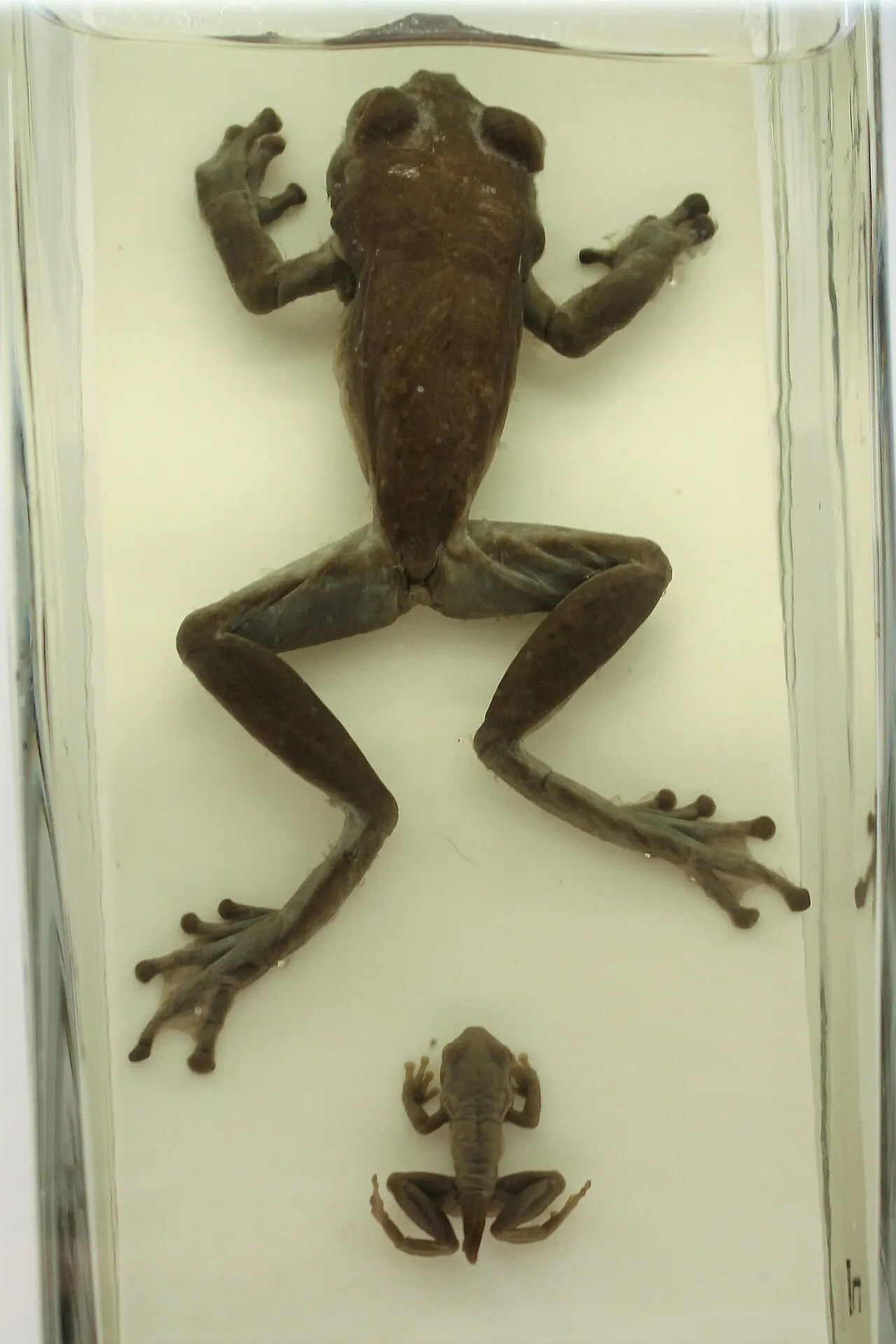
This is a large tree frog, and females are bigger than males. The sexes also differ in colour: males are usually red-brown and females green. It is nocturnal. By day it rests on leaves, where it turns pale and waxy in appearance.
Where it lives
The frog is endemic to Seychelles and belongs to the family Hyperoliidae. Duméril and Bibron's 1841 description is the one cited for the name, and early names placed it in the genus Eucnemis. No other species is placed in its present genus. It lives on the granitic islands, the remnant of a continental fragment that was once associated with India and Madagascar. Nature Seychelles names Mahé, Praslin, Silhouette and La Digue as the islands it occupies.
It occurs from coastal plateaus up to higher ground, with the IUCN giving an elevation range from sea level to 700 m. It is perhaps most common in mid-altitude forest. Its habitats include moist lowland forest, rivers, swamps and freshwater marshes (including ones that dry out seasonally), plantations, rural gardens and heavily degraded former forest. It does particularly well in old plantations.
Pins are Wikidata “endemic to” fields. Orange dots, when present, are GBIF occurrence tiles — survey bias included.
How it lives
Males call from vegetation and rocks beside pools and streams, and calling peaks around December, the main breeding season. Eggs are laid on vegetation above the water. When they hatch, the tadpoles drop into the water and develop there until they become frogs. Breeding has been recorded in marshes and pools, and possibly in streams, both slow and fast. The IUCN lists the frog as not a migrant.
Why it is in trouble
For years the species looked secure. Red List assessments rated it Rare in 1988, 1990 and 1994, Vulnerable in 1996, and Least Concern in 2004 and 2013. The 2025 assessment moved it to Endangered under criterion B1ab(iii), which reflects a small range treated as a single location and a continuing decline in habitat quality. Its population trend is listed as decreasing.
The threats the IUCN records are habitat change, drought, storms and flooding, pesticides and herbicides, housing, tourism developments, sewage, and the taking of surface water for household and farm use. Other species are also listed as a threat. The recorded stresses include deaths of animals as well as habitat damage.
What is being done
The conservation actions recorded are site and area management, and control of invasive or otherwise problem species. The frog occurs inside at least one protected area.
Sources
Written for this catalog in our own words from the sources below, checked against them on 12 November 2026. Population figures are estimates and carry the year they were made. Status and assessment year: IUCN. 2026. The IUCN Red List of Threatened Species. Version 2026-1. iucnredlist.org.




