Critically Endangered
Sentani rainbowfish
Chilatherina sentaniensis
The Sentani rainbowfish (Chilatherina sentaniensis) is a small, deep-bodied fish known only from Lake Sentani near Jayapura, in Indonesian Papua, and the streams that feed it. The IUCN Red List rated it Critically Endangered in 2020. Males are bright and reddish, and a small captive population exists.
How to recognise it
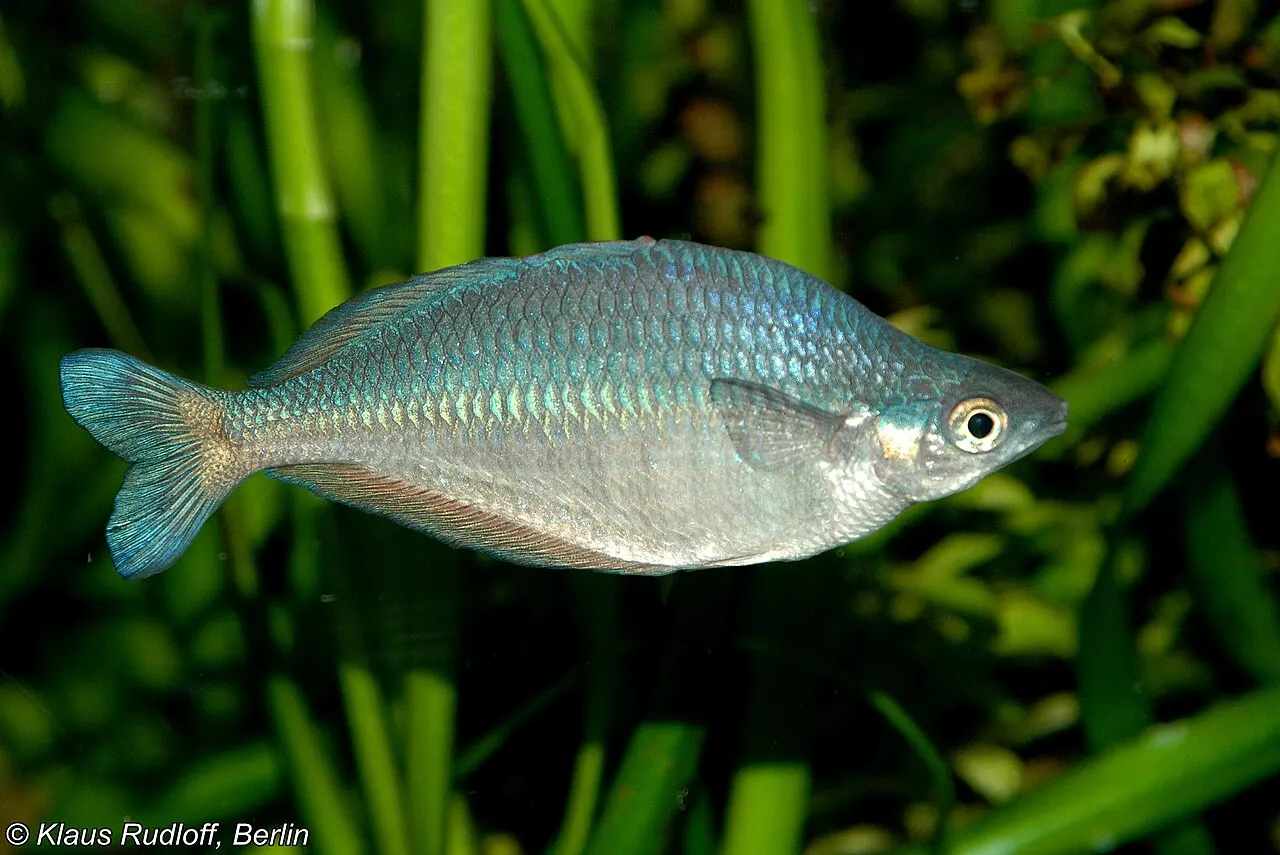
This is a rainbowfish with a tall, flattened body that gets deeper with age, especially in males. The back is silvery blue or greenish, fading to silvery orange along the sides, with a diffuse blue or green stripe down the middle. Males carry six to eight reddish brown bars on the lower flanks.
Males are brighter and bigger than females. They can reach about 12 cm, while females are usually under 10 cm. Aquarists who bred the fish in 2011 described adults as bright red over most of the body, with a hint of pink and bold black fin edges.
It is often confused with a close relative, Chilatherina fasciata, which is more thickset. Fish imported in the 1990s were frequently mistaken for that species, so older aquarium records need care.
Where it lives
Lake Sentani lies about 10 km west of Jayapura, at roughly 75 m above sea level. It has three main sections, with recorded depths from 7 to 52 m. The rainbowfish gathers around the margins, near submerged plants and fallen branches. Later expeditions found it more often in the inflowing streams than in open water.
The IUCN counts a single location for the species and puts its extent of occurrence at about 90 square kilometres. Part of that range lies inside a protected area.
Pins are Wikidata “endemic to” fields. Orange dots, when present, are GBIF occurrence tiles — survey bias included.
How it lives
It is a peaceful, daytime fish that stays in small groups. In the wild it eats small crustaceans, insect larvae, algae and detritus. Eggs are scattered over fine-leaved plants, and in tanks they hatch in roughly a week to ten days.
In a 2011 captive spawning, 70 to 80 fry hatched, and the largest reached 4 to 5 cm in four months.
Why it is in trouble
The IUCN lists sewage, mining and quarrying, and competition from other species among the threats, with ecosystem degradation and species mortality as the stresses. The species has reportedly disappeared from the open lake itself, with pollution and introduced species blamed.
The 2020 assessment records a continuing decline in the area of habitat while giving the population trend as stable.
What is being done
Part of the range lies inside a protected area, and the IUCN lists population trend monitoring as a research need. Aquarium hobbyists keep and breed the fish, and a small captive population is maintained, which gives a limited safety net.
Sources
Written for this catalog in our own words from the sources below, checked against them on 12 November 2026. Population figures are estimates and carry the year they were made. Status and assessment year: IUCN. 2026. The IUCN Red List of Threatened Species. Version 2026-1. iucnredlist.org.




