Critically Endangered
Semper's Warbler
Leucopeza semperi
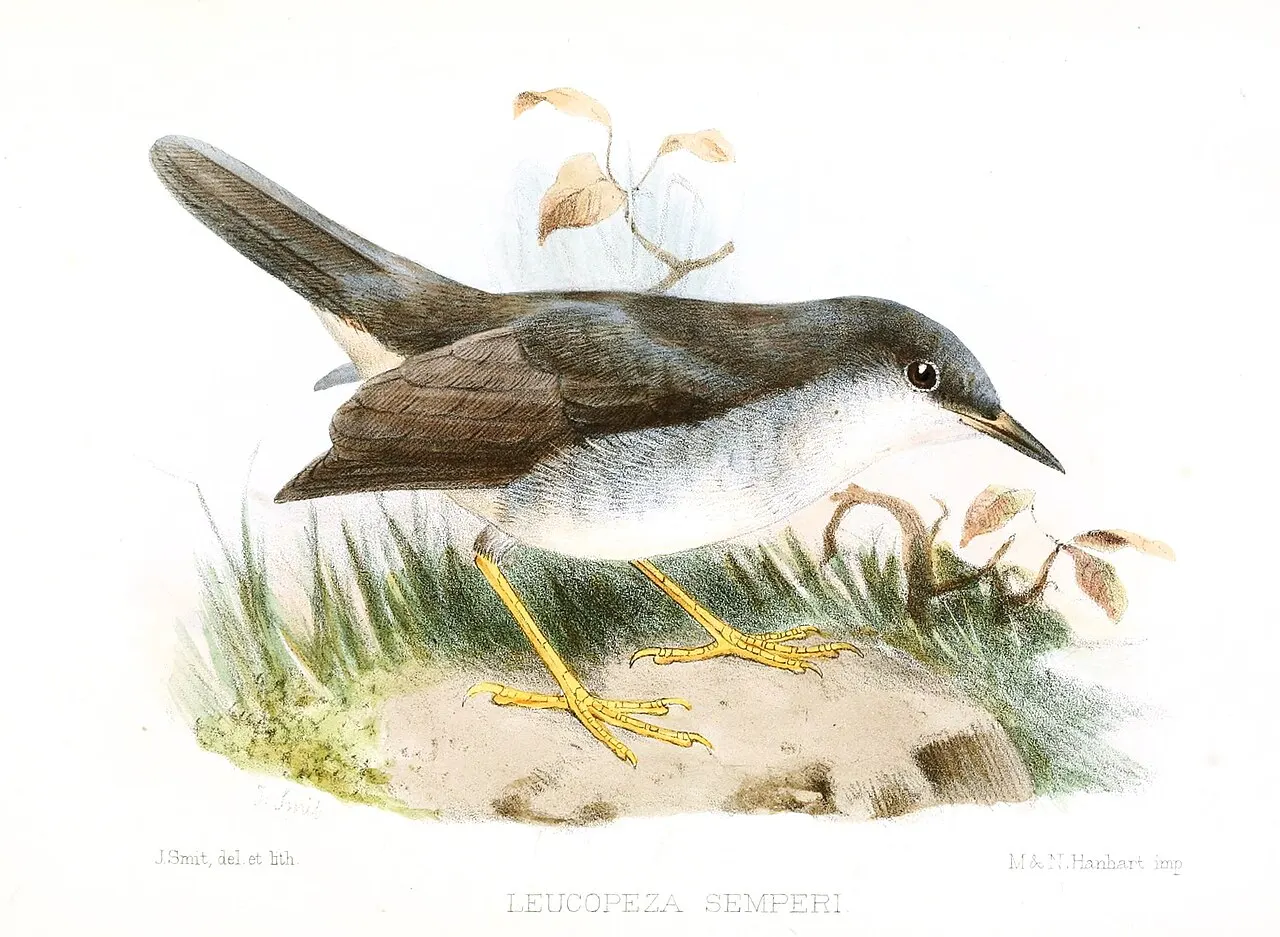
Semper's warbler (Leucopeza semperi), known locally as the pied-blanc, is a long-legged songbird from the rainforests of Saint Lucia in the Lesser Antilles. The IUCN Red List assessed it as Critically Endangered in 2020, estimating at most 49 mature birds. No sighting has been confirmed since 1961, so it may already be gone.
How to recognise it
It is a big, rather dull warbler, about 14.5 cm long, dark grey above and whitish below, with long pale legs. Young birds are browner above and buffier underneath. The bill is long, pointed and dark, and the tail and wings are brown.
Almost nothing is known of its voice. The song has never been described. The known call is a scolding series of notes written as tuck-tick-tick-tuck, and it chatters when alarmed. It is the only species in its genus, Leucopeza, and the name honours John Semper, a clergyman and amateur ornithologist on the island who sent the first specimen to the zoologist Philip Sclater, who described the species in 1876.
Where it lives
It is found only on Saint Lucia. Most records come from the Barre de l'Isle ridge, between Piton Flore and Piton Canaries, and the species is tied to undisturbed undergrowth in lower montane rainforest and elfin woodland. The IUCN lists moist lowland and montane forest, with an upper elevation limit of 900 m.
It forages mainly in the understory, usually close to the ground, and may nest on or near it. Beyond that, its breeding and diet have never been properly studied.
Pins are Wikidata “endemic to” fields. Orange dots, when present, are GBIF occurrence tiles — survey bias included.
A long silence
The bird was reportedly common locally in the 19th century, but few reports exist from the 20th. The last specimen was collected on the summit of Piton Flores in 1934, and there was a sighting in 1947. The last confirmed sighting was in 1961.
Unverified reports followed in 1965, 1989, 1995 and 2003. At a 2003 ornithology meeting a forester described a bird he had seen a few years earlier on one of the Pitons, and later searches found nothing. A possible sighting in the early 1990s led to several trips in the mid-1990s by a birder and forestry guides, again without success. Reports continued into 2014 and 2015, with no major search following. Some catalogues give other dates for the last record.
In April 2016, specialists from the RSPB worked with Saint Lucia's Forestry Department to plan a proper search. They estimated it would take about 84 days to cover ten priority areas of the island's most natural rainforest. No Semper's warblers were detected during the fieldwork that year.
Why it is in trouble
Mongooses were introduced to Saint Lucia in 1884 to control the fer-de-lance snake. They are a likely cause of the bird's decline, particularly if it nests on the ground, and the Red List scores the threat as medium impact with rapid declines. Rats and cats also roam freely and have caused some other native species to disappear from the island.
The Red List also cites habitat loss, including agro-industry farming. The assessment says all the birds belong to a single subpopulation, if any remain, and that the population is below 50 mature individuals. The trend is unknown.
What is being done
The IUCN records that the bird's whole range is covered by identified conservation sites and that it occurs in at least one protected area. No recovery plan or monitoring scheme is recorded in 2020, and no birds are in captivity. After the 2016 workshop, the Forestry Department said it was highly confident the bird may persist in remote parts of the rainforest.
Sources
Written for this catalog in our own words from the sources below, checked against them on 12 November 2026. Population figures are estimates and carry the year they were made. Status and assessment year: IUCN. 2026. The IUCN Red List of Threatened Species. Version 2026-1. iucnredlist.org.




