Endangered
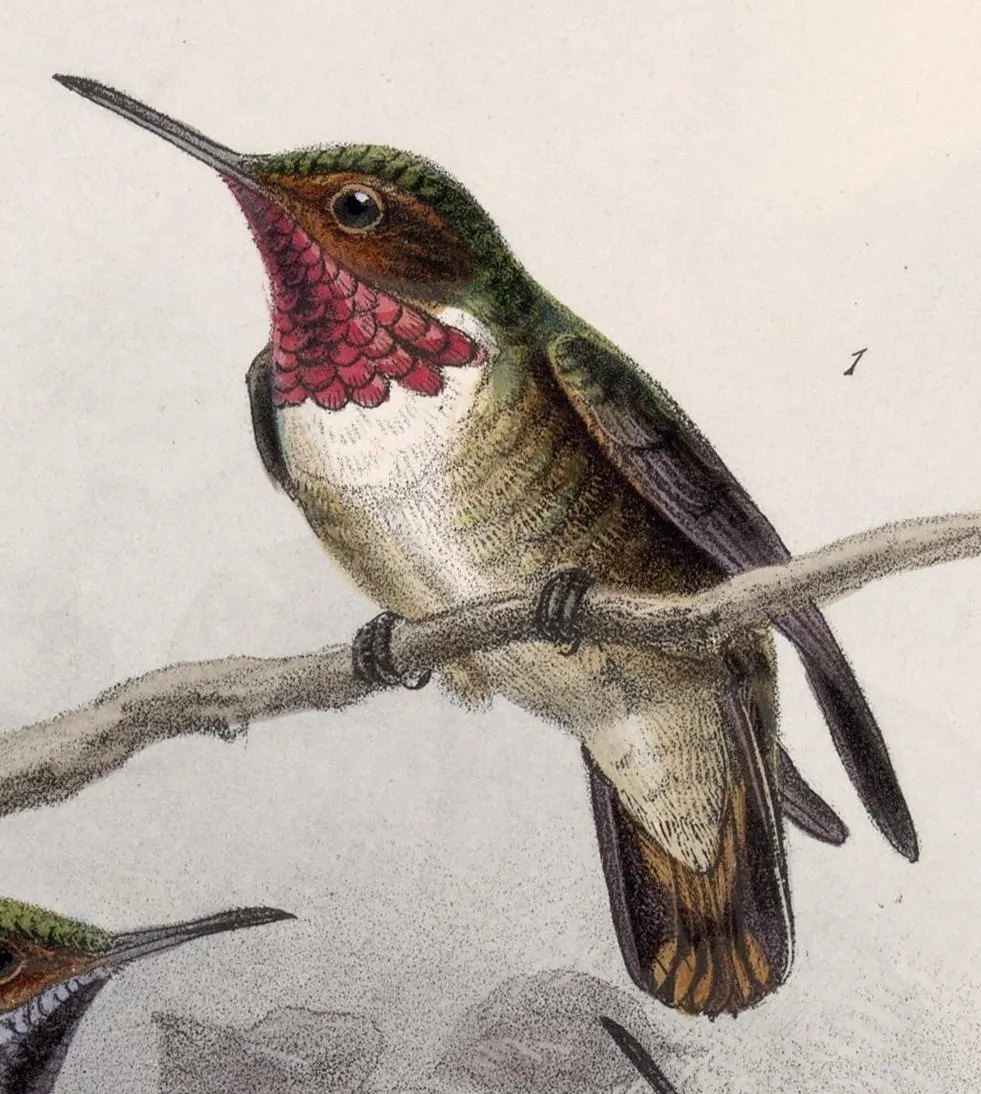
Glow-throated hummingbird
Selasphorus ardens
The glow-throated hummingbird (Selasphorus ardens) is a 7 cm hummingbird found only in the mountains of western Panama. The IUCN Red List assessed it as Endangered in 2020, with an estimated 2,000 to 12,000 mature birds and a falling trend. Males carry a pinkish-red throat patch, the gorget.
How to recognise it
It's tiny, about 7 cm long, with a short, straight black bill. The male has bronzy green upperparts, a black tail edged in rufous, and a pinkish-red gorget with a white patch below it. The belly is white in the centre and buff to cinnamon on the sides.
The female lacks the gorget. Her throat is pale buff speckled with grey, and her outer tail feathers are rufous at the base with a black band and buff tips. Young birds look like females, with rusty fringes on the crown and nape.
Where it lives
Osbert Salvin described the species in 1870. It is endemic to Panama and has a very small range in the western and central highlands, in Chiriquí and Veraguas provinces. It was once recorded more widely in the Serranía de Tabasará, but since the early 20th century records have come mostly from Cerro Colorado, Cerro Flores, Cerro Tute and the Santa Fé district.
The IUCN assessment lists it from about 1,000 to 2,520 m and names moist montane forest, high-altitude shrubland and moist lowland forest as habitat. Another account gives a lower band of roughly 750 to 1,800 m and describes it at forest edges and clearings. The IUCN records it as not migratory.
A 2019 survey in Ornitología Neotropical, led by Daniel Buitrago-Rosas, found a possible second area. Researchers surveying Cerro Hoya National Park on the Azuero Peninsula collected a small series of Selasphorus hummingbirds, three males and a female, and named them as probably this species. The peninsula lies apart from the western and central highlands, so these birds may be isolated, and the identification is still labelled as tentative.
Pins are Wikidata “endemic to” fields. Orange dots, when present, are GBIF occurrence tiles — survey bias included.
How it lives
Very little has been recorded. Its diet has reportedly never been documented, and it is assumed to feed like its close relative the scintillant hummingbird, on flower nectar and small insects. Breeding timing is unknown, and as of 2022 it was reported that the main public sound archives held no recordings of its voice.
Why it is in trouble
The IUCN estimates 2,000 to 12,000 mature birds, all in a single subpopulation, and says the number is decreasing. The Red List first called the species Threatened in 1988, Vulnerable from 1994 to 2012, and Endangered from 2013. The current rating rests on criterion C2a(ii), which covers small populations that are shrinking.
The assessment lists small-holder farming, large-scale farming, small-holder grazing, more frequent fires, and herbicides and pesticides as ongoing threats. Forest keeps being cleared for crops and pasture both inside and outside Santa Fé National Park. Climate change is a future worry. The bird lives near the tops of fairly low mountains, so warming could squeeze its range further.
What is being done
It occurs in at least one protected area, Santa Fé National Park, and the assessment records site protection as the only conservation action in place. There is no recovery plan and no systematic monitoring scheme. The species is listed in CITES Appendix II, which regulates international trade.
Sources
Written for this catalog in our own words from the sources below, checked against them on 12 November 2026. Population figures are estimates and carry the year they were made. Status and assessment year: IUCN. 2026. The IUCN Red List of Threatened Species. Version 2026-1. iucnredlist.org.




