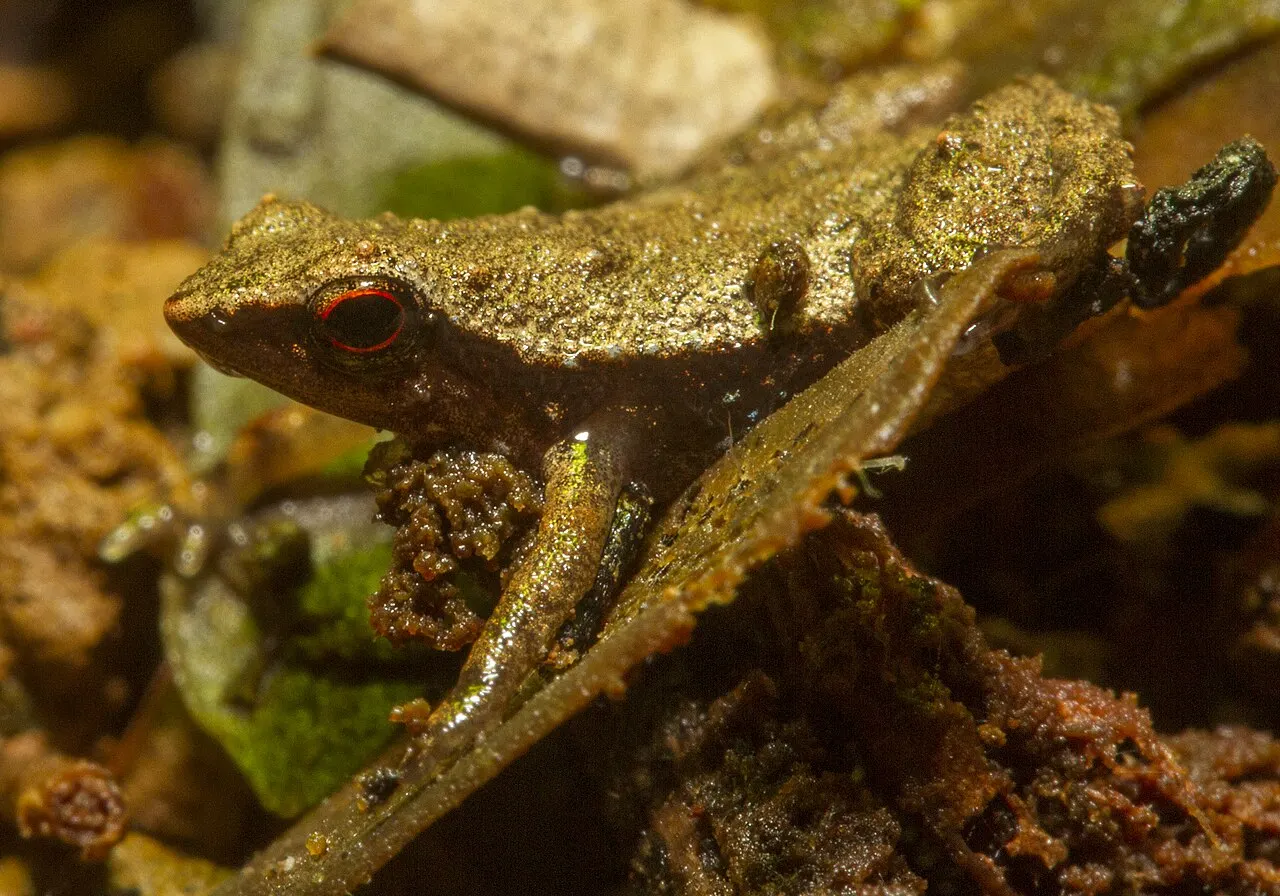
Endangered
Gardiner's Seychelles frog
Sechellophryne gardineri
Gardiner's Seychelles frog (Sechellophryne gardineri) is one of the smallest frogs on Earth, barely a centimetre long. It lives only in the forests of Mahé and Silhouette in the Seychelles. The IUCN Red List lists it as Endangered (assessed 2025), with a decreasing population.
How to recognise it
This is a brown frog with a dark stripe running from the mouth back toward the legs. Adults top out at about 11 mm, and males are smaller still, around 8 mm. Newly hatched froglets measure roughly 3 mm.
It lives under leaf litter, and the male's call comes from beneath the debris, not from an open perch.
Where it lives
The species is found only in the Seychelles, on the islands of Mahé and Silhouette. The 2025 Red List assessment records it over an estimated extent of about 107 square kilometres, with an area of occupancy of around 24 square kilometres, and treats it as a single location for assessment purposes. An earlier assessment counted three locations holding five subpopulations.
It uses moist forest from the lowlands up into the hills, and it also turns up in rural gardens and in badly degraded former forest. Elevation limits differ between sources: the 2025 assessment lists 49 to 848 m, while another account gives 150 to 991 m. Either way, it has a wider altitude spread than any other Seychelles frog. It also tolerates forest dominated by introduced trees such as cinnamon.
Pins are Wikidata “endemic to” fields. Orange dots, when present, are GBIF occurrence tiles — survey bias included.
How it lives
Gardiner's frog lives on the ground in forest litter and on low plants, sheltering in leaf axils. It hunts at night for tiny invertebrates. Mites, fungus gnat larvae, ants and amphipods have all been recorded in its diet.
Breeding happens on land and goes on through the year. A female lays a small clump of large eggs on moist ground, reportedly 8 to 16 of them. There is no tadpole stage. The eggs hatch straight into miniature frogs.
It also hears in an unusual way. It has no middle ear cavity, and research found it uses its mouth cavity to amplify sound toward the inner ear.
Why it is in trouble
The 2025 assessment lists ongoing habitat shifting and alteration across the whole range, along with more frequent or intense fires, housing, surface water being drawn off for homes and farms, droughts, and storms and flooding.
Earlier accounts describe the frog as common at many sites, with more than 2,000 animals per site in some places. Even so, the population is judged to be shrinking across a very small range. Climate change and invasive species are leading worries, and clearance for farming, timber and settlement adds pressure.
What is being done
Part of the range lies inside Morne Seychellois National Park on Mahé, and there is also a conservation project site on Silhouette. The assessment lists control of invasive and problem species as a conservation action. Captive colonies exist, but the frog has not been bred in captivity.
A project led by James Mougal ran from 2014 to 2017 on Mahé, Praslin and Silhouette to improve knowledge of where Seychelles frogs live and how many there are, and to develop a monitoring method. Genetic work has reportedly found the Mahé and Silhouette populations distinct enough that they might be separate species, so each has been proposed as its own conservation unit.
Sources
Written for this catalog in our own words from the sources below, checked against them on 12 November 2026. Population figures are estimates and carry the year they were made. Status and assessment year: IUCN. 2026. The IUCN Red List of Threatened Species. Version 2026-1. iucnredlist.org.




