Critically Endangered
Scutiger spinosus
Scutiger spinosus
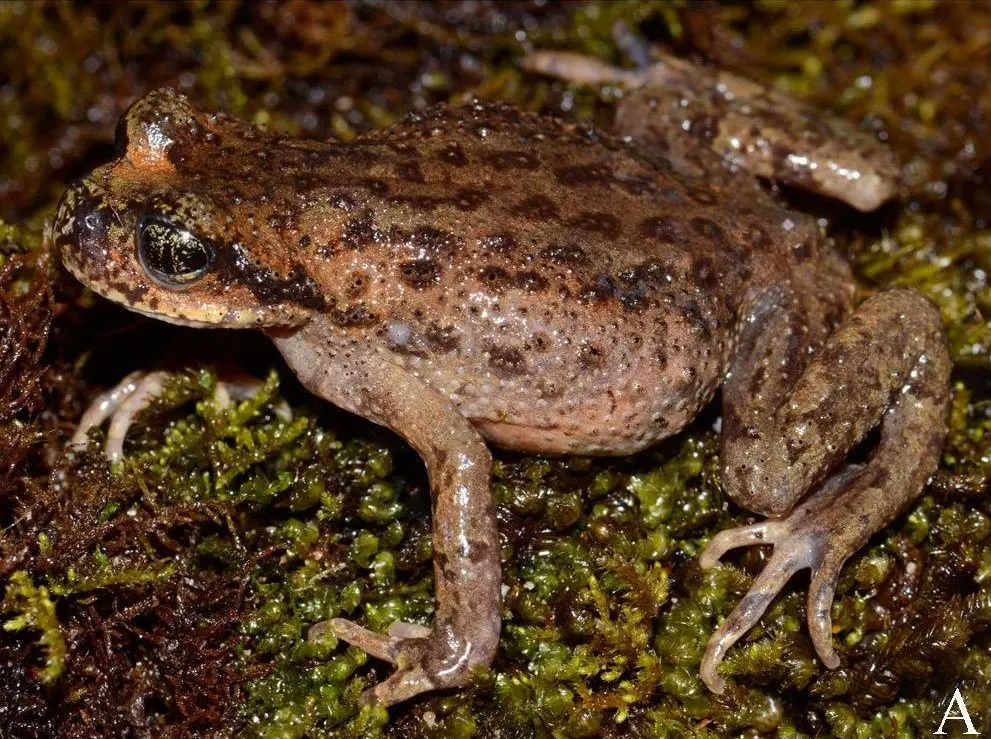
The spiny lazy toad is a medium-sized mountain toad from the forests of southeastern Tibet, with possible records from India and Bhutan. It was named only in 2016. The IUCN rated it Critically Endangered in 2022 because its known range is about 10 square kilometres, treated as a single location, and its habitat is declining.
How to recognise it
Males measure roughly 51 to 56 mm from snout to vent and females 54 to 57 mm. The back is dark brownish gray and extremely rough, covered in large conical bumps that carry black spines, and a light brown triangle marks the top of the head. The belly is an even light yellow.
The Latin species name spinosus means spiny. Spines on the back are denser in males than in females. Breeding males also have black nuptial spines on their first two fingers and the inner side of the third, no vocal sac, and forearms about one and a half times as stout as a female's. These features had faded by mid-July.
Where it lives
The toad was described from a site called 62K near Medog in southeastern Tibet, at about 2,705 m. Before 2016 animals from Medog were identified as a related toad, Scutiger nyingchiensis, but DNA and body shape showed they were a separate species. Fieldwork between 2011 and 2013 produced 16 specimens, 12 males and 4 females.
The IUCN confirms it only in Tibet. It lists India and Bhutan as uncertain, noting one Bhutan specimen with no exact locality and Indian reports from the Sela Pass area that the describing team thinks belong to this toad. Some accounts also list Tawang district in Arunachal Pradesh, reaching about 4,170 m, but the IUCN could not confirm the elevation range. The toad shares its mixed mountain forest with a Medog frog, a second Scutiger toad and another small frog.
Pins are Wikidata “endemic to” fields. Orange dots, when present, are GBIF occurrence tiles — survey bias included.
How it lives
In early to late June, pairs were found under logs by day. At night they turned up in slow-flowing brownish streams and in small to medium permanent ponds with slightly acidic water. Females attach doughnut-shaped egg masses to the undersides of logs and rocks.
The tadpoles take more than a year to become juvenile toads, so they must overwinter in the water. That ties the species to permanent pools, which a road or a drained stream could remove.
Why it is in trouble
The IUCN names roads as the threat, along with the shrinking extent and quality of the forest habitat, and infers a decreasing population. It describes the toad as locally abundant, but the scope and severity of the threat are unknown. During the 2011 to 2013 fieldwork, several breeding pools were destroyed entirely and heavy deforestation was seen along the roads.
The describing scientists urged protection of the type locality and further study of the toad's ecology and numbers. The IUCN records the species in the Yarlung Zangbo Grand Canyon National Nature Reserve and calls for stronger management there and wider habitat protection. No population count exists.
Sources
Written for this catalog in our own words from the sources below, checked against them on 12 November 2026. Population figures are estimates and carry the year they were made. Status and assessment year: IUCN. 2026. The IUCN Red List of Threatened Species. Version 2026-1. iucnredlist.org.




