Endangered
Melliss's Scorpionfish
Scorpaena mellissii
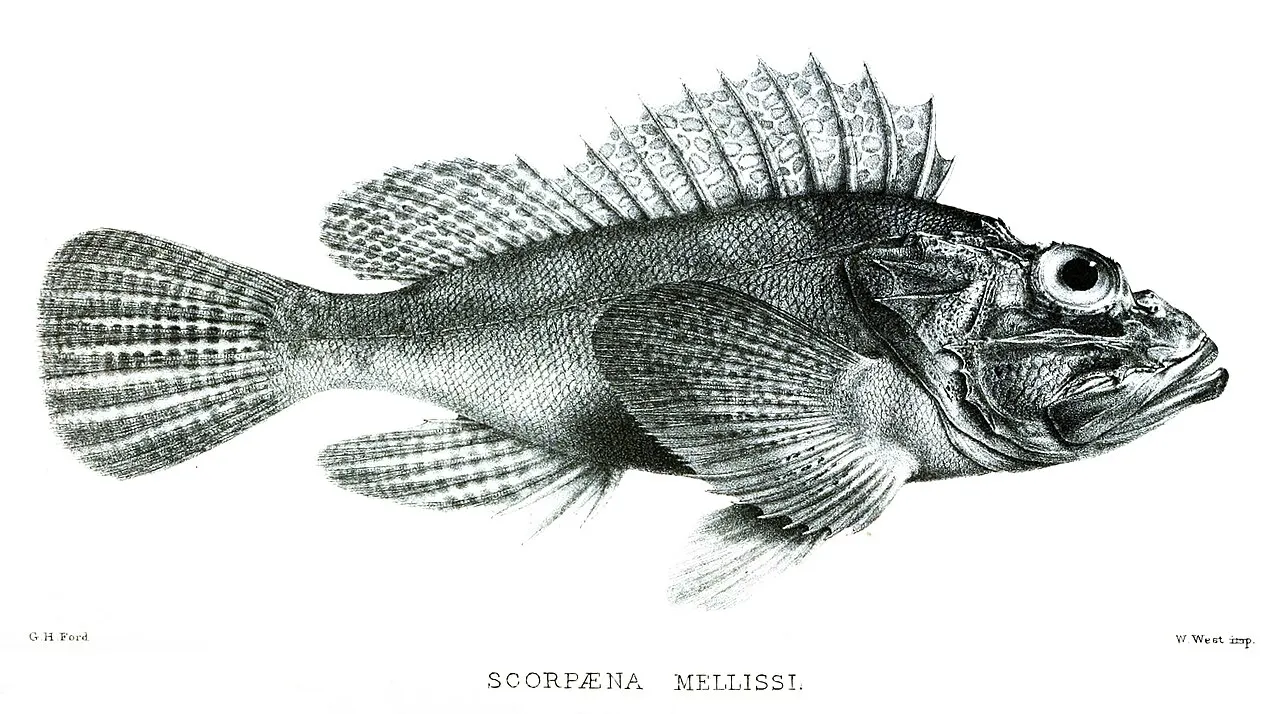
Melliss's scorpionfish is a small, mottled, venomous reef fish known only from Saint Helena, the remote volcanic island in the South Atlantic. It lives on rocky bottoms at depths of roughly 10 to 110 m. The IUCN Red List assessed it as Endangered in 2015, mainly because its whole range is so small.
How to recognise it
Divers describe it as mottled, anywhere from light brown to deep red, with paler spots along the flanks. Dive guides give its length as 20 to 25 cm, and FishBase gives a maximum of 28.5 cm standard length. The dorsal spines are reportedly venomous and can cause very painful stings, so it's a fish to look at, not to handle.
The zoologist Albert Günther described the species in 1868 from Saint Helena. The single original specimen, the holotype, is held at the Natural History Museum in London. The species name honours John Charles Melliss (1835 to 1911), an amateur naturalist.
Where it lives
It's known only from Saint Helena. A checklist of the region's shallow-water marine fishes lists it among 33 endemics, though that count also takes in Ascension and Tristan da Cunha.
It lives on rock, among weed and in crevices. Dive guides say it's mostly found in the nooks and crannies of shallow water, which makes night dives the best time to see one. The IUCN assessment gives a depth range of 10 to 110 m, an estimated area of occupancy of 490 square kilometres, and between two and five locations. Its habitat is classed as subtidal loose rock, pebble and gravel.
Pins are Wikidata “endemic to” fields. Orange dots, when present, are GBIF occurrence tiles — survey bias included.
Why it is in trouble
The Endangered rating (criterion B2ab(iii)) rests on the tiny range and on a decline in habitat quality, which is what that criterion measures. The assessment lists large-scale harvest and tourism and recreation areas as the threats. The population trend is recorded as unknown, and no population size has been published, so the species is rated on risk rather than on a measured decline.
What is being done
The assessment records no conservation actions in place for the species. Its fate is tied to the condition of the shallow rocky reefs around Saint Helena, and nothing found describes a fishery that targets it.
Sources
Written for this catalog in our own words from the sources below, checked against them on 12 November 2026. Population figures are estimates and carry the year they were made. Status and assessment year: IUCN. 2026. The IUCN Red List of Threatened Species. Version 2026-1. iucnredlist.org.




