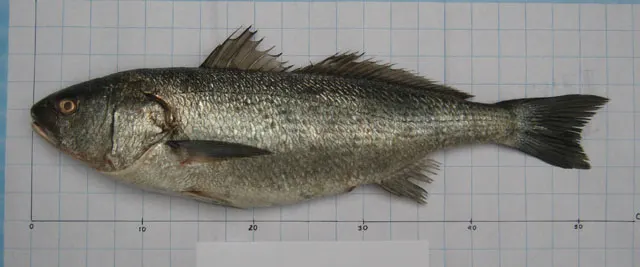
Critically Endangered
Callao drum
Sciaena callaensis
The Callao drum (Sciaena callaensis) is a croaker known only from the coast of Peru, first described from Callao Bay in 1946. The IUCN Red List rated it Critically Endangered in 2020 and flags it as possibly extinct. Almost nothing has been published about its life, and its last known record is old.
What it is
It belongs to the Sciaenidae, the drums and croakers, a family of mostly coastal fishes, and is a marine ray-finned fish of the eastern Pacific. Samuel Hildebrand described it in 1946 in his catalog of the shore fishes of Peru, using a holotype held at the US National Museum (USNM 36934) and one paratype split from the same lot. Fish catalogs still treat it as a valid species, citing Chirichigno and Velez (1998) and Parenti (2020).
Where it lives
The type locality is Callao Bay, on the central Peruvian coast, and the Red List treats the species as native to Peru only. It counts a single location. The only habitat listed is coastal brackish or saline lagoons, though one fish catalog lists it simply as brackish and marine.
Details such as its size, diet and breeding are not recorded in the sources available, so none are given here.
Pins are Wikidata “endemic to” fields. Orange dots, when present, are GBIF occurrence tiles — survey bias included.
Why it is in trouble
The 2020 assessment records a continuing decline in its area of occupancy and an unknown population trend. Listed threats are sewage and two other kinds of pollution, each scored as low impact. The assessment rests on the species' tiny known range rather than on counts of fish.
One extinction database gives its last record as 1966. That is a single secondary source, but it fits the Red List's possibly extinct flag.
What is being done
The assessment records no conservation actions in place. It marks research needs: population trends, habitat trends, life history, threats and what could be done about them. Fresh surveys around Callao Bay would be the first step in learning whether the fish survives.
Sources
Written for this catalog in our own words from the sources below, checked against them on 12 November 2026. Population figures are estimates and carry the year they were made. Status and assessment year: IUCN. 2026. The IUCN Red List of Threatened Species. Version 2026-1. iucnredlist.org.




