Endangered
Schismatogobius insignus
Schismatogobius insignus
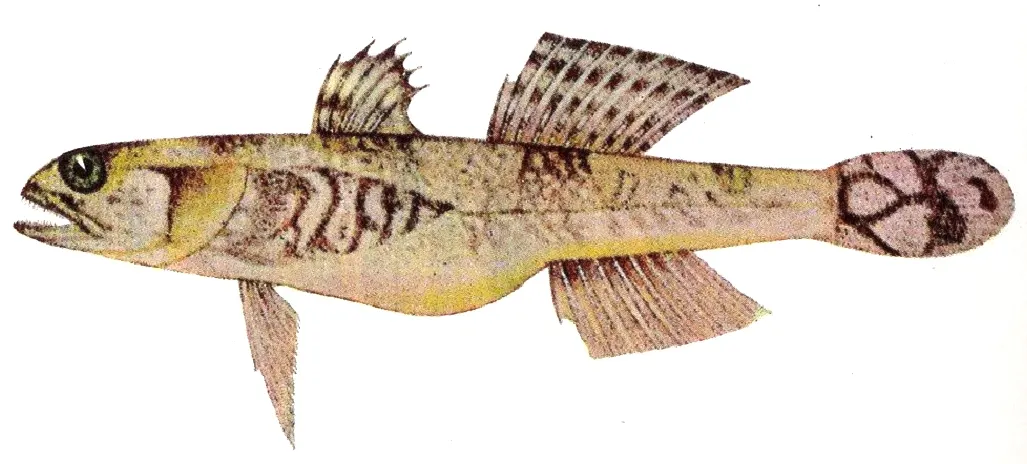
Schismatogobius insignus is a tiny goby of the Philippines and Indonesia, reaching only about 4.4 cm. The IUCN Red List rated it Endangered in 2021. Its pale, banded and speckled body blends into sand and gravel in streams, river mouths and shallow bays.
How to recognise it
This is a very small fish, no longer than 4.4 cm. The body is whitish with scattered tiny brown spots and three broad diagonal bars running from the back down toward the belly. The mouth is large and slanted, set at the front of the head, with three rows of slender pointed teeth in each jaw.
The first dorsal fin is small and set well apart from the second. Both carry dark bands, and the tail has a white spot at its base ringed by dark brown bands. That pattern makes the fish hard to see against sand and gravel.
Where it lives
The American ichthyologist Albert Herre described the species in 1927 from specimens collected in the Dumaguete River on Negros in the Philippines. The Red List records it from the Philippines and Indonesia, and one fish catalogue lists Negros, Panay and Lombok.
Habitat records are mixed. The IUCN lists permanent rivers and streams, including waterfalls, and estuaries. FishBase describes it as a stream dweller on sandy bottoms that buries itself in the sand, found in shallow bays and river mouths.
Pins are Wikidata “endemic to” fields. Orange dots, when present, are GBIF occurrence tiles — survey bias included.
Why it is in trouble
The assessment counts five locations and an occupied area of about 224 square kilometres, and it records a continuing decline in the area it occupies. The population trend and total numbers are unknown.
Threats listed are all rated low in impact: soil erosion and silt, nutrient runoff, herbicides and pesticides, sewage, and accidental catches in small-scale and large-scale fishing.
What is being done
The 2021 assessment records no conservation actions in place. Research listed as needed includes taxonomy, numbers and distribution, life history, harvest and threats.
Sources
Written for this catalog in our own words from the sources below, checked against them on 12 November 2026. Population figures are estimates and carry the year they were made. Status and assessment year: IUCN. 2026. The IUCN Red List of Threatened Species. Version 2026-1. iucnredlist.org.




