Extinct in the Wild
Racovitza's rudd
Racovitza's rudd
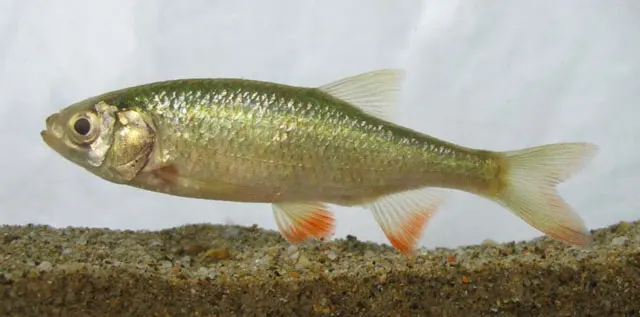
Racovitza's rudd, or thermal rudd (Racovitza's rudd), is a small freshwater fish that lived in a single hot-spring lake near Oradea in Romania. The IUCN lists it as Extinct in the Wild (2024 assessment), as the lake's thermal water failed. Only fish kept in captivity remain.
What it is
The thermal rudd belongs to the minnow family Leuciscidae, the family in which current references place rudds. Older catalogues file it under Cyprinidae. Geza Julius Müller described it in 1958 from a thermal pond near Oradea, and the name honours the Romanian cave biologist Emil Racovitza. GBIF and WoRMS both treat it as a valid, accepted species.
It is a compact fish, deeper in the head and tail stalk than the common rudd. FishBase gives a maximum length of 8.5 centimetres.
Where it lived
The species was endemic to one small lake fed by a geothermal spring in Bihor County, northwestern Romania, in the upper valley of the Peța, a tributary of the Crișul Repede. The lake is known locally as Pețea or Ochiul Mare, and the area as Băile 1 Mai. FishBase describes a shallow, densely vegetated hot spring with a mud bottom, and the IUCN lists its habitat as geothermal wetland.
A 2025 article in Oryx calls the species a Pannonian relict, meaning a survivor from an earlier climate.
Pins are Wikidata “endemic to” fields. Orange dots, when present, are GBIF occurrence tiles — survey bias included.
How it lived
Little is recorded about its biology. The IUCN notes that it gathered in groups all year and did not migrate. A 2015 morphometric study in the Transylvanian Review of Systematical and Ecological Research used fish caught in 2013 and described the lake's temperature regime as precarious, a major risk when combined with other pressures. The sample was small because collecting an endangered species is legally restricted.
Why it is in trouble
Overuse of the thermal springs feeding the lake caused severe water loss in the early 2010s. The IUCN lists groundwater abstraction for domestic and commercial use as causes of rapid decline, alongside drought, tourism and recreation areas, sewage, run-off, pesticides, nutrient loads, garbage, soil erosion and two introduced fishes, the topmouth gudgeon and the brown bullhead, all recorded as past impacts.
The lake nearly dried out in 2013 and 2014, which triggered an emergency rescue by the Țării Crișurilor Museum in Oradea. Sources differ on when the habitat was finally lost. Some references give 2014, while a 2025 article in Oryx dates its complete destruction to 2022. The IUCN had rated the species Critically Endangered in 2008 and Extinct in the Wild in 2024.
What is being done
Captive breeding first succeeded in 2014 under an international programme funded by the Mohamed bin Zayed Species Conservation Fund. Juveniles were released at the original site and sent to zoos and public aquariums. With no suitable wild habitat left, the fish survive in zoos and research facilities, and the IUCN assessment lists reintroduction, site management and habitat restoration as needed actions.
In 2024 the Oradea museum, a museum in Galați, Schönbrunn Zoo in Vienna and a Hungarian university began a renewed effort to produce offspring from the existing stock. Hormone and temperature-induced spawning in Oradea produced fertilised eggs and embryos in spring 2025. According to Oryx, 130 juveniles from that trial went to Schönbrunn Zoo and the Oradea museum, and Hungarian broodstock also produced offspring.
Sources
Written for this catalog in our own words from the sources below, checked against them on 12 November 2026. Population figures are estimates and carry the year they were made. Status and assessment year: IUCN. 2026. The IUCN Red List of Threatened Species. Version 2026-1. iucnredlist.org.
- IUCN Red List assessment
- Racovitza's rudd, Wikipedia
- Oradea museum, New efforts for saving the thermal rudd
- Oryx 59(5), 2025, Ex situ conservation of the thermal rudd
- Transylvanian Review of Systematical and Ecological Research, 2015 abstract
- FishBase, Racovitza's rudd
- GBIF, Racovitza's rudd
- WoRMS, Racovitza's rudd




