Endangered
Sawbwa Barb
Sawbwa resplendens
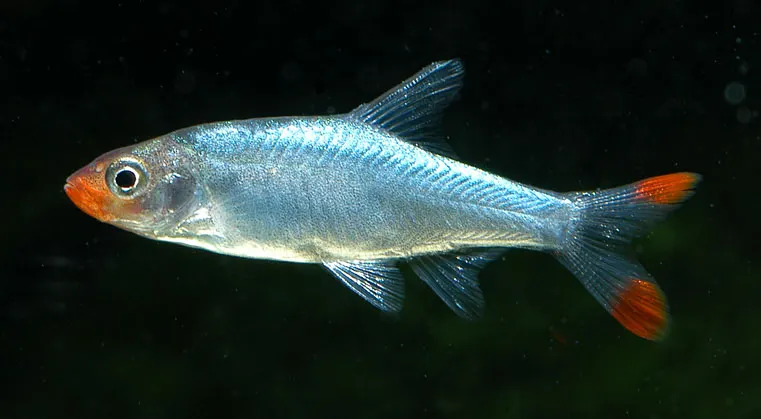
The sawbwa barb is a tiny, brightly marked fish found only in Inle Lake, a shallow lake in Myanmar. The IUCN Red List assessed it as Endangered in 2011 and records its population as decreasing. Males reportedly carry a red snout and red tail lobes on a silvery-blue body.
How to recognise it
This is a very small fish, reportedly reaching about 3.5 cm in total length. Mature males are described as iridescent silvery-blue with a red snout and red lobes on the tail fin. Females are duller, have no red, and show a dark spot near the anus.
It is the only member of its genus, Sawbwa. Other names include Burmese rammy nose, Asian rummynose and rummynose rasbora.
Where it lives
The Red List records the barb from Myanmar, in permanent freshwater lakes, at an elevation of 880 m, and gives its extent of occurrence as 116 square km. Inle Lake sits at about that height in Shan State.
Aquarium enthusiasts who documented the lake describe clear, still water with an average depth near 2 m in the dry season and a deepest point of about 3.7 m. The level can rise about 1.5 m in the rainy season. Temperatures run from roughly 20 to 28 degrees C, with a pH around 8. Submerged plants such as hornwort and pondweeds grow there, and the lake bed is clay and sand with silt.
A survey of a spring pond at Hopong, about 35 km from the lake, ran in 2016, 2019 and 2020. It found 25 fish species, seven of which had been considered endemic to Inle Lake, and the sawbwa barb was one of them. Small outlying populations may therefore exist, though the Red List treats the lake as its range.
Pins are Wikidata “endemic to” fields. Orange dots, when present, are GBIF occurrence tiles — survey bias included.
Why it is in trouble
The Red List names sewage, drought and pressure from other species as threats, and lists ecosystem degradation and species disturbance as the stresses on the fish.
Introduced fish add to the problem. A 2016 inventory of fishes in and around the lake, based on collections from 2014 to 2016, recorded 49 species. Of these, 13 were endemic or nearly endemic to the lake system and 17 were suggested to be non-native. The Hopong pond held eight suspected or definite introduced species, including Nile tilapia and mosquitofish.
The change is also noticed by the local Intha people. A 2023 study of fish naming found that younger Intha knew fewer fish names than older people, and suggested that environmental disturbance, which has caused many fish to disappear locally, may be the reason.
What is being done
The assessment lists no conservation actions in place for this species. Its small range, essentially one lake, is the reason it qualifies as Endangered under Red List criterion B2ab(iii,v): a restricted area with declining habitat quality and declining numbers.
Sources
Written for this catalog in our own words from the sources below, checked against them on 12 November 2026. Population figures are estimates and carry the year they were made. Status and assessment year: IUCN. 2026. The IUCN Red List of Threatened Species. Version 2026-1. iucnredlist.org.




