Critically Endangered
Sarotherodon linnellii
Sarotherodon linnellii
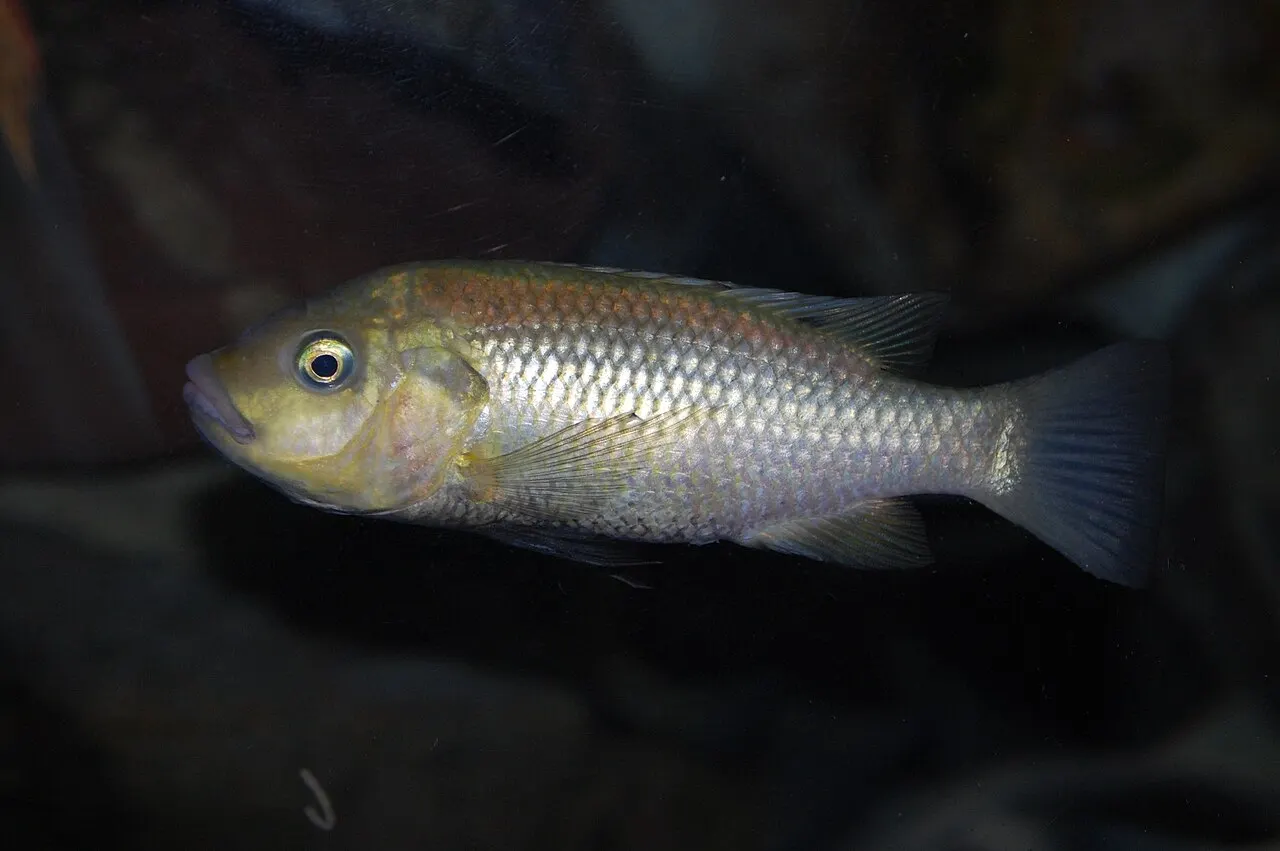
The unga (Sarotherodon linnellii), also called the blackbelly or blackfin tilapia, is a cichlid fish found nowhere except Lake Barombi Mbo, a crater lake in western Cameroon. The IUCN's 2010 assessment lists it as Critically Endangered, with its population trend unknown.
How to recognise it
The unga reaches about 18.5 cm in standard length, measured without the tail fin. It has a large head, big eyes and very small jaw teeth. The body is dark grey or green, looking silvery green in life. Breeding females and young fish look more silvery grey, and the pelvic fins can be yellow. Some fish carry a dark patch on the throat, though it varies between individuals.
Young fish carry the dark spot on the dorsal fin known as the tilapia mark. It fades as they grow and is gone above about 15 cm. The dorsal fin has 14 to 16 spines. The species was first described in 1903 as Tilapia linnellii by Einar Lönnberg, and the name honours Gunnar Linnell, a Swedish plantation owner in Cameroon who sent the collection containing the type specimen.
Where it lives
Lake Barombi Mbo sits at about 300 m above sea level in south-western Cameroon. It is a crater lake with roughly 5 square kilometres of open water by one count (the IUCN gives 7), a mean depth of 69 m and a maximum depth of 111 m. The most recent lava flow into the lake was about a million years ago, so the lake is at least that old.
Fifteen fish species have been recorded there and 12 are endemic. Nearly all of the endemics are tilapia-type cichlids. The unga belongs to the only non-endemic cichlid genus, Sarotherodon, but it is itself unique to this one lake.
Pins are Wikidata “endemic to” fields. Orange dots, when present, are GBIF occurrence tiles — survey bias included.
How it lives
Ungas are mostly active by day and sometimes form schools. In open water they gather in small groups of fewer than 10, at depths down to about 5 m. Adults feed mainly on phytoplankton. Juveniles eat mayfly larvae and terrestrial insects, so their diet leans toward animal food.
It is a mouthbrooder. Fish move toward the lake edges to spawn, where the male builds a crater in the sand. Pairs bond only briefly. Females do most of the brooding, and males occasionally incubate the eggs.
Why it is in trouble
A single small lake holds the whole species, which is why the IUCN rates it Critically Endangered under criteria B1ab(iii)+2ab(iii), covering a tiny range and a declining quality of habitat. The assessment lists the population trend as unknown, and no population count is given.
The assessment names deforestation, oil palm plantations and slash-and-burn farming around the lake as the main current threat, because they pollute the lake and wash sediment into it. It also lists groundwater abstraction to supply the town of Kumba, which it expects to rise, and plans for tourism development. Volcanic activity appears as a future threat rated negligible.
Another worry is a sudden release of carbon dioxide from the lake bed, as happened at Lake Nyos. The assessment treats this as a potential threat and reports, on an informal account, that fish died after a possible release in 2007. An encyclopedia entry says studies indicate Barombi Mbo does not hold excess amounts of the gas, so the risk is disputed.
What is being done
The IUCN assessment records one measure: commercial fishing is forbidden in the lake. It also notes that no introduced species have been recorded there.
Sources
Written for this catalog in our own words from the sources below, checked against them on 12 November 2026. Population figures are estimates and carry the year they were made. Status and assessment year: IUCN. 2026. The IUCN Red List of Threatened Species. Version 2026-1. iucnredlist.org.




