Endangered
São Tomé olive pigeon
Columba thomensis
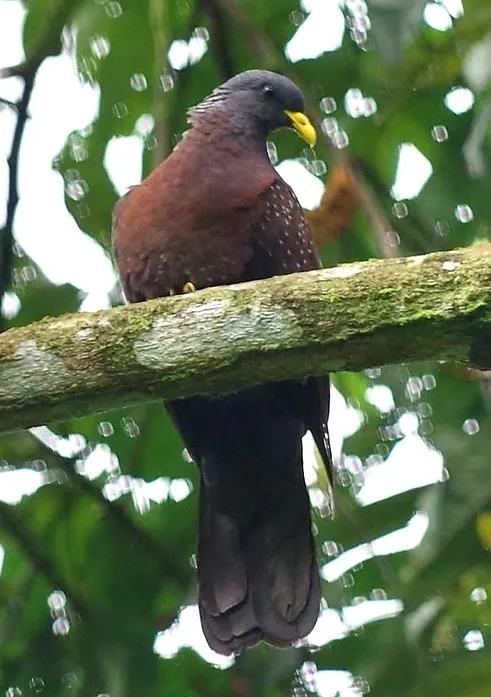
The São Tomé olive pigeon (Columba thomensis), also called the maroon pigeon, is a large, dark forest pigeon found only on São Tomé, an island in the Gulf of Guinea. The IUCN Red List rated it Endangered in 2021. Hunting and the loss of old forest have pushed it into a small range.
How to recognise it
It is a big pigeon, 37 to 40 cm long, and very dark. The head is slate-grey, the underparts are deep maroon with faint white speckling, and the bill and legs are bright yellow. Females are duller than males. The call is a deep, almost owl-like cooing.
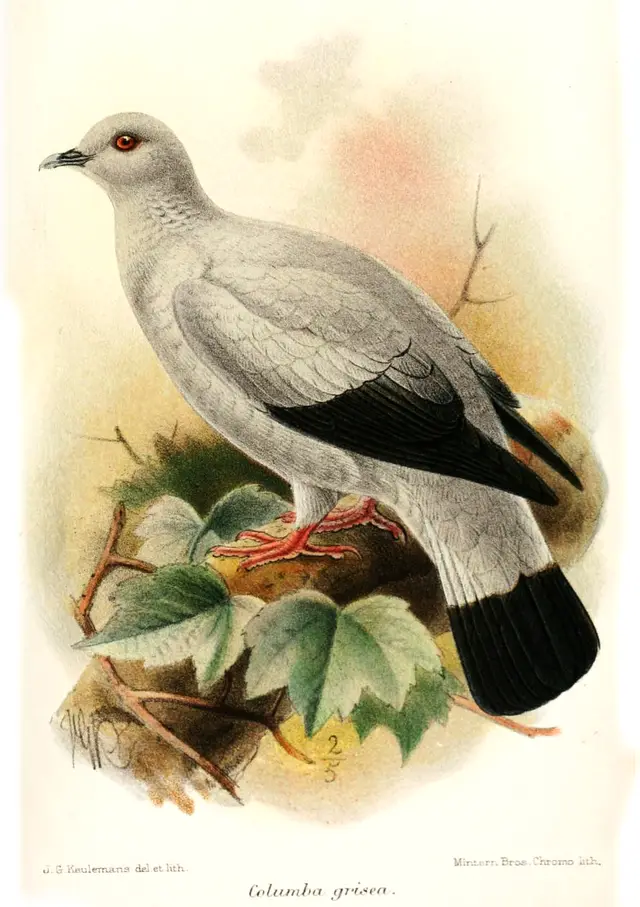
The other large pigeon in the same forests, the São Tomé bronze-naped pigeon (Columba malherbii), is smaller and paler, with metallic patches on the neck.
Where it lives
The species is endemic to the island of São Tomé, in São Tomé and Príncipe, and Bocage described it in 1888. The IUCN counts it as one location, with an area of occupancy of about 480 square kilometres. It occurs from sea level up to about 2,000 m, in moist lowland and montane forest, and sometimes in plantations.
A 2015 transect survey in Bird Conservation International found it strongly tied to old-growth forest, and less abundant and more restricted in range than the island's lemon dove and bronze-naped pigeon. Only a few patches of old-growth forest remain on the island, mostly on steep, hard-to-reach slopes.
Pins are Wikidata “endemic to” fields. Orange dots, when present, are GBIF occurrence tiles — survey bias included.
Why it is in trouble
Hunting is the biggest pressure. The IUCN rates deliberate hunting of the species as affecting most of the population and causing rapid declines, with small-scale incidental harvest adding to it, and it lists human food as a use. Pigeons on São Tomé are sociable and unafraid of people, and they may stay put when shot at, which makes them easy prey. A 2013 University of Porto thesis reported the heaviest hunting during the breeding season.
Forest loss is the other factor. The IUCN also lists forest conversion for farming and roads, though it rates the current effect of those as negligible, and it records a continuing decline in the area the bird occupies.
Population figures differ by source and year. The 2021 IUCN assessment gives 2,600 to 3,700 individuals and a decreasing trend. A 2013 thesis put the number at probably 250 to 999 mature individuals, a rough guess based on the bird's scarcity. Neither figure comes from a full count.
What is being done
Part of the pigeon's range lies in Obô Natural Park, which covers about 30 percent of the island, and the IUCN records the species as occurring in at least one protected area. The IUCN calls for full legal protection of the remaining primary forest, listing the pigeon as a protected species under national law, enforcing existing environmental laws, and awareness work to cut hunting. It also asks for research on its ecological needs and regular monitoring of numbers, and records no recovery plan or monitoring scheme.
Sources
Written for this catalog in our own words from the sources below, checked against them on 12 November 2026. Population figures are estimates and carry the year they were made. Status and assessment year: IUCN. 2026. The IUCN Red List of Threatened Species. Version 2026-1. iucnredlist.org.
- IUCN Red List assessment, Columba thomensis (2021)
- Wikipedia, São Tomé olive pigeon
- Carvalho et al. 2015, Bird Conservation International 25(1), abstract via Crossref
- Pereira 2013, Conservation genetics of the endemic pigeons of São Tomé and Príncipe (University of Porto thesis)
- Carvalho et al. hunting study on São Tomé pigeons (Cambridge Core reader)