Endangered
Sanghir squirrel
Prosciurillus rosenbergii
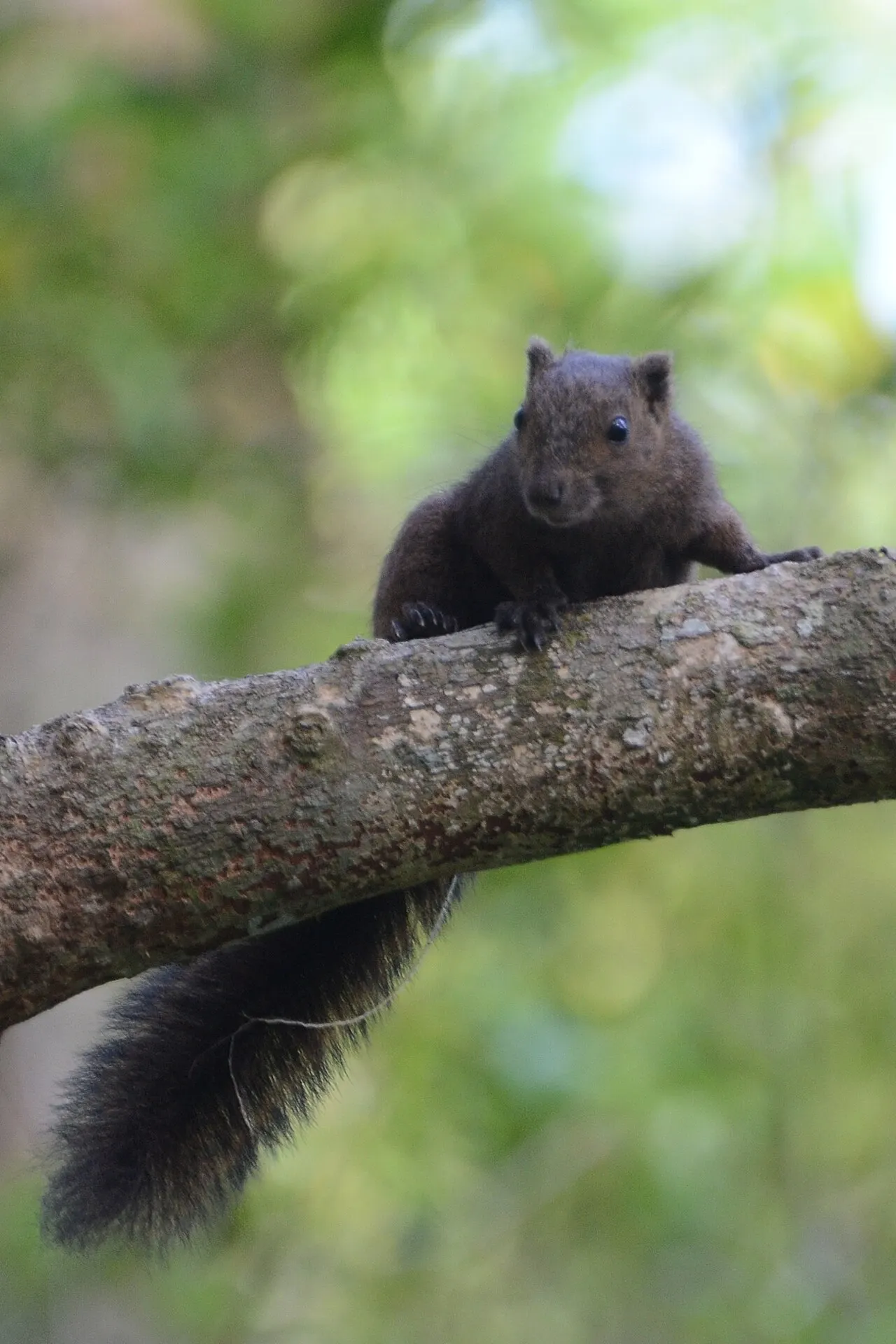
The Sanghir squirrel (Prosciurillus rosenbergii) is a small chestnut-brown tree squirrel found only on the Sangihe islands of Indonesia, north of Sulawesi. The IUCN Red List rated it Least Concern in 2016 and Endangered in 2024, when it was treated as occupying a single location.
How to recognise it
It is a compact squirrel, with a head and body about 190 mm long and a tail of about 180 mm, so the tail is nearly as long as the body. The back is a rich chestnut-brown, the underside dark brownish to buff, and the tail looks blackish. There are no ear tufts, but there is a stripe down the middle of the back and patches on the nape.
Identification is simple where it lives. It is the only squirrel on the Sangihe islands.
Where it lives
The species belongs to the Sangihe (Sangir) island chain in the Celebes Sea, between Sulawesi and Mindanao in the Philippines. The islands are part of Indonesia. The squirrel was described in 1879 by Jentink. Records from the 1800s place it on Siau, Tahulandang and Ruang as well as on Sangihe itself.
A mammal reference published in 2016 doubts that it still lives across that whole range, pointing to heavy deforestation and conversion of habitat. The latest Red List assessment treats the squirrel as occupying a single location, with an estimated extent of occurrence of 696 square kilometres.
Pins are Wikidata “endemic to” fields. Orange dots, when present, are GBIF occurrence tiles — survey bias included.
How it lives
It is diurnal, though no activity study exists for this species. It uses both primary and secondary forest up to around 1,000 m, and probably higher, and it also turns up in plantations and gardens. On Sangihe Island, surveys reported densities of 1 to 8 animals per hectare in primary forest and 0 to 5 per hectare in secondary forest.
No information on its diet or breeding is available.
Why it is in trouble
The 2024 assessment names small-holder farming, shifting agriculture and mining and quarrying as ongoing threats. Each is rated as affecting a minority of the population. The two farming threats are listed as causing slow but significant declines, and the area the squirrel occupies is still shrinking.
The squirrel copes with some change, since it will use plantations and gardens. Even so, the 2024 assessment puts its known range at a single location of about 696 square kilometres.
What is being done
The assessment records site and area protection and management as needed actions, and it records that the species does not occur in any protected area.
Sources
Written for this catalog in our own words from the sources below, checked against them on 12 November 2026. Population figures are estimates and carry the year they were made. Status and assessment year: IUCN. 2026. The IUCN Red List of Threatened Species. Version 2026-1. iucnredlist.org.




