Endangered
Eastern Province rocky
Sandelia bainsii
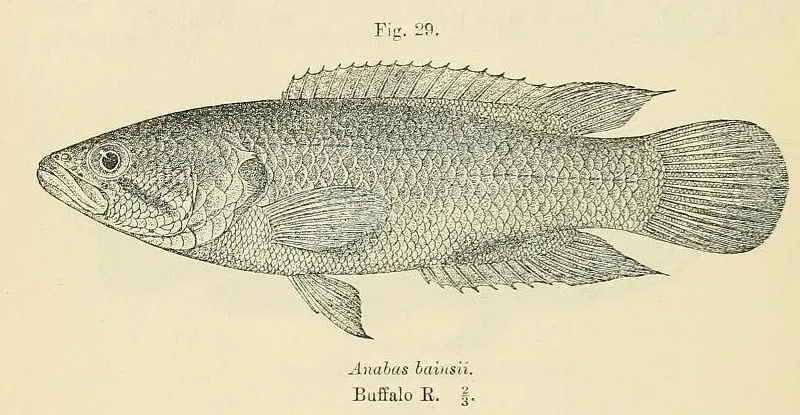
The Eastern Province rocky (Sandelia bainsii) is a large, sedentary freshwater fish found only in a handful of rivers in South Africa's Eastern Cape. The IUCN Red List rated it Endangered in 2018. Its populations are small, scattered and shrinking, and some may not last.
How to recognise it
It's the biggest member of the Anabantidae, the family of labyrinth fishes, and can reach a standard length of about 260 mm.
Castelnau described it in 1861. The species name is thought to honour Andrew Geddes Bain, a Scottish geologist, explorer and soldier who also collected animal specimens.
Where it lives
It is endemic to South Africa and has been recorded in the Gulu, Igoda, Buffalo, Nahoon, Kowie, Kat (Great Fish), Koonap and Tyhume (Keiskamma) river systems. The 2018 assessment counts five locations and describes the population as severely fragmented. It lists rivers, streams, pools, marshes and lakes, both permanent and seasonal, as its habitat.
A 2020 study in the journal Koedoe recorded remnant populations only in short stretches of the streams where they were found, and not at all in the heavily polluted parts of the Kowie and Bloukranz rivers where the fish was once abundant.
Pins are Wikidata “endemic to” fields. Orange dots, when present, are GBIF occurrence tiles — survey bias included.
Three lineages in one species
The same 2020 study found three genetically distinct lineages, informally called Kowie, Keiskamma and Buffalo. The Kowie lineage lives in the Kowie and Great Fish systems, the Keiskamma lineage in the Keiskamma system, and the Buffalo lineage in the Buffalo and Igoda systems. Work on whether the lineages are distinct taxa is still under way.
Why it is in trouble
The Red List assessment records a decreasing population and lists farming, dams, housing, sewage, soil erosion and sedimentation, and small-scale harvest among the threats. Introduced species are also named as a pressure.
The Koedoe study points to poorer water and habitat quality, non-native predatory fish, barriers and impoundments, and changes to river flow. Small, isolated populations also face genetic drift and inbreeding. In the Kowie, only two fish turned up in surveys between 2010 and 2017, and that population is feared to be close to extinction.
What is being done
The assessment records ex-situ conservation, meaning fish are held outside the wild, and lists habitat restoration, site protection, captive breeding, a genome resource bank, reintroduction and education among the actions in place or proposed. Today the species is recorded in the Bloukrans River inside the Blaauwkrantz Nature Reserve.
Sources
Written for this catalog in our own words from the sources below, checked against them on 12 November 2026. Population figures are estimates and carry the year they were made. Status and assessment year: IUCN. 2026. The IUCN Red List of Threatened Species. Version 2026-1. iucnredlist.org.




