Endangered
Salamandrina perspicillata
Salamandrina perspicillata
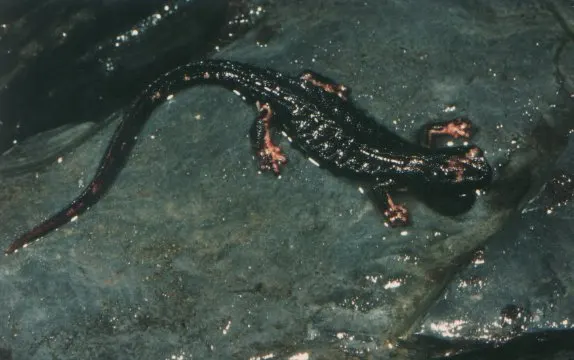
The northern spectacled salamander (Salamandrina perspicillata) is a slim, secretive salamander found only in the Apennine woods and streams of Italy. It's marked by a pale V between the eyes that looks like spectacles. The IUCN Red List moved it to Endangered in 2022, with a decreasing population.
How to recognise it
Adults are small and thin, usually 7 to 10 cm long, with the occasional female reaching about 13 cm. The back is dark brown to nearly black, and a whitish, yellowish or pinkish V-shaped mark between the eyes gives the species its name. The belly is red, white or ivory, scattered with black spots that differ from animal to animal. Hands and feet have four toes. Males have longer tails and limbs and bigger heads on average.
It was long lumped with the southern spectacled salamander (Salamandrina terdigitata). Studies in 2005 and 2006 supported treating them as two species. The southern one is reportedly about 1 cm shorter on average and has more red on the underside, but DNA is the most reliable way to tell them apart.
Where it lives
It is endemic to the Apennines of Italy, from south-eastern Piedmont to northern Campania, and is commonest on the Tyrrhenian side. The IUCN gives an elevation range of 50 to 1,500 m and an extent of occurrence of about 96,000 square kilometres. It is especially common in hilly country between about 200 and 700 m.
On land it prefers woodland in good condition, such as oak, Turkey oak and beech, and also uses scrub, meadows and cultivated land. It needs slow-moving water to breed, including stream margins, pools, springs and spring troughs.
Pins are Wikidata “endemic to” fields. Orange dots, when present, are GBIF occurrence tiles — survey bias included.
How it lives
It is shy and mostly nocturnal, though it can be active by day in damp weather. It shelters in soil and among tree roots, sometimes down to about a metre. If disturbed, it may arch its body and tail, play dead for a few seconds, or rear up on its hind legs. Adults catch spiders, worms, springtails and other small invertebrates with a sticky tongue.
Mating takes place on land. Females move to water in spring and lay 20 to 60 eggs per clutch, attaching them to the underside of submerged stones, roots, twigs and leaves. Egg-laying mostly runs from March to May. Larvae hatch at 7 to 13 mm and take 2 to 5 months to metamorphose, depending on water temperature. Females mature at 4 to 5 years and can live 14 to 15 years.
Why it is in trouble
Its life depends on both woodland and clean, slow water. The IUCN lists housing and urban development and small-holder plantations as threats, with ecosystem conversion and degradation as the main stresses. Human changes to breeding water are the heart of the problem. Local water pollution and the vulnerability of small spring troughs both matter, and road building can cut off populations. Trout and other fish introduced to streams where they didn't occur are also a concern.
The IUCN also records some unintentional harvest and use of the species as pets or display animals. Earlier assessments in 2008 and 2009 rated it Least Concern, and the Endangered listing came in 2022.
What is being done
The species is covered by the Bern Convention (Appendix II) and the EU Habitats Directive (Annexes II and IV), and it occurs in protected areas. The IUCN lists policies and regulations, invasive species control and international-level action as conservation needs. Local protection of egg-laying sites and tunnels under roads for migrating animals are among the measures used.
Sources
Written for this catalog in our own words from the sources below, checked against them on 12 November 2026. Population figures are estimates and carry the year they were made. Status and assessment year: IUCN. 2026. The IUCN Red List of Threatened Species. Version 2026-1. iucnredlist.org.




