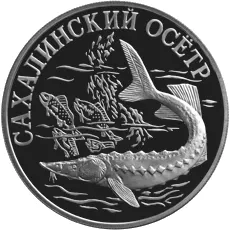
Critically Endangered
Sakhalin sturgeon
Acipenser mikadoi
The Sakhalin sturgeon (Acipenser mikadoi), also called the Mikado sturgeon, is a big migratory fish of the north-west Pacific that now breeds in only one river, the Tumnin in Russia's far east. The IUCN rated it Critically Endangered in 2022, estimating about 50 individuals in total.
How to recognise it
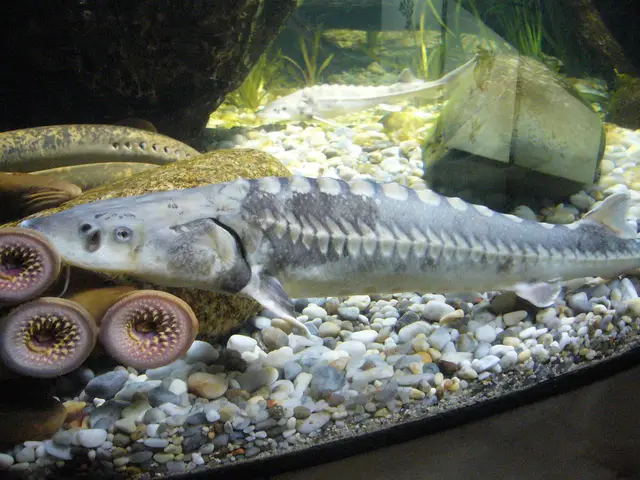
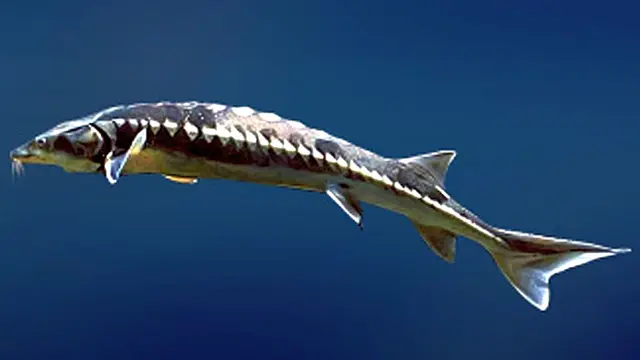
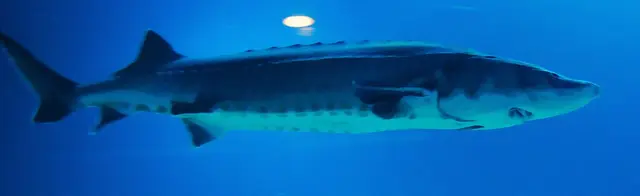
It has the usual sturgeon build: a cartilage skeleton, rows of bony plates called scutes, hard ganoid scales, a flat snout and a bottom-facing mouth with four barbels. Its back is olive to dark green, it is paler and yellowish below, and an olive-green stripe runs along each side.
Size figures differ by source. NOAA gives up to about 8 feet and 330 pounds, while an encyclopaedia entry gives a maximum recorded length of roughly 150 cm. In Japan it is known as chozame.
Where it lives
It feeds at sea in the Sea of Japan, from the Amur estuary and Tatar Strait south toward the Tumen River. The IUCN assessment lists Russia, Japan (Hokkaido) and North Korea within its range, and its habitat includes rivers, estuaries and shallow sandy and muddy seabed.
Historically it bred in several small Russian rivers, among them the Suchan, Tumnin and Tym, and in Hokkaido's Ishikari and Teshio Rivers. Today spawning is known from the Tumnin only, within about 100 km of the river mouth. A single mature male was caught in the Viakhtu River in 2011.
Pins are Wikidata “endemic to” fields. Orange dots, when present, are GBIF occurrence tiles — survey bias included.
How it lives
Adults move into fresh water in spring and spawn in June and July. Fish mature at about 8 to 10 years old and live at least 20 years. At sea they eat shrimp, crabs, worms, small crustaceans and fish such as sand lance. The IUCN gives a generation length of roughly 33 to 49 years, so recovery is slow.
Why it is in trouble
The IUCN estimates a past decline of about 99 percent and says all individuals belong to one subpopulation of around 50. NOAA's own estimate is that 10 to 30 fish enter the Tumnin to spawn each year.
Past harvest caused rapid declines. Ongoing pressures include accidental catch in fixed and gill nets in estuaries and bays, illegal fishing during the spawning run, pollution from oil production, farming and mining, and dams. The assessment rates several of these as unknown in scale.
What is being done
NOAA names hatchery breeding and the release of young fish into the Tumnin River and Lake Tunaicha as the main conservation method. The species is on CITES Appendix II and was listed as endangered under the US Endangered Species Act in 2014. The IUCN notes a recovery plan exists but records no systematic monitoring scheme and no protected area covering the population.
Sources
Written for this catalog in our own words from the sources below, checked against them on 12 November 2026. Population figures are estimates and carry the year they were made. Status and assessment year: IUCN. 2026. The IUCN Red List of Threatened Species. Version 2026-1. iucnredlist.org.