Endangered
Saint Lucia Black Finch
Melanospiza richardsoni
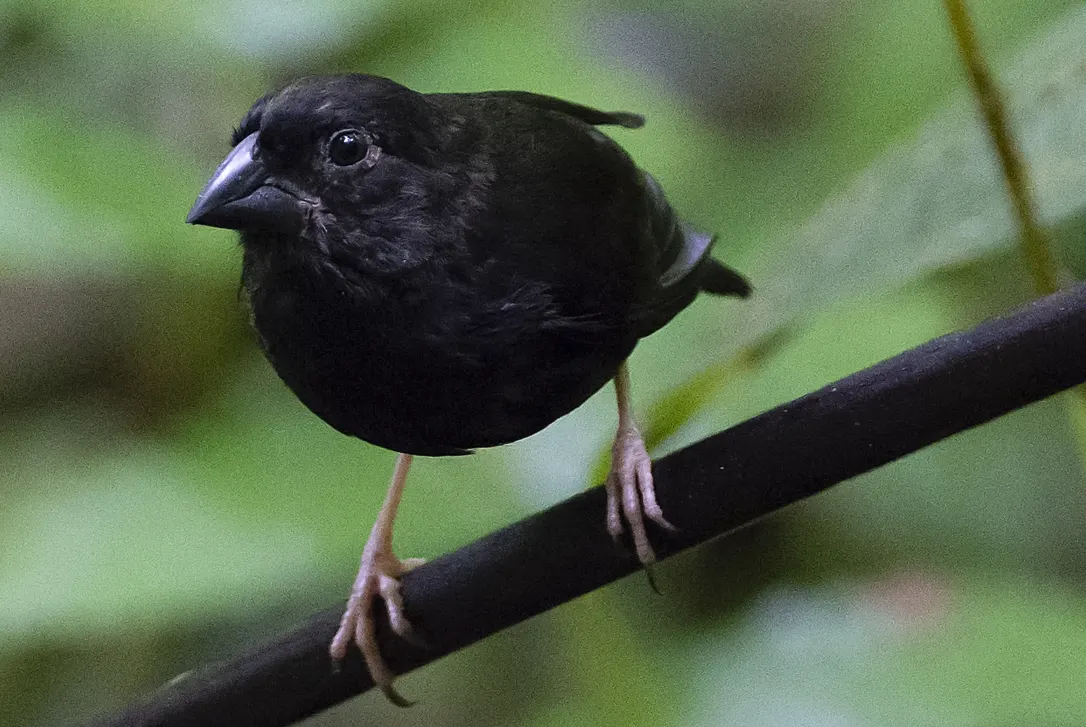
The Saint Lucia black finch (Melanospiza richardsoni) is a stocky, thick-billed songbird found only on the Caribbean island of Saint Lucia. The male is almost entirely black. Rated Endangered in 2020, it has an estimated 250 to 999 mature birds, and its numbers are still falling.
How to recognise it
It is a small, chunky finch, 13 to 14 cm long and reportedly weighing about 18 to 23 g, with a heavy bill and a fairly short tail. Males are almost entirely black, with a black bill and pink legs. Females have a grey head, brown upperparts and light brown underparts, and juveniles look like females.
The bird most often mistaken for it is the Lesser Antillean bullfinch, which is larger, with a smaller bill, a red throat patch and black legs. When perched, the finch bobs its tail up and down. Its song is a rough, multi-note phrase said to resemble a bananaquit's, and its call is a sharp tiiip. Locally it is called Moisson Pied-blanc.
Where it lives
The species is endemic to Saint Lucia, in the Lesser Antilles, and its range covers about 380 square kilometres. The Red List counts 11 to 100 locations and gives an upper elevation of about 800 m, though other sources give 700 to 1,000 m. It is described as uncommon and local, and it occurs in at least two protected forest areas.
It lives in tropical evergreen and moist lowland forest, dry forest and dry shrubland, favouring dense undergrowth, and it will use plantations. Moist forest and dry forest are its most important habitats.
Pins are Wikidata “endemic to” fields. Orange dots, when present, are GBIF occurrence tiles — survey bias included.
How it lives
It is a resident that does not migrate, and it is often seen in pairs. It forages mainly on the ground in leaf litter, taking insects, fruits and berries, though its diet has not been studied in detail.
Breeding runs from November to June. The nest is a loose, domed ball of twigs, ferns and leaves with a side entrance, usually placed in a small palm or shrub around 3 m up, and in some accounts nearer the ground. The female lays two white eggs with brownish-red spots.
Why it is in trouble
The Red List records a continuing decline in the number of mature birds and in the area of habitat. Clearing the undergrowth in timber plantations and other forest is a main pressure, scored as causing slow but significant declines. Forests are also converted to farmland and tourism development, and dry forest, which is often targeted for tourism building, is part of the finch's home.
Introduced predators add to the strain. Rats, feral pigs and the small Asian mongoose are all named as threats, and the finch's low nests are thought to be vulnerable.
What is being done
The Red List asks for less undergrowth clearing in plantations and other forest, and for control of non-native predators, notably pigs and mongooses. It also asks for new surveys of the bird's range and numbers to design a conservation strategy. As of the 2020 assessment there was no recovery plan, no monitoring scheme and no education programme in place, although conservation sites had been identified across the whole range.
BirdsCaribbean said in 2024 that protecting Saint Lucia's dry forests would help the species, and that continued public awareness is needed to build local support.
Sources
Written for this catalog in our own words from the sources below, checked against them on 12 November 2026. Population figures are estimates and carry the year they were made. Status and assessment year: IUCN. 2026. The IUCN Red List of Threatened Species. Version 2026-1. iucnredlist.org.




