Endangered
Saint Croix ground lizard
Pholidoscelis polops
The Saint Croix ground lizard (Pholidoscelis polops) is a small, striped lizard with a blue tail that lives on four tiny cays off Saint Croix in the U.S. Virgin Islands. The IUCN Red List assessed it as Endangered in 2017. Mongooses and habitat loss drove it from the main island.
How to recognise it
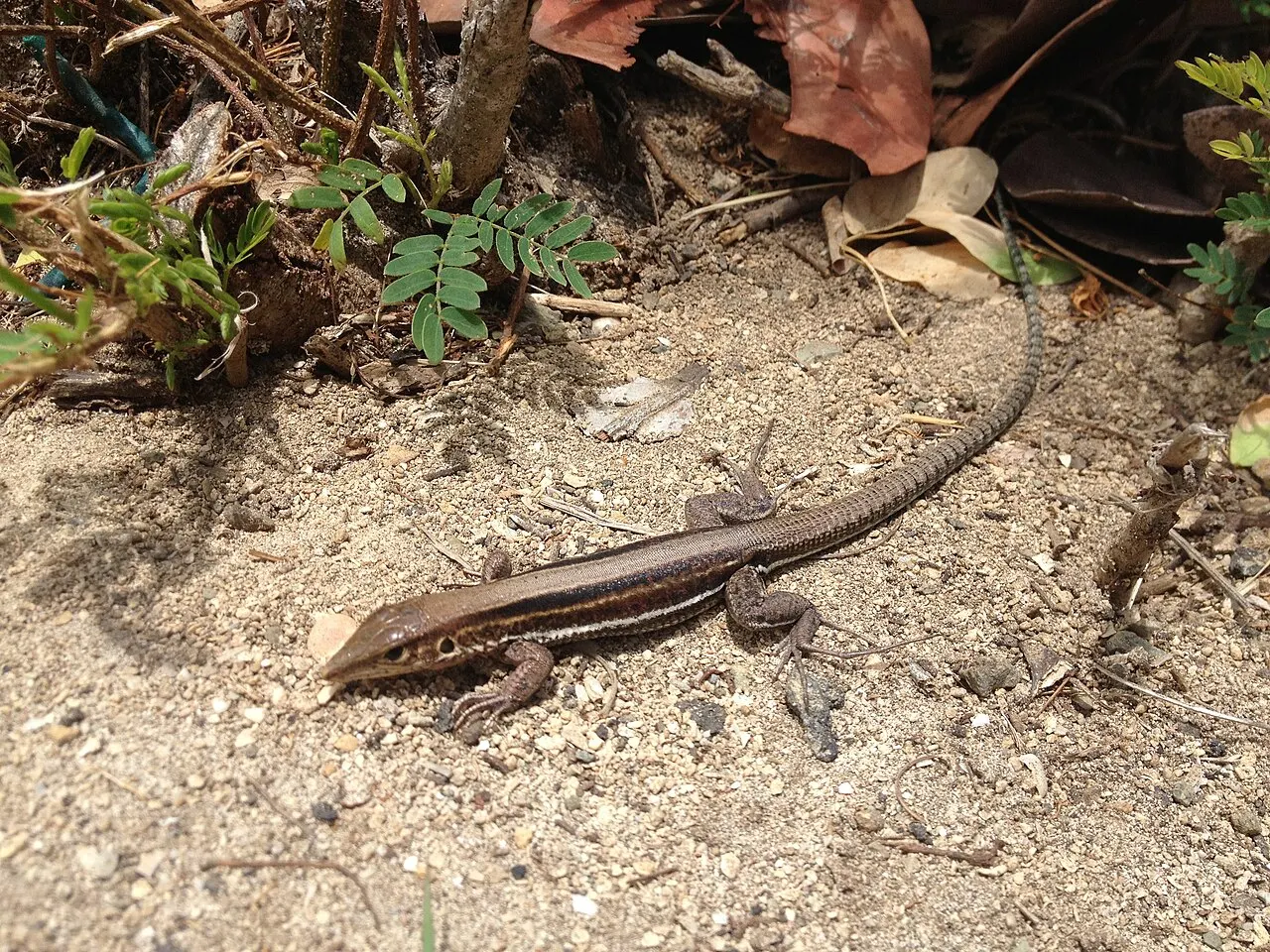
Adults measure roughly 35 to 90 mm from snout to vent, not counting the tail. The back is striped in light brown, dark brown and white, and the flanks carry narrow brown, black and white vertical bars. Males show bright blue patches on a white belly, with deep pinkish red on the rest of the underside. The tail is brown near the body and ringed in blue and black toward the tip.
Hatchlings and juveniles have an entirely bright blue tail. The species was described in 1863 as Ameiva polops, a name still found in older sources.
Where it lives
It once lived on Saint Croix itself but is now known from four small islands: Protestant Cay, Green Cay, Ruth Cay and Buck Island. Ruth Cay is a man-made island built by dredging in the 1960s. The IUCN counts four locations, gives an area of occupancy of 16 sq km, and records elevations from sea level to 50 m.
It uses sandy beaches, dry forest and dry shrubland, and it also turns up in introduced vegetation and rural gardens.
Pins are Wikidata “endemic to” fields. Orange dots, when present, are GBIF occurrence tiles — survey bias included.
How it lives
The diet is varied. Reported foods include berries, moths, ants, amphipods (small crustaceans) and small hermit crabs.
A 2021 Oryx study by Nicole Angeli and Lee Fitzgerald put Green Cay, Protestant Cay and Ruth Cay at roughly 100 to 400 lizards each, and the total across the four islands at about 3,000.
Why it is in trouble
The small Indian mongoose was brought to Saint Croix in 1884 to control rats in sugar cane fields. Together with habitat loss, it helped drive the lizard out of about 99.97 percent of its former range on the main island, according to the Oryx study. Mongooses are absent from only about 3.65 percent of the island (7.96 sq km), mostly in the south.
The IUCN names invasive species predation, recreation and tourist development, and storms and flooding as threats. The surviving cays are tiny, so one bad storm or one invasive arrival could do serious harm. The IUCN lists the overall population trend as unknown.
What is being done
The U.S. Fish and Wildlife Service listed the lizard as endangered in 1977, and the IUCN records a recovery plan and systematic monitoring in place. Translocation has been the main tool. Ten lizards from Protestant Cay were moved to Ruth Cay in 1990. In 2008, 57 lizards from Green Cay were released on Buck Island, which has no mongooses, and the Oryx study counted more than 2,000 there.
The same study modelled habitat on Saint Croix and estimated it could hold about 142,000 lizards. It proposed Sandy Point National Wildlife Refuge, Altoona Lagoon and Southgate Coastal Reserve as release sites, with reintroductions planned for 2020 to 2023.
Sources
Written for this catalog in our own words from the sources below, checked against them on 12 November 2026. Population figures are estimates and carry the year they were made. Status and assessment year: IUCN. 2026. The IUCN Red List of Threatened Species. Version 2026-1. iucnredlist.org.




