Endangered
Sailfin grouper
Mycteroperca olfax
The sailfin grouper (Mycteroperca olfax) is a big reef fish of the eastern Pacific, living around the Galapagos, Cocos Island and Malpelo Island. The IUCN Red List raised it to Endangered in 2023, after a Vulnerable listing in 2018. Galapagos fishers call it bacalao, and it is reportedly the most valuable finfish landed there.
How to recognise it
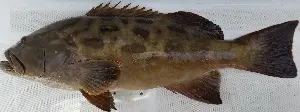
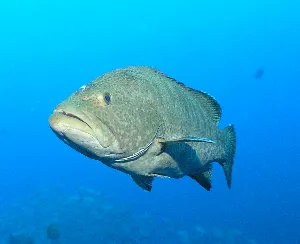
It's a heavy, elongate, flattened-sided grouper that can reach 120 cm in length. Most fish are pale grey-brown or olive-brown with many closely spaced brown spots, and some show 10 to 12 thin dark bars. The fin edges are dark with a narrow white rim.
The tail is notched in adults and straight-edged in juveniles. A rare yellow morph is bright yellow all over, which is where the name yellow grouper comes from. Colorado grouper is another common name.
Where it lives
The species is found at the Galapagos (Ecuador), Cocos Island (Costa Rica) and Malpelo Island (Colombia). Strays have been recorded now and then along the mainland coast between Costa Rica and Peru, though FishBase discounts the reports from Panama and Peru.
Adults favour rock walls, reef drop-offs and underwater lava ridges. Most are found at 15 to 40 m, though the IUCN records the species from about 1 m down to 180 m. Juveniles stay in shallow places such as sandy lagoons, seagrass beds, mangrove lagoons and even landlocked lava ponds.
Pins are Wikidata “endemic to” fields. Orange dots, when present, are GBIF occurrence tiles — survey bias included.
How it lives
Adults hunt mostly fish. The biggest ones eat a lot of Pacific creolefish. Spawning runs from October to April, peaking in October and December, and spawning aggregations have been recorded. Outside the breeding season, males tend to stay farther offshore than females.
It grows slowly and lives long. A 2016 PLOS ONE study of the Galapagos fishery put maturity at about 65 cm and 6.5 years, and found fish up to 21 years old. The IUCN gives a generation length of 13.7 years. The fish seem to start life as females and change to males later, though that hasn't been proven with tissue studies.
Why it is in trouble
In the Galapagos it's caught on handlines year-round, with a peak from October to April ahead of Easter. The fish is salted and dried, then eaten in fanesca, a traditional Easter soup. Bacalao made up nearly all finfish landings in the 1940s but under 17 percent in recent years.
The 2016 study sampled 489 landed fish in 2012 and found a mean length of 46.8 cm. About 96 percent were smaller than the size at maturity, and only 0.2 percent were very large spawners. Mean landed length fell by 7.9 cm over roughly 30 years, and the spawning potential ratio was 0.05, meaning about 5 percent of the egg output an unfished population would give. The IUCN lists large-scale and small-scale harvest as ongoing threats, estimates a past reduction of 50 to 79 percent and rates the trend as decreasing. Temperature extremes are also listed, with unknown effect.
What is being done
The species lives inside protected areas, including the Galapagos Marine Reserve, but the 2016 study found the reserve's general zoning hadn't worked for this fish, and at that time no rules were aimed at bacalao itself. A no-take zone had been declared around Darwin and Wolf islands. The study proposed a minimum landing size of 65 cm, a maximum of 78 cm and a closed season from October to January. The IUCN records that the species occurs in at least one protected area, and lists site protection, site management and harvest management among its conservation actions.
Sources
Written for this catalog in our own words from the sources below, checked against them on 12 November 2026. Population figures are estimates and carry the year they were made. Status and assessment year: IUCN. 2026. The IUCN Red List of Threatened Species. Version 2026-1. iucnredlist.org.