Critically Endangered
São Tomé Fiscal
Lanius newtoni
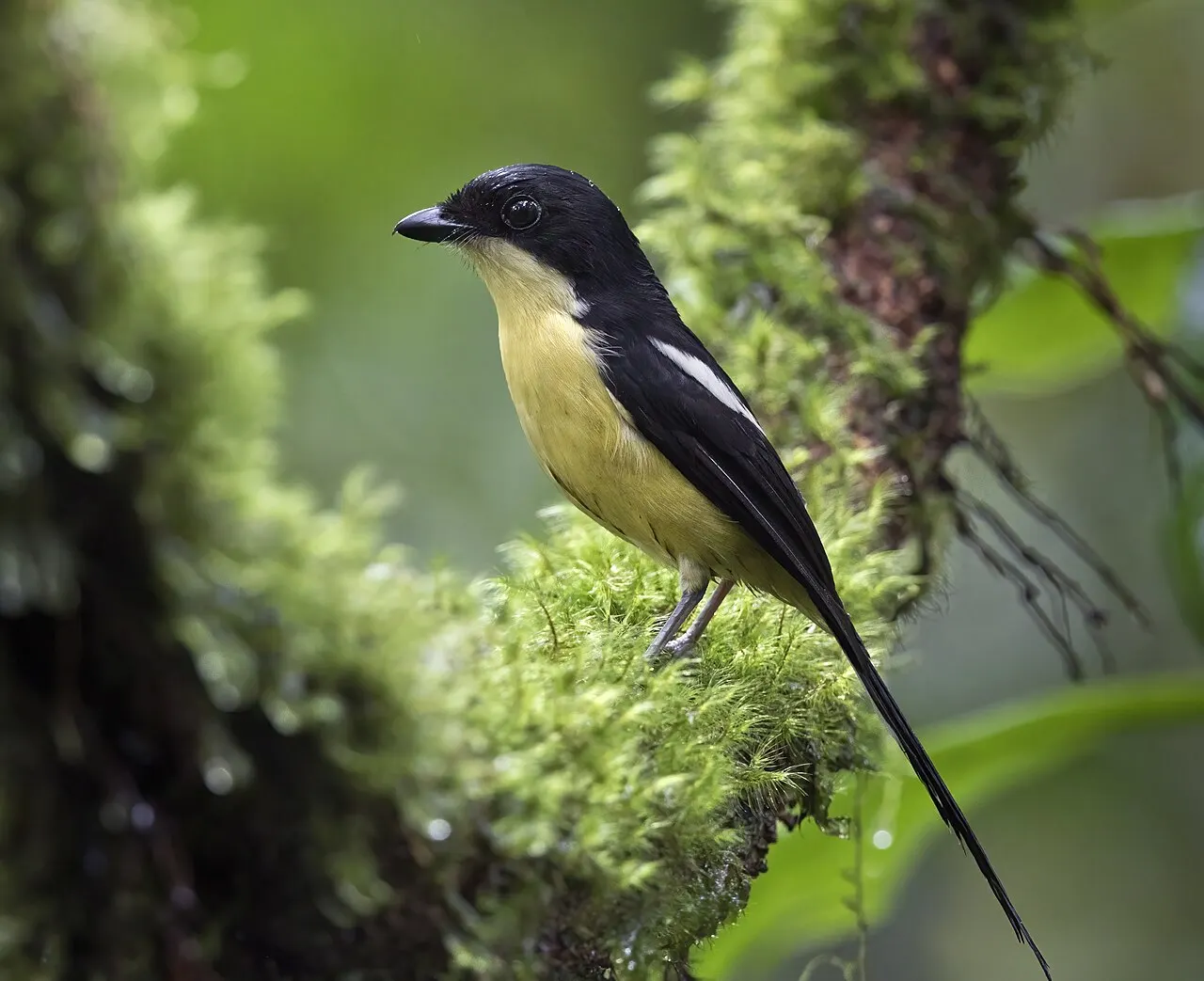
The São Tomé fiscal (Lanius newtoni), also called Newton's fiscal, is a black and yellow shrike found only in the forests of São Tomé island, off west Africa. The IUCN listed it as Critically Endangered in 2021, with an estimated 50 to 249 mature birds.
How to recognise it
This is a slim shrike about 20 cm long and roughly 22 g in weight. It is black above with a white bar along the shoulder, and the chin, breast, belly and flanks are pale yellow. The tail is graduated, with all-black central feathers and more white on the outer ones.
It is easier to hear than see. Its voice is a clear, repeated whistle, something like tiuh tiuh, and a metallic tsink tsink that carries a long way through the forest.
Where it lives
The species exists nowhere except São Tomé, the larger of the two main islands of São Tomé and Príncipe. A 2017 survey in Bird Conservation International made 1,680 point counts across the island and recorded fiscals at 111 of them, always in native forest. The birds preferred middle altitudes of 400 to 1,300 m. Records in the survey ranged from 185 to 1,504 m, though an earlier figure puts the upper limit nearer 1,400 m.
It favours stretches with fewer trees, apparently open patches within closed-canopy forest. The survey's new records clustered at middle altitudes south of Pico de São Tomé and around Cabumbé Peak. The species is also reported from Obô Natural Park, although the IUCN assessment records no protected-area occurrence.
Pins are Wikidata “endemic to” fields. Orange dots, when present, are GBIF occurrence tiles — survey bias included.
How it lives
The fiscal feeds on invertebrates, reportedly taking prey in short sallies. It is sedentary and does not migrate. Nesting is poorly known, though some indications point to breeding from November to February.
For decades it was almost a ghost. It was seen in 1888 and again in 1928, then not until 1990, when one bird turned up near the source of the Rio Xufexufe. More birds have been found since.
Why it is in trouble
Because it lives only in native forest, it is sensitive to forest clearance. Forest has been cleared for coffee and cocoa plantations, and secondary forest that regrows on cleared land suits the bird poorly. The IUCN also lists timber and farming expansion, roads, large dams and unintended harm from harvesting as threats, and records a continuing decline.
Invasive species may add to the pressure. The survey flagged the quinine tree (Cinchona), which can fill the understorey the fiscal needs to be open. Black rats, mona monkeys, African civets and feral cats live on the island and may raid nests, but the survey, which found feral pigs and black rats in the same areas, saw no solid evidence of harm to the birds.
The numbers are uncertain. The IUCN has treated the population as fewer than 50 mature birds, a precautionary figure, and the survey suggested the true number may be larger. Its models put the species' range at about 117 km2, roughly half the 260 km2 the IUCN had assumed. The survey argued the fiscal might fit Endangered better than Critically Endangered. The 2021 Red List assessment kept it Critically Endangered, estimating 50 to 249 mature birds and using the criterion for small, declining populations (C2a(ii)).
What is being done
The IUCN notes that conservation sites have been identified across the fiscal's whole range. Actions listed include training, awareness work and site management at national level. It records no recovery plan, no systematic monitoring scheme and no captive population, so counts of this elusive bird remain rough estimates.
Sources
Written for this catalog in our own words from the sources below, checked against them on 12 November 2026. Population figures are estimates and carry the year they were made. Status and assessment year: IUCN. 2026. The IUCN Red List of Threatened Species. Version 2026-1. iucnredlist.org.




