Endangered
Ryukyu Spiny Rat
Tokudaia osimensis
The Ryukyu spiny rat, also called the Amami spiny rat (Tokudaia osimensis), is a forest rodent found only on Amami Ōshima island in southern Japan. The IUCN Red List classes it as Endangered (assessed 2016). It is best known for a genetic oddity: the species has no Y chromosome.
How to recognise it
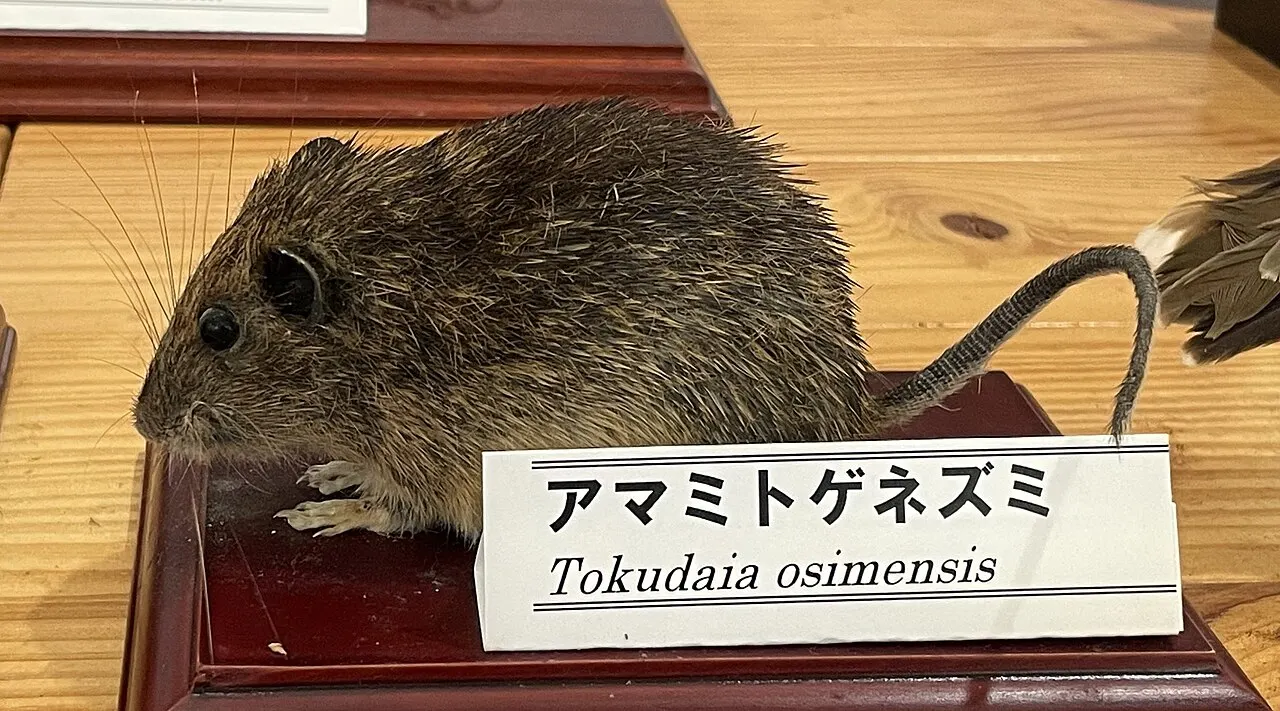
It's a small, long-furred rat with an orange-tinged dark brown back and white to grey underparts. Its coat is dense, and mixed into it are stiff grey spiny hairs with black tips, about 2 cm long.
Head and body measure roughly 103 to 160 mm, and the tail adds another 83 to 135 mm. Ears are about 22 to 23 mm.
Where it lives
Only on Amami Ōshima, in the Amami Islands of the Ryukyu archipelago. The Red List gives its estimated extent of occurrence as 657 square kilometres and its elevation range as sea level to 500 metres. It lives in broadleaf forest, particularly secondary forest with chinquapin trees (Castanopsis).
A similar animal on nearby Tokunoshima island was long grouped with this species. Both were recognised as separate species in 2006. A study in Mammal Study found that the two islands' rats differ in chromosome number (2n = 25 on Amami, 2n = 45 on Tokunoshima) and in their DNA, and concluded they had been isolated for several million years.
Pins are Wikidata “endemic to” fields. Orange dots, when present, are GBIF occurrence tiles — survey bias included.
How it lives
The spiny rat lives on the ground and is probably active at night. Reported foods include chinquapin seeds, sweet potatoes, and ants and their larvae. Breeding has been reported from October to December, with litters of 1 to 7.
Its genetics are what draw scientists. It has an odd chromosome number (2n = 25) and has lost both the Y chromosome and the SRY gene that normally switches on male development. Its Tokunoshima relative has done the same.
Why it is in trouble
The 2016 assessment, under criterion B1ab(iii,v), records a decreasing population in a severely fragmented range, with continuing decline in habitat area. Habitat destruction and fragmentation are reported causes. Introduced animals add to the pressure: feral cats and dogs, and the small Indian mongoose, are listed as threats, and introduced black rats compete with it.
No population count is available.
What is being done
The Red List lists site protection, site management and control of invasive species as conservation actions, and records that the species occurs in at least one protected area. Research on population trends is listed as a need.
Sources
Written for this catalog in our own words from the sources below, checked against them on 12 November 2026. Population figures are estimates and carry the year they were made. Status and assessment year: IUCN. 2026. The IUCN Red List of Threatened Species. Version 2026-1. iucnredlist.org.




