Critically Endangered
Russian Desman
Desmana moschata
The Russian desman (Desmana moschata) is a semi-aquatic, long-snouted relative of moles that lives along slow rivers, oxbow lakes and ponds in western Russia. Its numbers have fallen sharply, and the IUCN Red List classed it Critically Endangered in 2023.
How to recognise it
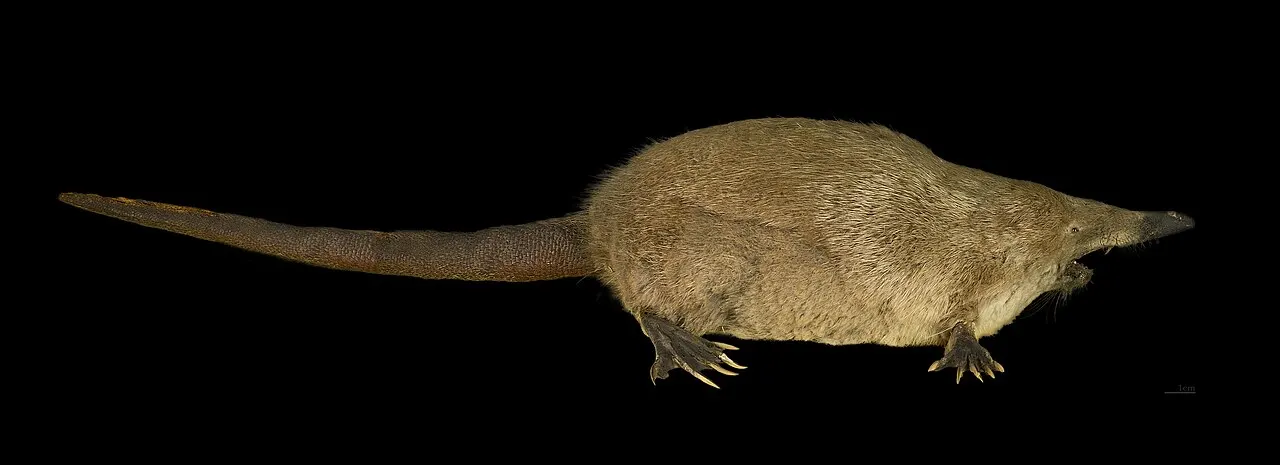
The desman is the largest of the moles. It measures about 18 to 21 cm in body length, with a flattened tail of 17 to 20 cm, and weighs roughly 400 to 520 g, though published weights vary. The hind feet are webbed, and the long, flexible snout carries touch-sensitive organs. The animal sees poorly and finds food mostly by feel.
Its fur is dense, which made it prized by fur traders. In the Middle Ages the animals were reportedly also hunted for castoreum, a musky secretion.
Where it lives
In the late 19th century the desman occurred in the Volga, Dnieper, Don and Ural basins. The Red List now shows it present in Russia, Ukraine and Kazakhstan, and extinct in Belarus, Moldova and Lithuania. Its extent of occurrence is about 2.8 million square kilometres, but the population is severely fragmented within that area.
The animal digs burrows into the banks of oxbow lakes, small slow rivers and overgrown ponds, most often lakes about 1 to 2 m deep with rich vegetation and bushes along the edge. Floodplain water bodies matter a great deal to it.
Pins are Wikidata “endemic to” fields. Orange dots, when present, are GBIF occurrence tiles — survey bias included.
How it lives
A desman eats a wide mix of food. A Small Mammal Specialist Group account lists at least 72 kinds of water invertebrates, 30 plant species, fish and amphibians in its diet. Animals reportedly share burrow areas in small groups of two to five that are not usually related.
Breeding can continue through the year in good seasons, with peaks in late spring and autumn, and males help look after the young. The desman depends on floods: a 2017 study in Nature Conservation Research reported that the Oka Reserve population fell about sevenfold during the arid years of 2008 to 2012, then began recovering in 2013 once floods returned.
Why it is in trouble
The decline has been steep. Counts reported in the Russian literature put the population at about 70,900 in 1970 and 40,800 in 1985. Surveys of 573 water bodies between 2010 and 2016, covering about 266 km of shoreline, found about 4,600 animals, and the study extrapolated that to 8,000 to 10,000 across the historical range. Other estimates differ, from about 4,000 in 2010 to 13,320 in surveys of 2009 to 2013, so the true figure is uncertain. The 2023 Red List assessment records an observed past reduction of 83 percent and a decreasing trend.
The best-documented killer is the cheap fixed fishing net. Left in the water for days, it traps desmans, which die within minutes. Electric landing nets used by poachers also strip out the fish and invertebrates the animal eats. Other pressures include land drainage, flooding of floodplain by hydroelectric reservoirs, drought, water pollution, and possible competition from introduced muskrats and nutria.
What is being done
The desman is listed in the Russian Red Data Book, and about 20 reserves list it, according to the 2017 study. After protection of the Ryazansky Sanctuary passed to the Oka Reserve in 2009, burrow density there rose from under one burrow per km to 7.2 per km by 2015. The reserve also cleared and deepened ponds.
Animals were released widely between 1929 and 1970, more than 9,000 in total, and the Red List records a successful reintroduction. Captive breeding has not worked: the 2017 review says no method for breeding desmans in captivity is known. The Biodiversity Conservation Center calls for limits on the sale of nets, measures against electric landing nets, and specialised reserves in key habitat.
Sources
Written for this catalog in our own words from the sources below, checked against them on 12 November 2026. Population figures are estimates and carry the year they were made. Status and assessment year: IUCN. 2026. The IUCN Red List of Threatened Species. Version 2026-1. iucnredlist.org.




