Endangered
Rufous-tailed Hawk
Buteo ventralis
Rufous-tailed Hawk is a bird in the family Accipitridae (order Accipitriformes) — Buteo ventralis, recorded as Endangered.
Appearance
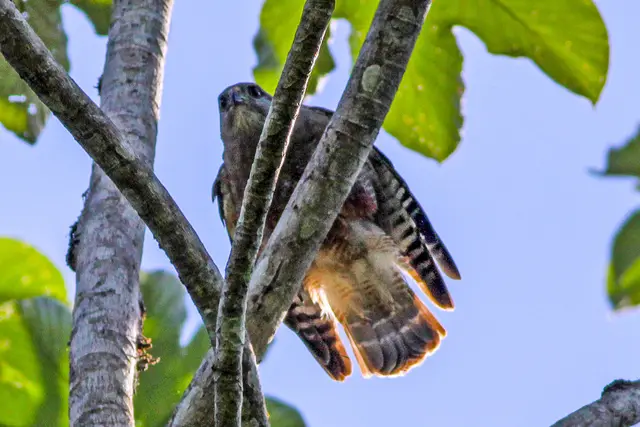
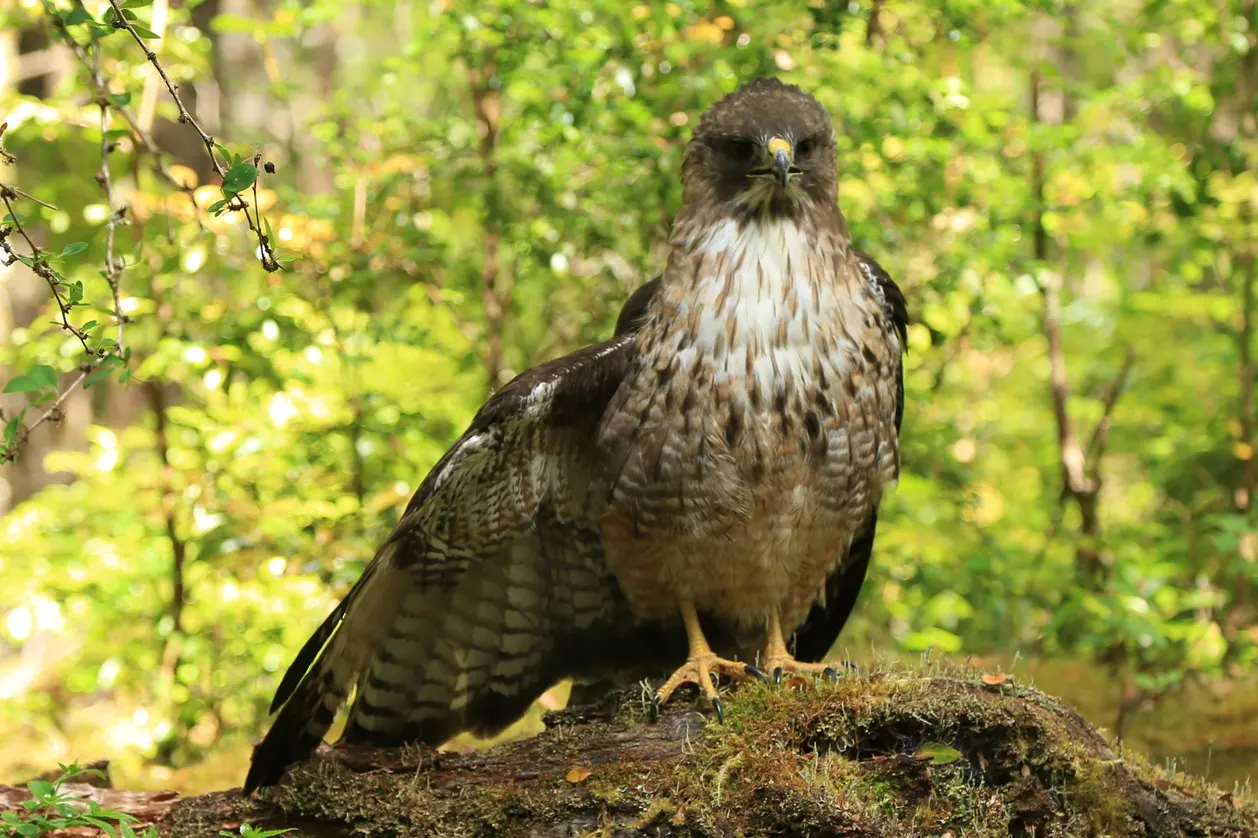
There are two different colorations of the rufous-tailed hawk. The more common pale version of the hawk has a blackish brown upper parts, with a darker cap and cinnamon feathers along the side of the head and neck. The belly is white with dark markings and reddish brown coloration on it.
The rufous-tailed hawk is a medium-sized hawk with a wing span of 45–60 cm.
Published measurements include mass about 950.
Range and habitat
The rufous-tailed hawk has been spotted living in a number of different habitat types, among them evergreen beech forest, mature forest and new growth forest that have been burned over, and finally in open country. The best theory for their ideal habitat was developed by Figueroa et al. (2000), Trejo et al. (2006), and Rivas et al. (2009), who all suggested that rufous-tailed hawks' ideal habitat is somewhere with high trees near open areas that are good for hunting for prey. The rufous-tailed hawk is found in southern Argentina and Chile, among them the entire region of Tierra del Fuego.
Pins are Wikidata “endemic to” fields. Orange dots, when present, are GBIF occurrence tiles — survey bias included.
Diet and breeding
The rufous-tailed hawk feeds on a large variety of prey. This shows that rufous-tailed hawks have a very broad diet that is similar to the red-tailed hawk.
Feeding or prey capture was also recorded to happen in forest and in prairies. The egg clutch size of a rufous-tailed hawk has only been reported to between 1-3 eggs in a nest.
In crisis
Rufous-tailed hawks are threatened by many factors, especially habitat loss. Pinus radiata and Eucalyptus globulus are fast-growing invasive plants that were introduced in order to spur the timber industry in Chile. The other main threat to rufous-tailed hawks are local people, who sometimes kill these birds because rufous-tailed hawks attack and eat their domesticated animals.
Ferguson-Lees and Christie (2001) estimated the population size to be around 100 individuals. As of 2025, their estimated population is 700 – 3,300 mature individuals.
CITES lists this taxon on Appendix II. Confirm the current appendix on the CITES checklist.
Rufous-tailed Hawk is Endangered on the IUCN Red List (assessed 2025, criteria C2a(ii)). Confirm the official criteria and any later count on the assessment page.
Sources
Adapted from the English Wikipedia article on Rufous-tailed Hawk (CC BY-SA 4.0; authors are listed in the article history; changes were made), Wikidata item Q1262855. Family and order context is original field-guide writing about the group, not a copied assessment of this one species. Not an IUCN assessment. Counts, when quoted, can change — confirm them on the recovery programme and on iucnredlist.org. Status and assessment year: IUCN. 2026. The IUCN Red List of Threatened Species. Version 2026-1. iucnredlist.org.