Endangered
Rudd's lark
Heteromirafra ruddi
Rudd's lark (Heteromirafra ruddi) is a small, short-tailed grassland bird found only on the high grasslands of eastern South Africa. The IUCN Red List assessed it as Endangered in 2021. Its numbers have fallen sharply as grassland has been farmed, planted, mined and built over.
How to recognise it
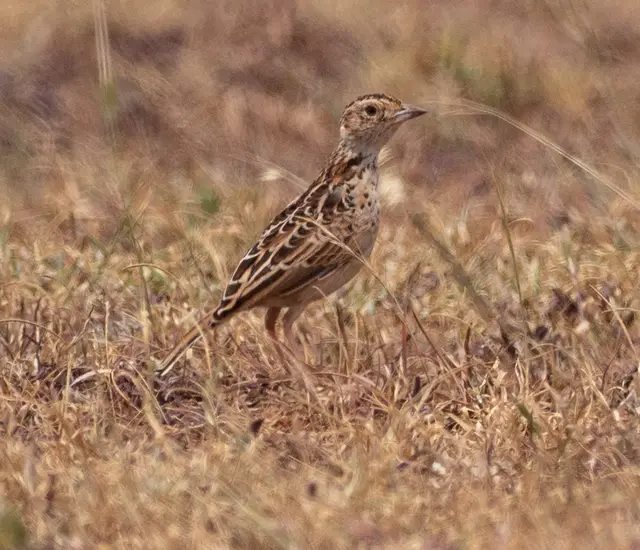
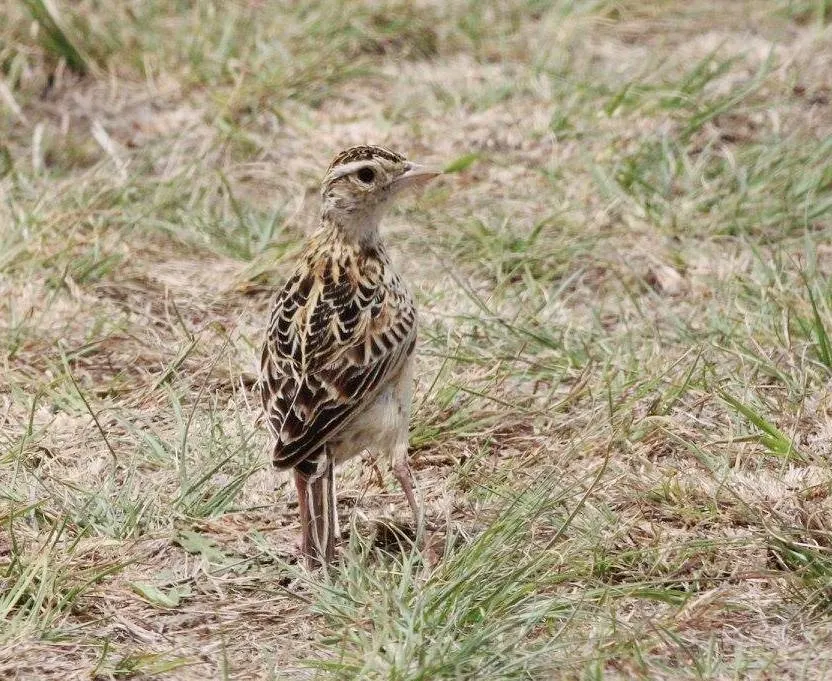
It is about 14 cm long, large-headed and short-tailed, with big dark eyes and long pinkish legs. When the crest is raised, a buff stripe shows down the middle of the crown. In flight the tail looks very short and thin and the wings broad and rounded.
It is easy to overlook. It is rather tame, but when threatened it tends to run fast along the ground and then stop suddenly. The Spike-heeled Lark is a lookalike, but has a white tip on its short tail.
Where it lives
The species is endemic to South Africa, with an estimated extent of occurrence of about 60,100 square kilometres. It lives in high-altitude subtropical grassland between about 1,600 and 2,200 m and does not migrate. The Wakkerstroom grasslands in Mpumalanga are one of its last strongholds.
The IUCN estimates the population at 1,700 to 3,300 birds, split into 2 to 10 subpopulations. The largest holds an estimated 251 to 1,000.
Pins are Wikidata “endemic to” fields. Orange dots, when present, are GBIF occurrence tiles — survey bias included.
How it lives
At Wakkerstroom, larks were more likely to be found in shorter grass, at higher altitude, with more broad-leaved herbs among the grasses. Earlier work there described a preference for lightly grazed grassland, and linked late-season burning to poorer breeding success.
Why it is in trouble
A 2019 study in Bird Conservation International by Gush and colleagues revisited 33 transects around Wakkerstroom that had been walked in 2002. Larks were recorded on 9 of them in 2002 and 5 in 2016, and the number of birds counted fell from 32 to 9, a 72 percent drop. Seven of the transects had become intensive cropland. Grass height, grass cover and bare ground had not changed significantly, and fire records did not clearly point to fire as the main driver.
The IUCN lists plantations, farming and grazing, housing, mining, renewable energy development and problem native species and diseases among the threats. It records a population reduction of 50 to 79 percent as past, ongoing and projected. The species was downlisted from Critically Endangered to Vulnerable in 2005, then raised to Endangered in 2017.
What is being done
The IUCN records that the lark occurs in at least one protected area, that conservation sites have been identified across its entire range and that awareness programmes exist. It also notes no recovery plan and no systematic monitoring scheme. BirdLife South Africa has a grassland conservation fellow based at Wakkerstroom, working on landowner stewardship, research and monitoring.
Sources
Written for this catalog in our own words from the sources below, checked against them on 12 November 2026. Population figures are estimates and carry the year they were made. Status and assessment year: IUCN. 2026. The IUCN Red List of Threatened Species. Version 2026-1. iucnredlist.org.