Critically Endangered
Romanichthys
Romanichthys valsanicola
The asprete (Romanichthys valsanicola) is a small, bottom-dwelling fish found only in Romania, where it now survives in a single river, the Vâlsan. The IUCN Red List rates it Critically Endangered (assessed 2024). It is the only species in its genus.
How to recognise it
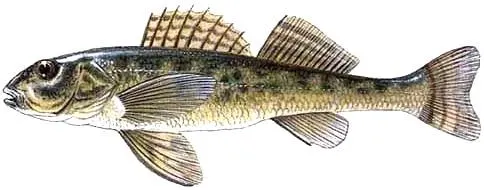
The asprete is a small member of the perch family, reaching roughly 10 to 12 centimetres. It is greyish-brown with small rough scales and two clearly separate dorsal fins, the first with 8 or 9 spines. It is also called the Romanian darter or sculpin-perch, and local names include poprete and sforete.
Romanian scientists Dumitrescu, Bănărescu and Stoica described it in 1957. Its closest relatives are the four Zingel species, and some evidence suggests it might belong inside that genus.
Where it lives
The asprete is endemic to southern Romania. It was once found in the upper Argeș River and two tributaries, the Râul Doamnei and the Vâlsan, but it now survives only in the Vâlsan. The IUCN counts a single location, estimates the area it occupies at 20 square kilometres, and lists its habitat as permanent rivers and streams.
Pins are Wikidata “endemic to” fields. Orange dots, when present, are GBIF occurrence tiles — survey bias included.
How it lives
It is nocturnal and territorial. By day it hides under stones. At night it hunts the larvae of aquatic insects, including stoneflies, caddisflies and mayflies. It breeds in May and June, and a female lays about 120 to 150 eggs under rocks.
Why it is in trouble
Hydroelectric dams were built upstream of its rivers from the late 1960s. According to Romanian biologist Mircea Marginean, they stripped sand and stones from the riverbed and dried up water, and afterward the fish could no longer be found in the Argeș or the Doamnei. The Vâlsan population depends on water released from a reservoir above it, and a 2020 Wilderness Society article says the required minimum flow is too low. Four small barriers also cut the Vâlsan into pieces, according to the Alex Găvan Foundation.
The IUCN assessment lists mining and seepage from mining, nutrient loads, sewage, pesticides, rubbish, silt and small dams as ongoing threats. It records the area of habitat as still declining and the population trend as unknown.
Counts have varied. The 2020 Wilderness Society article puts the population at about 200 fish in the early 2000s and 10 to 15 in 2020. In 2020 the Romanian environment ministry estimated 7 to 10, while a survey that year counted 12. A survey in October 2022 covered 41 sites on three rivers and found 58 fish, all in the Vâlsan along 15 kilometres. Marginean extrapolated from that to 300 to 350 fish, though that is an estimate, not a count.
What is being done
An EU-funded LIFE project in the early 2000s helped restore some flow to the Vâlsan, and the Alex Găvan Foundation began a project in 2019 to study removing the barriers or building fish ladders. The habitat lies in a Natura 2000 site and the Vâlsan Valley Nature Reserve, and the IUCN records the whole known range as an identified conservation site.
Campaigners have proposed an action plan covering river basin restoration, a warden and captive breeding capacity, but say existing protection is poorly enforced. The IUCN lists species recovery, captive breeding, site management and habitat restoration among the actions needed, and records no ex situ conservation in place.
Sources
Written for this catalog in our own words from the sources below, checked against them on 12 November 2026. Population figures are estimates and carry the year they were made. Status and assessment year: IUCN. 2026. The IUCN Red List of Threatened Species. Version 2026-1. iucnredlist.org.




