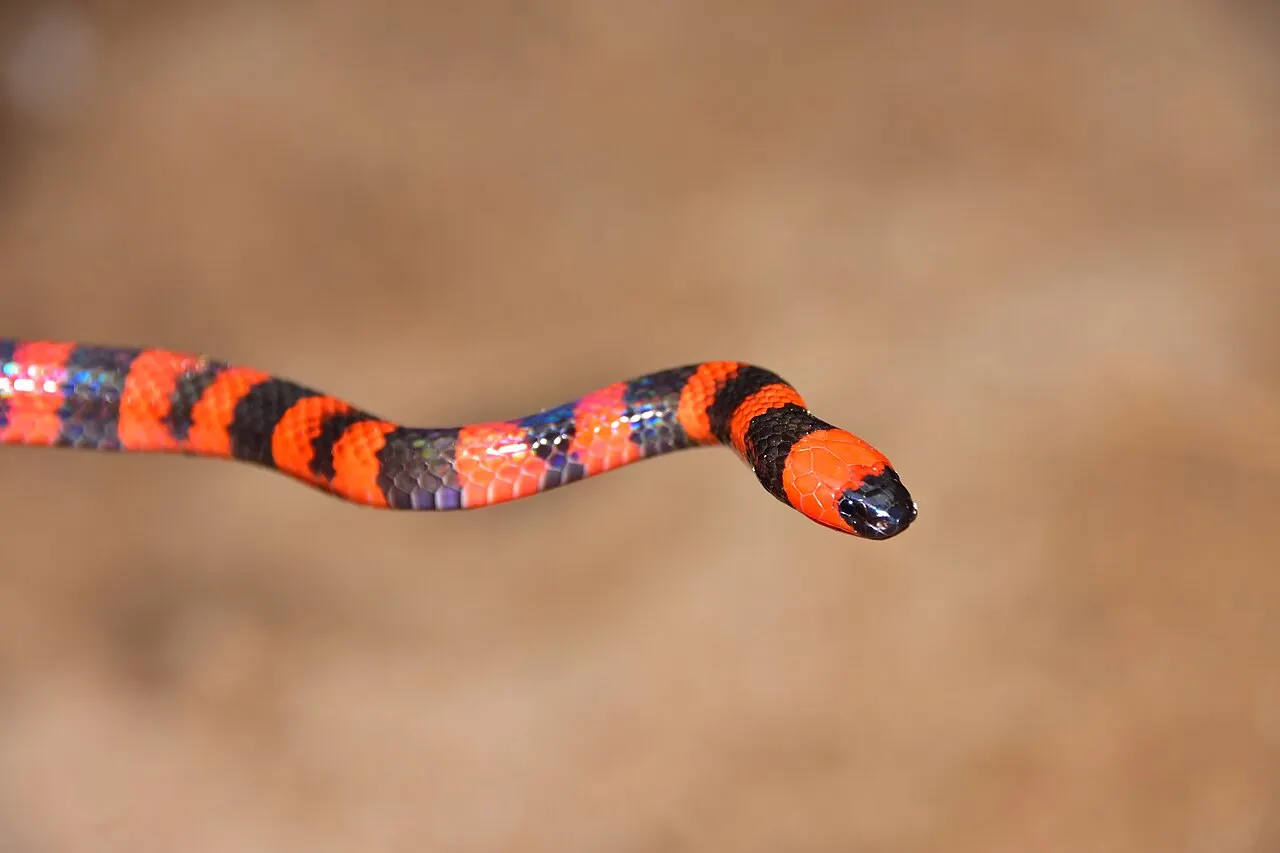
Critically Endangered
Roatan coral snake
Micrurus ruatanus
The Roatán coral snake (Micrurus ruatanus) is a small, venomous, red-and-black ringed snake found only on Roatán, one of Honduras's Bay Islands. The IUCN Red List rated it Critically Endangered in 2013. Its whole known range is a patch of lowland forest roughly 90 square kilometres in extent.
How to recognise it
It's a bicoloured coral snake, with black rings alternating with red ones. The wide black rings are about three scales across, while the narrow ones are only one or two scales wide. Males carry 33 to 39 black body rings and females 41 to 45, so the sexes can be told apart by counting.
Adults are usually 45 to 60 cm long, with a recorded maximum of 68 cm. That makes it medium-sized for a coral snake.
Where it lives
The species is endemic to Roatán, one of the Bay Islands off Honduras's Caribbean coast. The Red List assessment treats it as a single location with an extent of occurrence of about 90 square kilometres, from sea level to roughly 20 m elevation, in moist lowland forest.
It is reportedly known locally as babaspul. Its scientific name comes from its type locality, Ruatan, an older spelling of the island.
Pins are Wikidata “endemic to” fields. Orange dots, when present, are GBIF occurrence tiles — survey bias included.
How it lives
It lives on the ground and partly underground, and it lays eggs. A lizard, Cnemidophorus ruatanus, is a recorded prey animal. Very little else has been published about its habits in the wild.
Its venom is rich in three-finger toxins. A 2019 laboratory study in the Journal of Proteomics tested venom from a single captive snake and found it highly lethal to mice, among the most potent in Central America. The same study showed that a coral snake antivenom made in Costa Rica neutralised it in the lab.
Why it is in trouble
A snake confined to one small island has few places to fall back on. The assessment lists tourism and recreation areas, and past housing development, as threats, and records the population as decreasing. Forest conversion and degradation are the pressures on its habitat.
Its family tree has also been unsettled. It was once treated as a subspecies of the Central American coral snake (Micrurus nigrocinctus). A 2023 study in Scientific Reports by Jowers and colleagues found that species is a complex of at least three lineages. The Roatán snake looked genetically very close to a mainland form, and the study held off on any name changes until more data are in.
What is being done
The assessment calls for species recovery work, captive breeding and protection of its habitat, but records no conservation measures already in place. Counts of living snakes are not available.
Sources
Written for this catalog in our own words from the sources below, checked against them on 12 November 2026. Population figures are estimates and carry the year they were made. Status and assessment year: IUCN. 2026. The IUCN Red List of Threatened Species. Version 2026-1. iucnredlist.org.




