Critically Endangered
Risiocnemis seidenschwarzi
Risiocnemis seidenschwarzi
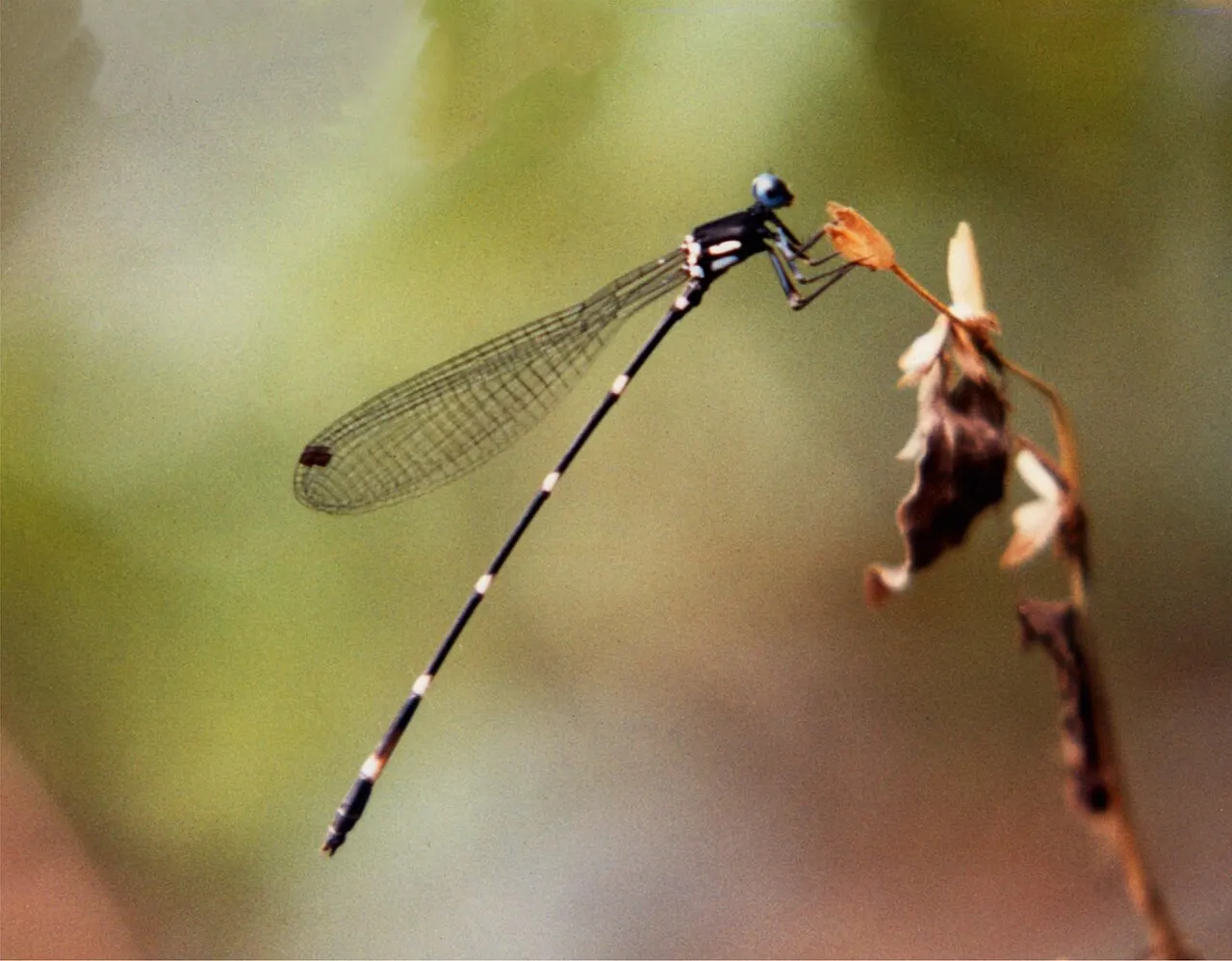
The Cebu frill-wing (Risiocnemis seidenschwarzi) is a black damselfly with pale blue markings, found only on Cebu in the Philippines. It was first collected at a single forest creek in 1998. The IUCN Red List rated it Critically Endangered in 2009, and that original population may have died out.
How to recognise it
Males are mostly black. The sides of the thorax carry pale bluish oval marks, the wing bases are pale blue, and the abdomen has pale bluish rings on segments 2 to 7. In freshly emerged males the rings are complete. In older males they break at the top, and the ring on segment 7 fades.
Females are brown, with larger blue marks on the sides of the thorax. Males in the original description had hind wings of 23 to 25 mm and abdomens of 35 to 37 mm. The single female measured had a hind wing of 24.5 mm and an abdomen of 35 mm. Its closest relative is Risiocnemis rolandmuelleri, which lives on other Visayan islands, but the shape of the male's anal appendages and the thorax pattern set the Cebu species apart.
Where it lives
It is found only on Cebu, the Philippine island that has lost the largest share of its original forest among the eleven biggest. Teobaldo Borromeo first collected it in November 1998 near Tabunan forest in the Manunggal range of central Cebu, and Matti Hämäläinen described it in 2000. It was named for botanist Franz Seidenschwarz, who studied and worked to restore Cebu's last virgin forests.
The original creek is 2.5 to 3.5 m wide, cut into shale, partly muddy and partly rocky, and fed by water from a limestone ridge. Tabunan forest begins less than 50 m uphill. Beyond a narrow strip of trees, ferns and weeds along the creek, the land had become pasture. In 1999 the damselflies were found along only about 30 m of it.
The species was last recorded at Tabunan in March 2001. A second population was later found on a very small rivulet beside the Kawasan River in southern Cebu, in an area of no more than 30 by 30 m. Counts there in 2007 and 2009 were usually 5 to 15 individuals a day.
Pins are Wikidata “endemic to” fields. Orange dots, when present, are GBIF occurrence tiles — survey bias included.
How it lives
Little has been written about its life cycle. At the original site, adults rested low, 30 to 120 cm above the ground, mostly near the leaf tips of a fern (Pneumatopteris laevis) with the abdomen held at right angles to the creek. The describer called it a forest stream damselfly, and the Red List records it from a stream and a small rivulet, both in forested areas.
Why it is in trouble
When the species was described, only about 45 hectares of original forest remained on Cebu, in a few patches between 480 and 930 m. Hämäläinen judged that, if the species is confined to Cebu, it may have one of the smallest remaining ranges of any dragonfly or damselfly. He also noted that Tabunan forest had lost land over the previous five years.
The 2009 Red List assessment (criteria B1ab(iii)+2ab(iii) and D) records one location, an area of occupancy of about 1 square kilometre, an extent of occurrence of about 12 square kilometres, and a population of roughly 20 to 50 individuals in one subpopulation. The trend is listed as unknown.
Forest was cleared at the Tabunan site in 2000, and the assessment says human settlement has probably caused at least one population to disappear. Most Cebu forest is gone and many streams are degraded.
What is being done
The assessment says no national conservation effort targets the species and that a local group is working on its habitat. It lists species recovery, site protection, habitat restoration, awareness and education as actions needed, and calls for protecting the Kawasan River habitat and monitoring the population there.
At the original creek, the Botany Research Group at San Carlos University aimed to restore the original forest around it. The species was also reportedly named in the Zoological Society of London's 2012 list of the world's 100 most threatened species. GBIF holds 12 research-grade iNaturalist observations from Cebu dated April 2025, with coordinates deliberately blurred, so the species was apparently still being seen then.
Sources
Written for this catalog in our own words from the sources below, checked against them on 12 November 2026. Population figures are estimates and carry the year they were made. Status and assessment year: IUCN. 2026. The IUCN Red List of Threatened Species. Version 2026-1. iucnredlist.org.




