Endangered
Rio Grande silvery minnow
Hybognathus amarus
The Rio Grande silvery minnow (Hybognathus amarus) is a small, silvery fish that once filled the Rio Grande and Pecos River and now survives in one stretch of the Rio Grande in central New Mexico. The IUCN rated it Endangered in 2019. Dams, river drying and a short lifespan keep its numbers low.
How to recognise it
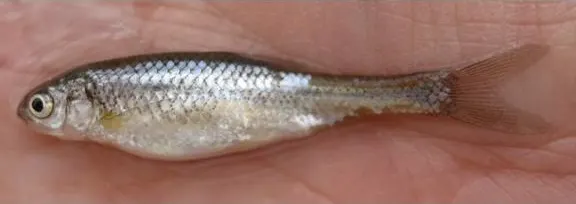
It is a stout, silvery minnow with a small mouth and moderately small eyes. Adults are often around 9 cm long, and the maximum is about 4.6 inches (117 mm). It grazes algae and plant material from the river bottom, and may swallow small invertebrates along the way.
Where it lives
The minnow once ranged down the Rio Grande from near Espanola, New Mexico, to the Gulf of Mexico, and up the Pecos River to Santa Rosa, New Mexico. The Red List puts the range loss at roughly 3,862 river kilometres down to 280, about 7 percent of the historical range. The fish is considered gone from the Pecos and from the Rio Grande in Texas, apart from experimental releases near Big Bend, Texas, which began in December 2008.
Wild fish now occur only in the Rio Grande between Cochiti Dam and the upper end of Elephant Butte Reservoir. The IUCN gives an extent of occurrence under 300 square kilometres and two to five locations. It favours slow to moderate current over silt, rarely sand, with eddies, backwaters and pools.
Pins are Wikidata “endemic to” fields. Orange dots, when present, are GBIF occurrence tiles — survey bias included.
How it lives
This is a drifting-egg fish. During a spawning season of one to two months in spring, females release semi-buoyant eggs that float just below the surface and drift with the current. The eggs hatch in a day or two, and the larvae are swimming actively within about a week. Fish are ready to breed the following spring.
Life is short. Most live about 18 months in the wild, and a few reach 3 years. A single bad year can therefore hit a population hard, and the Red List describes year-to-year swings in abundance as large as an order of magnitude.
Why it is in trouble
The river itself has been remade. The Red List names dewatering and diversion of water, dams, channelisation and drought. It also cites competition and predation from non-native species, and poor water quality. Healthy spring flood pulses help trigger breeding, and eggs and larvae can be carried through diversion structures into unsuitable nursery habitat. The species was listed as endangered under the US Endangered Species Act on 20 July 1994.
Monitoring shows how thin the margin is. In May 2023, crews sampled 20 standard sites and caught four silvery minnows, at two of those sites. The overall density was 0.05 fish per 100 square metres. May surveys since 1993 average 5.67 per 100 square metres, and 0.05 is the lowest May value in that record.
What is being done
Several programmes run side by side. A 2018 report described biologists driving into the dry riverbed each summer to scoop minnows from shrinking pools and carry them to wetter stretches. Each May, the Albuquerque BioPark nets eggs from the river and raises the fish for release, and an experimental refuge near Los Lunas holds more.
The IUCN lists a recovery plan, habitat restoration, control of problem species, awareness work and reintroduction among the actions in place. Its recovery-plan summary stresses restoring natural flows, including spring and summer flood pulses.
Sources
Written for this catalog in our own words from the sources below, checked against them on 12 November 2026. Population figures are estimates and carry the year they were made. Status and assessment year: IUCN. 2026. The IUCN Red List of Threatened Species. Version 2026-1. iucnredlist.org.
- IUCN Red List assessment, Hybognathus amarus (2019), read via the Red List API
- Wikipedia article on the Rio Grande silvery minnow
- US Fish and Wildlife Service species profile
- Dudley, Platania and White, May 2023 population monitoring report (USGS-hosted PDF)
- KNAU Earth Notes, silvery minnow rescues (4 July 2018)




